
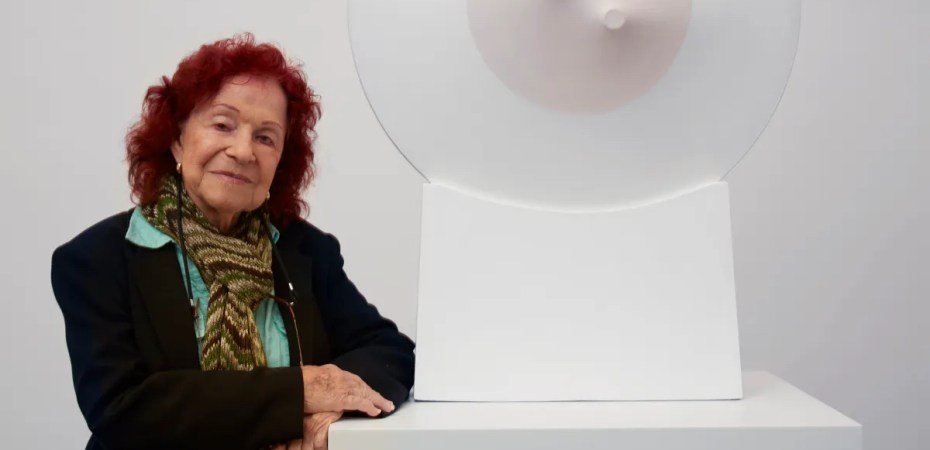

 Zilia Sánchez, the celebrated Cuban artist renowned for her sensual, sculptural canvases that blurred the boundaries between geometric abstraction and eroticism, has passed away at the age of 98. Her death was confirmed on December 18 by Galerie Lelong in New York, which represented her since 2013.
Born in Havana in 1926, Sánchez’s early exposure to art was influenced by her father, a hobbyist painter, and the renowned artist Víctor Manuel, who was both her neighbor and mentor. After studying at the prestigious Escuela Nacional de Bellas Artes San Alejandro, she began exhibiting her work in Cuba, initially exploring African traditions and spirituality in her early series Afrocubanos (1956–58), which melded vivid colors with sharp, geometric shapes.
In the 1960s, Sánchez relocated to New York, where her work began to take on its distinctive biomorphic character, standing in stark contrast to the dominant Minimalist movement. It was in this environment that she began to stretch canvas over wooden frames, creating “erotic topologies”—dimensional works that evoked the sinuous forms of the female body, taut like skin or flesh. These evocative pieces, often painted in muted whites and grays, remain central to her legacy. “This is an egg, it’s the world, and it’s a breast. Three things,” Sánchez once explained, encapsulating the fusion of natural forms and sensuality that defined her art.

Sánchez’s unique sculptural paintings were not only tactile and physical but also deeply conceptual. She often drew inspiration from Greek mythology, with works such as Antigone and Troyanas referencing female strength and resistance. Her Troyanas pieces, in particular, feature protruding white shapes that evoke both femininity and defiance, like the defensive spears of the women of Troy.
In the 1970s, Sánchez moved to Puerto Rico, where she continued to evolve her visual language, creating large-scale murals for the facades of buildings. Her life and art were marked by a sense of exile—she was a queer woman artist navigating male-dominated spaces, and her work resonated with themes of distance and belonging. Hurricane Maria, which devastated Puerto Rico in 2017, caused significant damage to Sánchez’s studio in San Juan, destroying much of her life’s work. However, with the help of former students, she rebuilt the space and returned to her creative practice, producing new works, including freestanding sculptures, which were showcased in a 2019 exhibition at Galerie Lelong.
Although Sánchez’s art was largely underrecognized in the United States for much of her career, her breakthrough came in the 2010s. In 2017, her work was included in the Venice Biennale, and in 2019, a major retrospective was mounted at the Phillips Collection in Washington, DC. The exhibition, Zilia Sánchez: Soy Isla (I Am an Island), captured her complex relationship with her Cuban and Puerto Rican heritage and the isolation and freedom she felt in her art. As she once said, “I like to float and feel free.”

Sánchez’s works were not just aesthetically innovative but also deeply personal and politically resonant. Her geometric abstractions served as a reflection of her unique experiences—living in exile, confronting the boundaries of gender and sexuality, and defying artistic conventions. As the Museo de Arte de Puerto Rico prepares to present Topologías (Topologies), a solo exhibition in 2025, her legacy as a trailblazer in Latin American art continues to inspire new generations of artists.
Zilia Sánchez’s influence, as both an artist and a woman of resilience, will endure far beyond her passing.
Discover more from Art Sôlido
Subscribe to get the latest posts sent to your email.
 Art Sôlido