

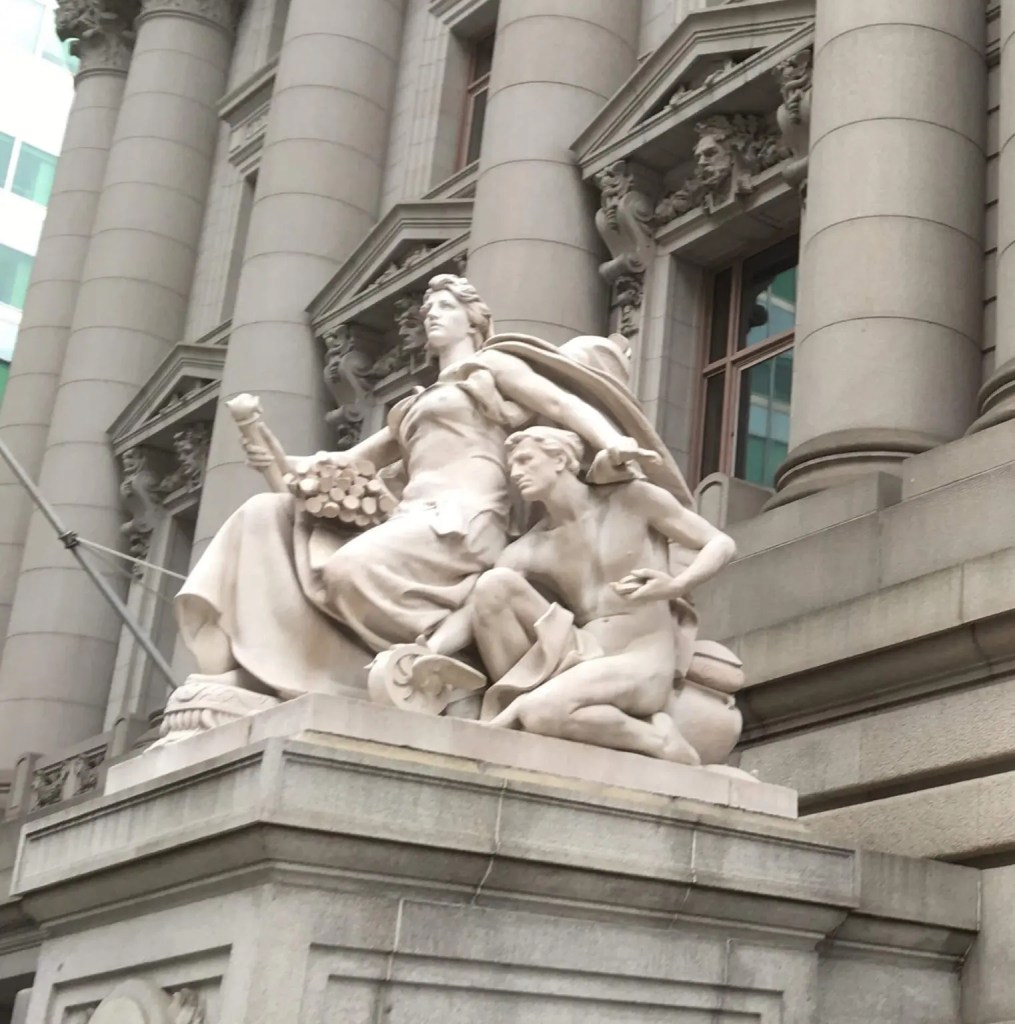
Munson’s likeness appears in a prominent sculpture, reinforcing her widespread influence across New York City.
 Audrey Marie Munson was a woman who, in her prime, symbolized the intersection of art, beauty, and public memory. Born on June 8, 1891, in Rochester, New York, she would come to be known as “Miss Manhattan,” “America’s Venus,” and “the Panama-Pacific Girl” – nicknames that capture both the idealized femininity she embodied and her extraordinary impact on early 20th-century art and popular culture. Munson’s life story is not only one of beauty and fame but also of scandal, tragedy, and a legacy of artistic inspiration that has largely been forgotten. Most notably, Munson was the muse for numerous public sculptures throughout New York City, where her likeness is immortalized in iconic monuments still standing today.
Rise to Fame and Role as an Artist’s Muse
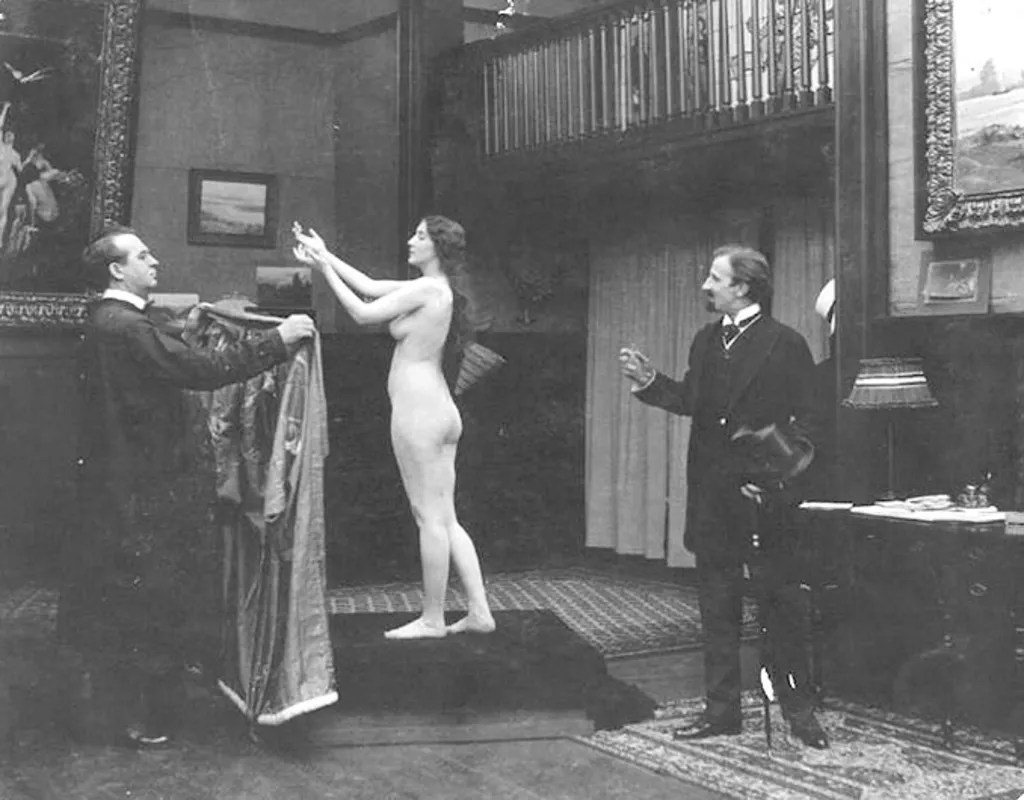
Munson’s modeling career began in the early 1900s when she was discovered walking through New York City, her beauty catching the eye of a photographer. This serendipitous encounter launched her into a career as one of the most sought-after models for sculptors and artists of the time. By the age of 16, Munson was posing for some of the most renowned figures of the Beaux-Arts movement. Artists such as Isidore Konti, Gertrude Vanderbilt Whitney, and Daniel Chester French (best known for his Lincoln Memorial) found in her the epitome of classical beauty.
Her most significant contribution was as a muse for public sculptures, and she became the living face of New York’s architecture and civic ideals. Munson modeled for more than a dozen public sculptures in Manhattan, including Adolph Alexander Weinman’s “Civic Fame” atop the Municipal Building, which has become one of the city’s most iconic figures, and the statues for the USS Maine Memorial at Columbus Circle. She also appeared in the memorial to Titanic victims Isidor and Ida Straus and in the Pulitzer Fountain at 59th Street. These works of art, often in the form of allegorical figures such as “Civic Fame” or “Duty” and “Sacrifice,” elevated her to a near-mythical status. Her image embodied the Greek ideal of female beauty and strength, which artists of the period revered.
A Brief Career in Silent Film

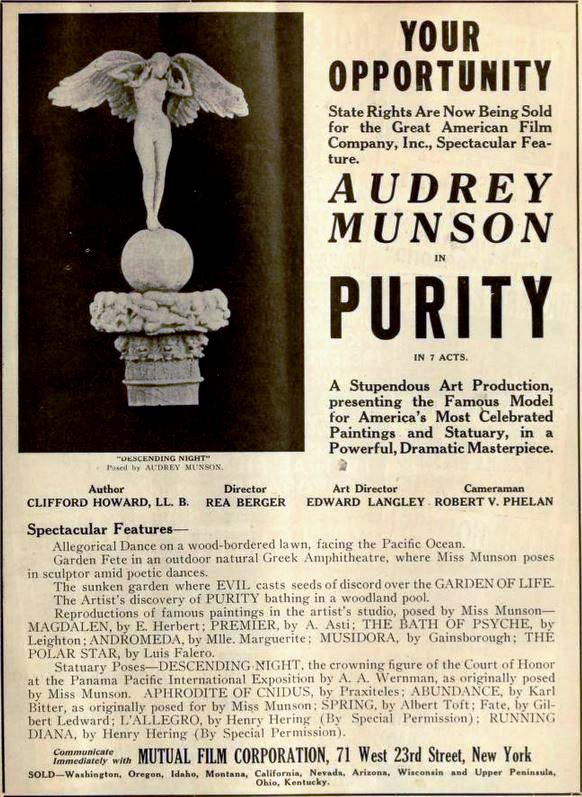
In addition to her modeling work, Munson also had a brief stint in Hollywood during the 1910s. Her fame from the sculpture world led her to film, where she appeared in four silent films. The most notable of these was Inspiration (1915), a film about a sculptor and his model, in which Munson famously appeared nude. This film was groundbreaking in that it was one of the first to feature nudity not for exploitation, but as part of a non-pornographic narrative exploring the artist’s relationship with his muse. Though controversial at the time, it reflected a changing attitude toward the human body in art and cinema.
Unfortunately, Munson’s film career did not last long. Her subsequent films, such as Purity (1916) and The Girl o’ Dreams (1918), were not as successful, and her acting was often panned. Nevertheless, her willingness to appear nude on screen marked her as one of the first actresses to break new ground in Hollywood.
The Scandals and the Downfall of Munson’s Career

Munson appears as the female figure carrying a basket of fruit at the base of the fountain, part of the Pulitzer Memorial in Central Park.
By the late 1910s, however, Munson’s career began to unravel, partly due to scandal and partly due to changing societal attitudes toward her profession. In 1919, she became embroiled in a highly publicized murder case when Dr. Walter Wilkins, her landlord, killed his wife in an attempt to marry Munson. Though Munson was never involved in the crime, the media frenzy surrounding the case tarnished her reputation. She had also become increasingly disillusioned with the artistic community, especially after revealing the exploitation of artists’ models through a series of articles she wrote in 1921. In these articles, Munson spoke out against the low pay and anonymity faced by models, and criticized the male-dominated art world that often sidelined women’s contributions.
By the early 1920s, Munson was unable to find work in New York or Hollywood. Her fame had waned, and she was living in obscurity with her mother in Syracuse, struggling to make ends meet by working as a ticket-taker in a dime museum. The mounting pressures led to a personal crisis, and in 1922, she attempted suicide. This marked the beginning of her long battle with mental illness.
Institutionalization and Longevity

Munson is the figure representing “Duty” and “Sacrifice” on this monument commemorating the sinking of the USS Maine.
In 1931, at the age of 40, Munson was committed to St. Lawrence State Hospital in Ogdensburg, New York, where she would remain for the next 65 years. She was diagnosed with schizophrenia and depression, and although she lived for an astonishing 65 more years, her life was marked by seclusion and institutionalization. Munson’s mental state deteriorated, and she became a forgotten figure, even within the walls of the hospital. Staff would occasionally smile at her claims of being the muse for statues around New York, not realizing that the woman before them had indeed been immortalized in marble and bronze.
When Munson passed away in 1996 at the age of 104, she was buried in an unmarked grave in New Haven, New York. It wasn’t until years later, in 2016, that her family erected a gravestone to honor her memory.
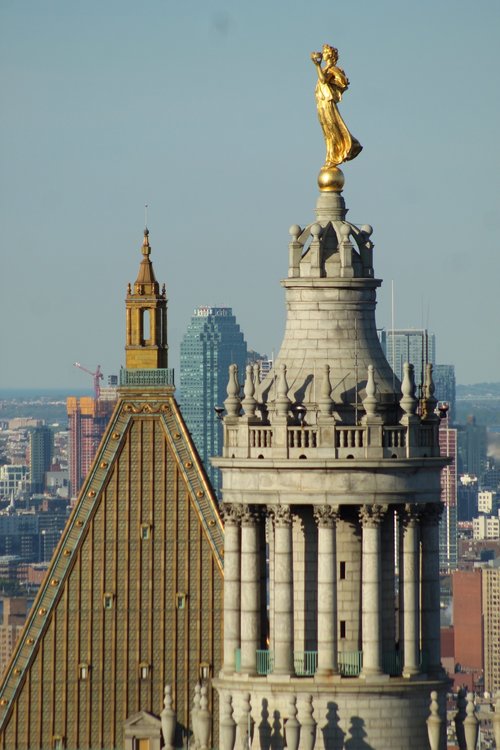
Munson’s likeness appears in Civic Fame, the gilded figure atop the Manhattan Municipal Building, designed by sculptor Adolph Alexander Weinman.
The Enduring Legacy of Audrey Munson
Despite her tragic end, Munson’s legacy endures in the statues and monuments that continue to grace the streets of New York City. Her image can be found at landmarks such as the Metropolitan Museum of Art, the New York Public Library, and the Pulitzer Fountain. Munson is the embodiment of the idealized beauty and classical grace that defined the Beaux-Arts movement. These public sculptures, which continue to stand in New York, are reminders of her central role in the artistic and architectural world of early 20th-century America.
However, the story of Audrey Munson is also a cautionary tale about the transient nature of fame and the exploitation of women in the arts. As one of the first supermodels and an early example of women using their physicality for artistic and commercial gain, Munson’s story highlights the complex dynamics of being both an object of admiration and an object of exploitation. Her contributions as an artist’s model were immense, yet history has often overshadowed her personal struggles and the cultural contributions she made. Her name may have faded from the public consciousness, but her face, immortalized in stone, continues to gaze down on New York City.
In recent years, artists like Andrea Geyer have begun to revisit Munson’s life and work, seeking to restore her legacy and give her the recognition she deserves as a powerful and active figure in the artistic process. Geyer’s research-based art practice and efforts to uncover the untold stories of women like Munson are part of a broader movement to reclaim the lost histories of women in the arts.
Audrey Munson may have lived a life marked by scandal, mental illness, and tragic obscurity, but she is also a symbol of artistic inspiration and a pioneer in the history of public art and cinema. Her legacy—one carved in the stone and bronze of New York City—is as much a testament to her strength as it is to the resilience of the women whose stories have been overlooked and forgotten.
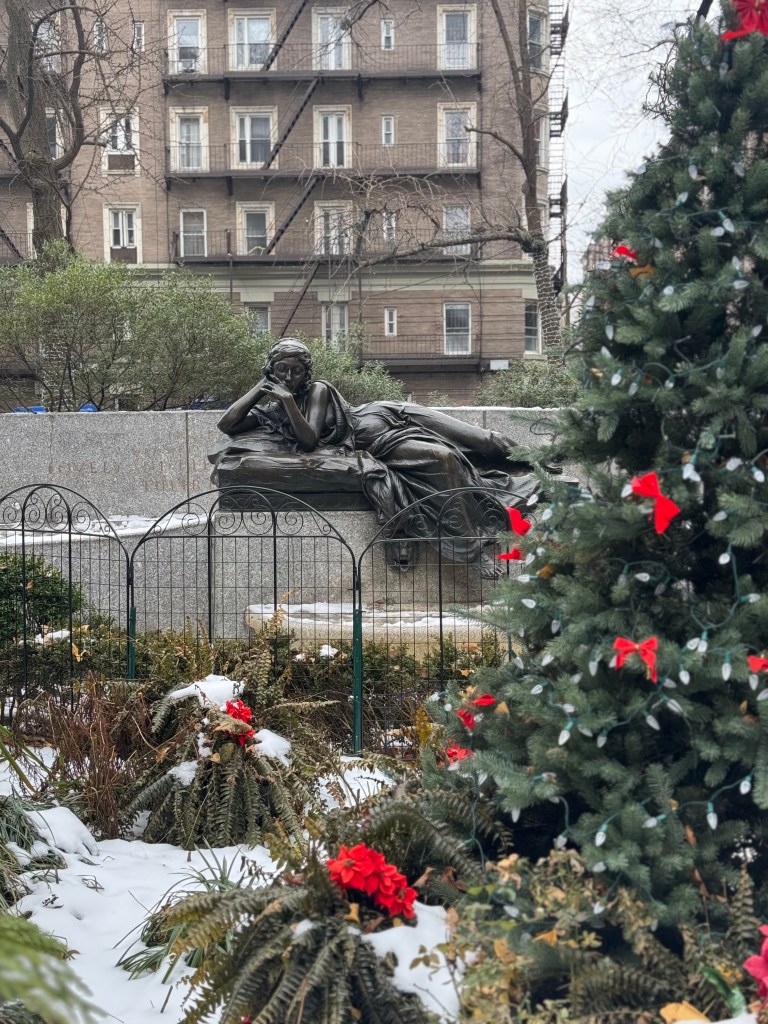
This memorial on the Upper West Side of Manhattan, honoring the Strauss family (founders of Macy’s), features Munson in a reclining position in bronze.
12 Notable Monuments in New York City Featuring Audrey Munson
1. Pulitzer Fountain (59th Street & Fifth Avenue, Central Park)
Munson appears as the female figure carrying a basket of fruit at the base of the fountain, part of the Pulitzer Memorial in Central Park.
2. Manhattan Municipal Building (1 Centre Street)
Munson’s likeness appears in Civic Fame, the gilded figure atop the Manhattan
Municipal Building, designed by sculptor Adolph Alexander Weinman.
3. USS Maine Memorial (Columbus Circle)
Munson is the figure representing “Duty” and “Sacrifice” on this monument commemorating the sinking of the USS Maine.
4. Strauss Memorial (Isidor and Ida Strauss Memorial)
This memorial on the Upper West Side of Manhattan, honoring the Strauss family (founders of Macy’s), features Munson in a reclining position in bronze.
5. Firemen’s Memorial (Riverside Park)
Munson is featured as “Duty” and “Sacrifice” in this poignant sculpture by Attilio Piccirilli, commemorating the lives of fallen firefighters.
6. Spirit of Commerce (Manhattan Bridge)
This statue by Carl A. Heber on the Manhattan Bridge has Munson’s likeness, representing the embodiment of commerce.
7. The Frick Collection (1 East 70th Street)
Munson’s image appears in the collection of sculptures at The Frick, an important museum and former mansion that houses works by renowned artists.
8. The New York Public Library (Fifth Avenue & 42nd Street)
Audrey Munson’s image is part of the symbolic sculpture for the library’s architecture, seen as allegorical figures of knowledge.
9. Metropolitan Museum of Art (1000 Fifth Avenue) Munson’s likeness is featured in several sculptures within the Met’s collections, notably in works by Daniel Chester French.
10. Brooklyn Museum (200 Eastern Parkway, Brooklyn)
Munson is featured in several sculptures located within the museum’s collection.
11. U.S. Customs House (1 Bowling Green)
Munson’s likeness appears in a prominent sculpture, reinforcing her widespread influence across New York City.
12. St. Patrick’s Cathedral (Fifth Avenue)
Some believe that Audrey Munson’s image may have been used in some of the architectural embellishments at St. Patrick’s Cathedral, though this is debated.
Discover more from Art Sôlido
Subscribe to get the latest posts sent to your email.
 Art Sôlido