

You know that feeling you get when you step into a place that feels timeless, like it’s been waiting for you? You’ll find it as soon as you pass through the doors of the New York Public Library’s Stephen A. Schwarzman Building. The city hums outside, its noise thick and impatient, but here, inside, it’s like the world pauses. The usual rush of Manhattan drips away, muffled by thick stone walls and the quiet rhythm of pages turning. The air feels ancient but fresh, the scent of old books mingling with the scent of new ideas.
You’re standing at the entrance to something monumental—something that’s been quietly shaping the way New Yorkers think, read, and dream for over a century. This building, with its grand marble steps and lion statues keeping watch, isn’t just a library. It’s an institution. It’s the keeper of stories, the guardian of knowledge. You can feel it as soon as you step into the lobby, where the towering pillars and arched ceilings seem to cradle the weight of the past.
The New York Public Library, founded in 1895, isn’t just the product of one man’s ambition but the result of a confluence of ideas, of institutions and patrons coming together to create a library that could serve the people. The merging of three separate collections—John Jacob Astor’s, James Lenox’s, and the Samuel J. Tilden Trust—created the foundation of what would become the largest public library system in the world. The building itself, designed by Carrère and Hastings, was dedicated on May 23, 1911, and it immediately took its place as one of New York’s most revered landmarks.

The building itself, with its labyrinth of halls and stairways, feels almost like a journey through time—each floor, each room, carrying its own part of the story. But here, at the heart of it all, is where the story truly begins. As you ascend from the bustling ground floor, the weight of the past begins to settle around you, and you find yourself drawn upward toward the third floor.
The transition is subtle, but palpable—a shift in atmosphere, from the energy of the city to the quiet reverence of history. When you walk into the McGraw Rotunda, it’s impossible not to feel that history breathing, pulsing all around you. You’ve moved from the street-level hustle to a sacred space, a bridge between the past and the present. And if you let your gaze drift upward, the murals tell their own story. You don’t just walk into the McGraw Rotunda—you step into a narrative.
The Story of the Recorded Word by Edward Laning Unveiled in Public Library.
In 1935, as part of the New York Public Library’s ongoing commitment to enriching its public space with monumental art, Laning’s murals were unveiled in the McGraw Rotunda of the library, in a ceremony attended by Mayor Fiorello La Guardia and other notable personalities. The unveiling, which was covered by The New York Times, was a momentous occasion in the city’s cultural history. The article noted that the usual studious calm of the library was interrupted by a “capacity crowd” and an air of celebration as the murals—depicting the evolution of the written word—took their place in one of New York’s most beloved.

The third floor, that moment of transition between the bustling world outside and the contemplative world inside, is where the murals by Edward Laning hang in all their vibrant glory. The space is like a portal, a quiet gathering place for thoughts and history, with its pale-red jasper marble walls and gold accents catching the light in a way that feels both regal and humble. You look up, and you’re immediately drawn to the ceiling—a sky so wide, so vast, that it feels as though the very universe is unfolding above you.
This isn’t just a ceiling—it’s a world in motion. The artist, Edward Laning, has created something alive up there, something that invites you to climb alongside humanity, to reach for the knowledge that lies just beyond the horizon. At the center of the barrel-vaulted ceiling is Prometheus, frozen in an eternal moment, holding the flame of knowledge above him as though offering it to the world below. The figures surrounding him are like shadows of human ambition, stretching, climbing, reaching for that flame. There’s something urgent in their posture, something desperate, as if that flame could slip away at any moment.
The ceiling, then, isn’t just a piece of decoration. It’s a starting point, a map of where humanity has been and where it’s going. You can almost feel the heat of that fire, as it calls to us all—pulling us forward, making us strive, even as it burns us with the knowledge it gives.
Then, the walls—each panel, each stroke of color, tells its own part of the story. The panels are windows into history, and each one is alive with the weight of time. There are four of them, flanking the Rotunda’s arched doorways, each one focused on a key moment in the evolution of the written word.

First, there’s Moses, descending from Mount Sinai, the tablets of the Ten Commandments in his hands. One of the tablets lies broken at his feet, while below him, the Israelites dance in a wild frenzy around the Golden Calf. This is a scene of contradiction—divine law in one hand, human chaos in the other. You see the tension between order and disorder, the unrelenting struggle between faith and folly. In that tension, Laning captures the moment when humanity first began to codify its beliefs in writing. The word, the law, is born, and yet, it is always in danger of being forgotten, discarded, or shattered.

Next, we move into the medieval world, where a lone scribe bends over his manuscript, copying the written word by hand. Behind him, a town burns, the flames licking at the edges of civilization, threatening to consume everything. Yet the scribe doesn’t stop. His quill continues its steady motion, preserving what can be preserved, despite the chaos outside. The fragility of knowledge is laid bare here, how easily it can be lost to history. And yet, despite the flames, the act of writing endures. There’s something almost heroic in his quiet persistence.

Then comes the dawn of the modern age—the birth of the printing press. Johannes Gutenberg, bearded and wise, hands a freshly printed page to a fellow scholar, the Bible in his hands a symbol of an era about to explode. This is the moment that will change everything. The written word, once bound to a few, now spreads across the world like wildfire. Laning’s depiction of this scene crackles with the energy of revolution, the shift from handwritten manuscripts to mass production, from knowledge held by the elite to knowledge available to all. The future is in the ink of that page.

And finally, we arrive at the age of mass communication. In the last panel, Ottmar Mergenthaler stands before his Linotype machine, which will forever change the way words are printed, the way news is shared, the way literature is disseminated. In the foreground, two men read a newspaper, while in the distance, a newsboy hocks his wares beneath the towering Brooklyn Bridge. The scene is an homage to the democratizing power of the written word—how a newspaper, once reserved for the few, is now in the hands of everyone. The world has shrunk in this moment, and Laning captures it, this great leap forward, this opening of doors and hearts through communication.
Each panel is a story, and each story is a chapter of human history. But none of this would be possible without the artist who gave these moments color, light, and shape. So, who was Edward Laning? How did he come to be the one who would paint these monumental murals?

Born in Illinois, Laning’s early life was far from easy—he was raised by his grandparents, after a childhood marked by loss and hardship. But somehow, in the quiet plains of the Midwest, Laning learned the language of life before he ever touched a brush. He began as a writer, as many artists do, but soon he discovered the power of color, the way it could speak, the way it could make history live again. In 1927, he moved to New York to study at the Art Students League, where he would be shaped by giants—Max Weber, John Sloan, and Kenneth Hayes Miller.
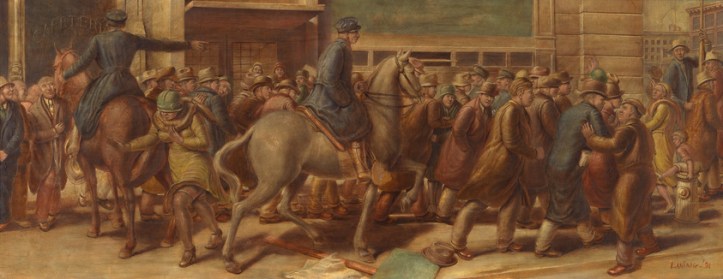
Edward Laning’s work extends beyond the monumental murals in the New York Public Library, as he engaged with both contemporary and historical themes throughout his career. For example, his painting Unlawful Assembly (1931) captured a moment of chaos and rebellion in Union Square, New York City, during the Great Depression. The painting depicts the aftermath of a protest, with riot police on horseback dispersing the crowd. Laning’s use of oil and tempera on linen captures the energy of the moment, reflecting his mastery of tempera—a medium that requires fine precision and was part of his exploration of the revival of traditional techniques. His composition contrasts the order imposed by the police with the disarray left behind by the protesters, creating a poignant reflection on the era’s political unrest. This work is housed at the Whitney Museum of American Art.
Another major contribution by Laning was his involvement in the murals at Ellis Island in 1937, titled The Role of the Immigrant in the Industrial Development of America. This commission highlights Laning’s ability to blend narrative history with a modern, social consciousness. His artistic vision melded traditional figural realism with contemporary subjects, making him a prominent figure in the American Scene movement. His work The Good Companions (1960) and Fourteenth Street (1931), both of which are housed at the Smithsonian American Art Museum and the Whitney Museum of American Art respectively, further demonstrate his versatility, capturing both the essence of everyday life and the grandeur of historical moments.
Laning went on to create murals for post offices, train stations, and public buildings across the country. And in 1980, at the age of seventy-four, he completed his final commission, overseeing the installation of murals in Ogden, Utah, at the historic railway station. But here, at the New York Public Library, his legacy lives on, captured in these sweeping panels and vibrant colors that continue to tell the story of humanity’s relationship with the written word.
These murals, these masterpieces, are more than just works of art—they are markers of a shared history, frozen in time but ever relevant. And as you stand there, beneath those vast ceilings, you can’t help but wonder: What will our story be?
Discover more from Art Sôlido
Subscribe to get the latest posts sent to your email.
 Art Sôlido