

Black life reimagined in full color and grayscale: Amy Sherald’s portraits stand at the intersection of memory, dignity, and myth.
 On a clear New York afternoon, just when the city seems too much like itself, I stepped into the Whitney and found myself somewhere else entirely. Amy Sherald was waiting, or maybe it was a boy in a canary-yellow hoodie, or a woman staring into the horizon with a rainbow on her chest. This is American Sublime — not the anthem, but the pause between notes. Sherald’s portraits hum with the quiet weight of history and the electric promise of presence. These are not just paintings, they are propositions: What if dignity were a default? What if beauty didn’t ask permission? Somewhere between Hopper’s solitude and Rockwell’s sweet Americana, Sherald paints a third way — vibrant, calm, Black, and unbothered.
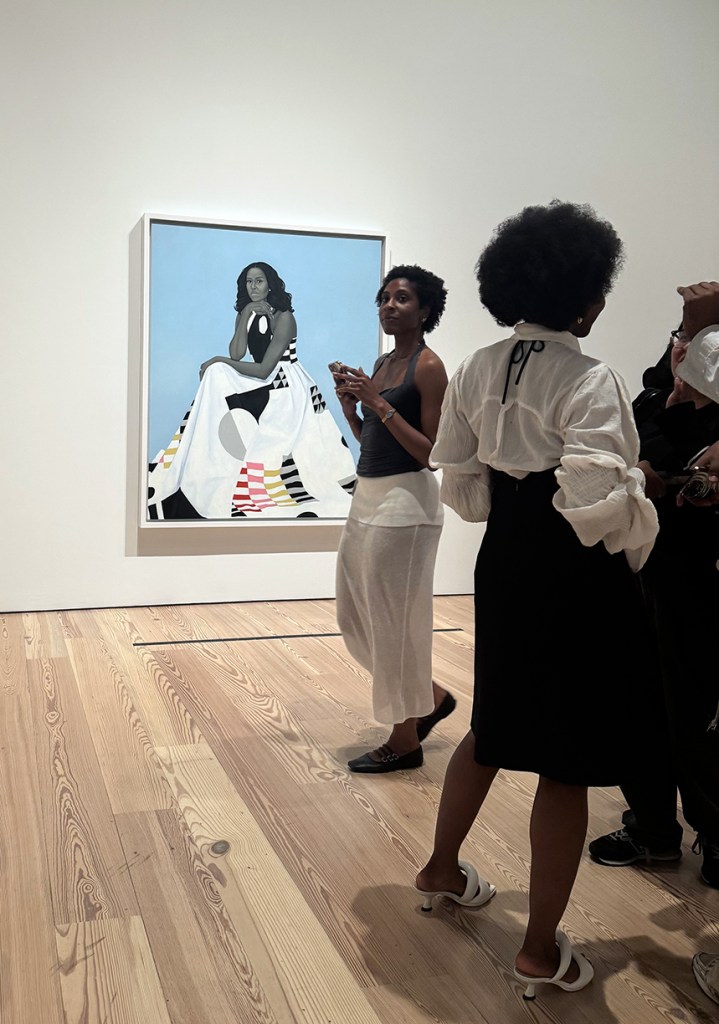
In her largest museum show to date, nearly 50 portraits by Sherald stretch across the gallery like a visual memoir of people we might know — a sister, a neighbor, a kid you once danced with at a barbecue. Their skin is painted in grayscale, a nod to Renaissance “grisaille,” but more subversive: it refuses to define by color what the eyes should discover through presence. The result is mesmerizing. These figures float between eras and spaces, backdrops stripped to essential blocks of color, like the memory of a summer day distilled into pigment.
Sherald made history painting Michelle Obama’s official portrait for the Smithsonian’s National Portrait Gallery in 2018, a sensation that drew crowds like pilgrims. But her story begins long before that. Born in Columbus, Georgia, in 1973, and later trained at Clark Atlanta University and the Maryland Institute College of Art, Sherald honed her vision in the halls of HBCUs and under the stern, abstract eye of Grace Hartigan. It was there that she discovered, almost by accident, the textural splatter that would give her early works their unique surface. A moment of frustration transformed into a new language.
But Sherald has never painted with anger. Even in Breonna Taylor, that now-iconic portrait created for Vanity Fair in 2020, the tone is radiant, solemn, hopeful. Set against a sea of aqua inspired by Taylor’s birthstone, the portrait anchors a gallery titled “The Girl Next Door,” surrounded by other young women who might be in a college brochure or standing in line at CVS. Taylor is not mythologized but remembered, claimed.

At the center of the exhibition is Ecclesia (The Meeting of Inheritance and Horizons), a monumental triptych that feels part Wes Anderson, part lighthouse dream. Sherald designed the watchtower herself, each canvas featuring a solitary figure whose clothing mirrors a weather pattern: sunrise, storm, rainbow. They are looking out at us, or maybe at their future. Maybe both.
If Norman Rockwell gave us an idealized America of small towns and Saturday evenings, Sherald paints the real and imagined Americana that was always there but rarely seen on museum walls. Her figures are not symbols but selves. There is fashion here, and yes, fabulousness—but also stillness, subtle rebellion, the everyday elevated. Her work insists on visibility without spectacle.
Sherald dresses her sitters from a studio wardrobe, stages scenes with buckets of sand, and constructs her own backdrops. Each canvas is a world she builds from scratch, where Black people are centered not because of trauma, but because of presence, style, thought, ease.
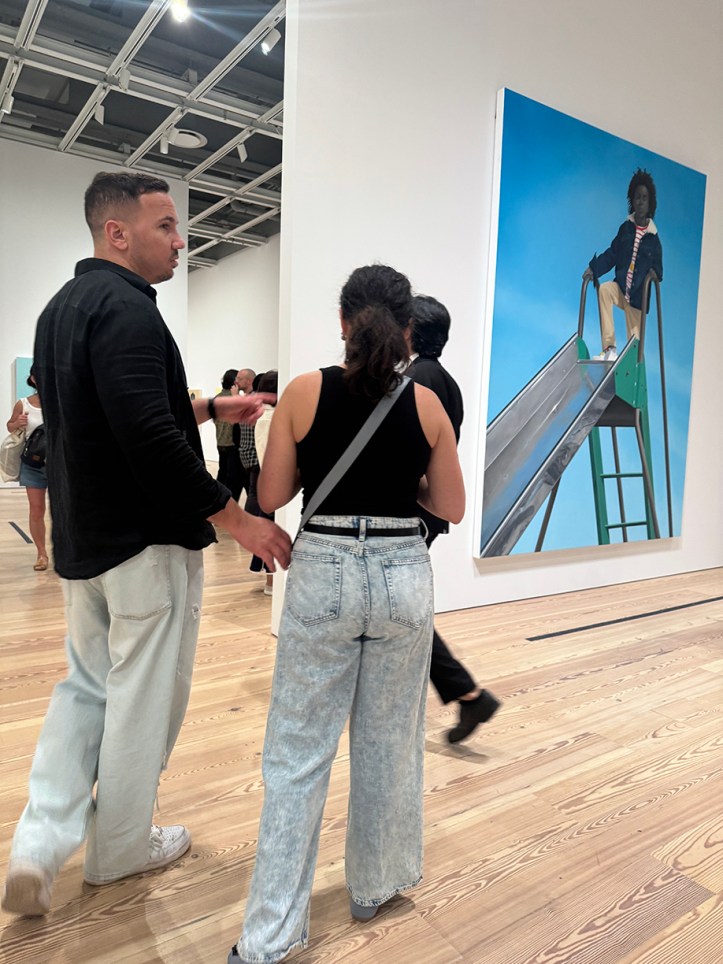
This, in the end, is the real sublimity: not grandeur, but grace. Not noise, but attention. To see Sherald’s paintings is to hear a whisper that cuts through the shouting outside: we are here, we have always been here, and look how beautiful ordinary can be.
Discover more from Art Sôlido
Subscribe to get the latest posts sent to your email.
 Art Sôlido