

 Well, someone lets the color talk. I mean really talk — not whisper, not behave. Candida Alvarez, in her Circle, Point, Hoop retrospective at El Museo del Barrio, lets it all loose: the fuchsia and the ochre, the emerald and the cherry pit black — memory’s palette, diaspora’s pulse, abstraction’s flirt with figuration. And the show? It spins like a kid in a living room trying to make the whole world dizzy.

You walk in and there’s a sense of return. Of looping back, like a hoop rolling through the city streets of Brooklyn or around the rural quiet of Baroda, Michigan. Alvarez’s journey — Brooklyn to Chicago, then back again — is a kind of cosmology built on windows: the ones she stared through as a girl in the Farragut Houses, watching the BQE twist like ribbon, and the ones she peers through now, out to the woods where blackbirds flash like brushstrokes. It’s all in the paintings.
What I love is that Alvarez makes memory work — not as a soft-focus reverie, but like a muscle, a vibrant system. “She Went Round and Round” (1983–84) could’ve been me or you or any kid spinning in a cramped apartment — blurred arms like Muybridge frames, dizziness as a kind of freedom, the floor giving way to dream. The room is hers, yes, but we know that light. That blur. That music.
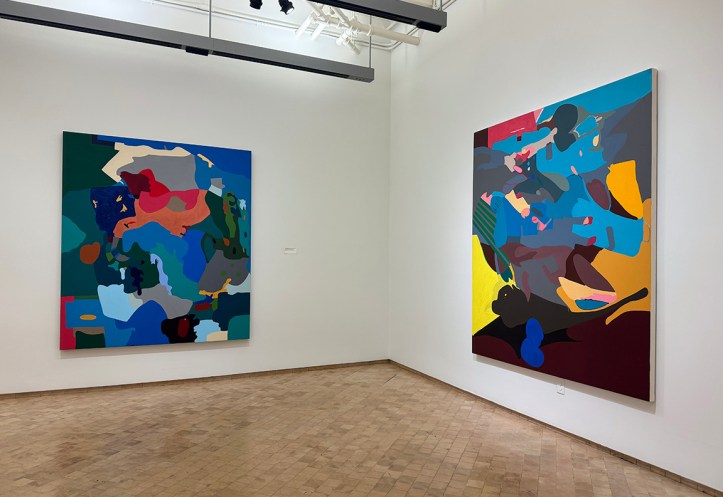
There’s something about Candida’s paintings that won’t be contained. She’s a big-canvas artist when it matters (thank you Jack Whitten), and when it’s intimate, she goes right into the napkin drawer — literally. Embroidering memories onto linen like spells, tiny and holy. It’s not art therapy, please — it’s poetic inventory. A child’s boat. A nursery rhyme. A bright toy elephant sailing through the tide of her son’s childhood.
And then there are the circles. Loops in her titles, her brushwork, her life. The title piece — Circle, Point, Hoop — pulls from a 1996 painting, but it might as well describe her whole way of seeing: symbolic, playful, and rigorous without being stiff. She’s like a jazz musician with a sewing kit and a subway map, threading together gesture and geography and the divine ridiculousness of being both here and from there.

Her identity as “Diasporican” isn’t some term cooked up for a curatorial pitch; it’s lived. It’s the stained-glass light of St. Ann’s Church mingling with the reflection off car hoods. It’s salsa in the kitchen and silence in the studio. And it’s all woven into this exhibition — not as an “identity” show, god help us, but as a life show. Alvarez doesn’t illustrate where she’s from — she metabolizes it. You feel it in the color, in the texture, in the way her lines know when to shout and when to hush.
The curators — Rodrigo Moura, Zuna Maza, and Alexia Arrizurieta — do well not to over-direct. The show breathes. It lets you wander through Alvarez’s timeline like you’re flipping through someone else’s dream journal (but the kind where you do recognize every entry). There are over 100 works here — a sprawl of paintings, drawings, sculpture, napkin-poems, and lived history. But the show doesn’t feel crowded. It feels generous.

And of course she’s back at El Museo. Of course. This is where she studied in the ’70s, back when the walls were louder and the art was an argument. Now she’s back — teacher, mother, legend — and the place glows with the echo of her beginnings. She’s mentored so many (Rashid Johnson, hello) and watched abstraction stretch to accommodate all these new voices. And here she is, not in the margins, but center court. Hoop, point, circle — and nothing wasted.
The works aren’t afraid of beauty. Or mess. Or joy. Black Cherry Pit is like a joke with a philosophical punchline. Her “Sunny” paintings — inspired by portraits of her mother — make domestic space feel sainted, lit by memory and not nostalgia. Komal Shah’s right: there’s power in Alvarez’s scale, but there’s joy too. So much joy.

Frankly, I left wanting to paint, which never happens. Or at least to look harder — at the green of Central Park, or the sunlight on the Hudson River. Because Candida Alvarez reminds us that to see the world clearly, we might have to spin around a bit. Get dizzy. Tilt our heads like a question mark. She makes the overlooked luminous and the abstract tender. She makes the city — and the diaspora, and the forest, and the kitchen table — feel like one long, looping sentence.
And maybe that’s what this show is. A sentence. An ongoing one. Color punctuating memory. Texture interrupting silence. The hoop keeps rolling.
El Museo del Barrio
April 24, 2025 to August 3, 2025
Discover more from Art Sôlido
Subscribe to get the latest posts sent to your email.
 Art Sôlido