
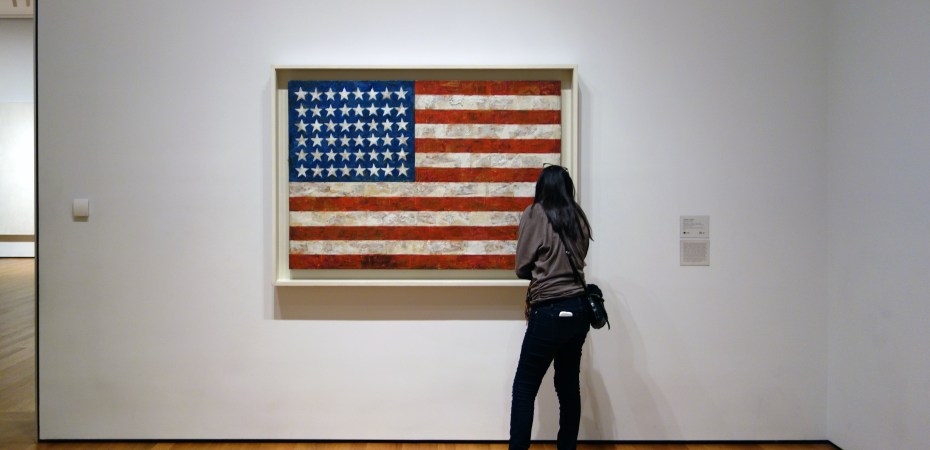
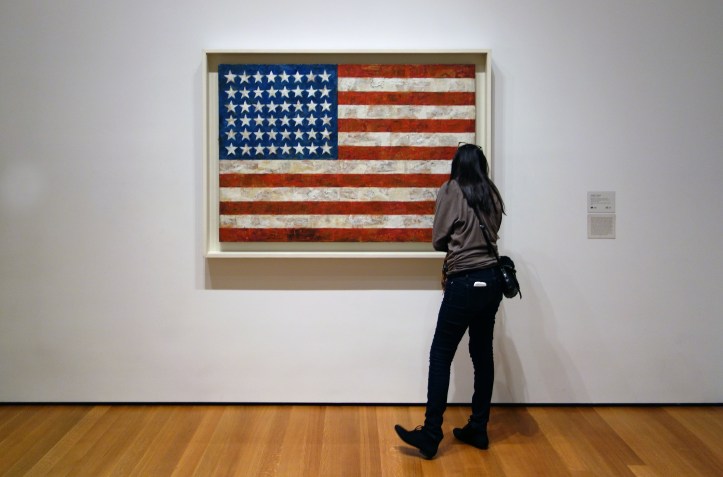
 I don’t know about you, but sometimes on the Fourth of July I’d rather be in a cool museum than sweating on a picnic bench watching fireworks fizz like a cliché. And maybe that’s why I think of Flag, that cool, waxy miracle Jasper Johns dreamed up in 1954. Not just a flag, the flag—except it isn’t waving or screaming, it’s sitting there, quiet and stubborn, painted in encaustic like a wound that won’t quite scab over.

Imagine dreaming the American flag and waking up to paint it. I mean, come on—that’s divine comedy and tragedy rolled into one. Johns didn’t salute it or burn it—he saw it. Not as a political banner, not even as pop, but as a thing you look at and then look again. And it keeps not being what you thought.
The wax! That ancient method, borrowed from funerary portraits and bees, all thick with the smell of time. You get up close and you see bits of newspaper, headlines bleeding through the stripes like half-buried memories. And isn’t that America too? Stuff we said yesterday, quietly fermenting under the red, white, and blue.
When Flag first showed its stars at Castelli’s gallery, people didn’t know whether to clap or protest. Was it art? Was it mockery? Was it too literal or too loaded? I mean, imagine painting the flag during the Cold War, in the age of conformity, while Pollock’s drips were still drying and everyone was supposed to be Abstract with a capital A. Johns had the nerve to be clear.
And then there’s White Flag—that ghostly whisper of a country. All the symbolism drained of its color, but not its weight. Painted right after Flag, in 1955, it’s not blank, it’s blanched—bleached by uncertainty, maybe even grief. You stand in front of it and it feels like something’s missing and you’re supposed to supply it. Like memory. Like conscience.
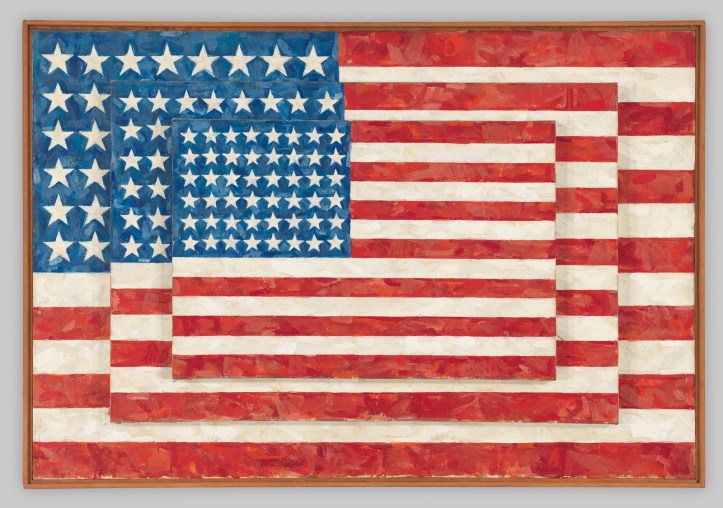
And just when you think you’ve got it, here come Three Flags in 1958, stacked like pancakes or propaganda, a recursion of stars and stripes shrinking into itself. A Matryoshka doll of patriotism! It’s in the Whitney now, which feels just right—it hums with all the layered complications of being American in a city that never quite agrees with itself.
Johns didn’t wave the flag, he interrogated it. With wax, with silence, with patience. He turned a familiar object into something so strange you had to start over. What is a flag, anyway? A symbol? A surface? A lie we all agree on?
It’s funny how a painting can become iconic by depicting what’s already iconic. But that’s the trick, isn’t it? Take something everyone thinks they understand—like a Coke bottle, a soup can, or a flag—and stare at it until it changes. Until you change.
So here’s to Jasper Johns on this Independence Day, and the way he made us squint a little harder at what we thought was obvious. He gave us flags that don’t wave, that don’t shout. They wait. They keep their waxen silence while the rest of the world makes noise.
And somehow, that feels more American than fireworks.
Discover more from Art Sôlido
Subscribe to get the latest posts sent to your email.
 Art Sôlido