

 The early autumn light fades into a soft evening glow over Fifth Avenue, where El Museo del Barrio stands like a quiet promise at the edge of Central Park. It’s opening night for “Coco Fusco: Tomorrow, I Will Become an Island“, and a warm crowd hums inside. I feel as though I’m arriving at a poetic rendezvous—a meeting of minds between Coco and the City, between the island and the world.
The Island Beckons at Dusk

I recall Piñera’s words: “Se me ha anunciado que mañana, a las siete y seis minutos de la tarde, me convertiré en una isla…” By some serendipity, it’s just past seven now. In the exhibition’s title—borrowed from that very poem—Fusco signals a transformation. Inside the gallery, those lines seem to whisper from the walls. Virgilio Piñera, one of Cuba’s great writers who knew the island as both confinement and la maldita circunstancia, offers an enigmatic key to understanding Fusco’s journey. To become an island is a bold, difficult decision—“isla como suelen ser las islas”—is to accept a kind of rebirth entwined with solitude. As I wander deeper, I sense Fusco inviting us to witness her own rebirths across the decades, each artwork unfurling like a new shore in an archipelago of ideas.
The gallery unfolds like a quiet conversation. Videos flicker in darkened rooms; photographs and artifacts draw my eye in closer. Fusco’s voice – “perceptive, acerbic, and piercing” as it’s often described – comes through in each piece, yet the tone shifts from work to work. It’s like walking around an island and finding different climates on each side. There’s humor and there’s severity; there’s play and polemic. Through it all, Fusco maintains a clarity of purpose: addressing those deep-down themes we carry but struggle to articulate – identity, power, exile, memory. She presents them with a frankness that feels like someone finally putting into words what the wind howling inside us means.
A Lyrical Walk Through Three Decades
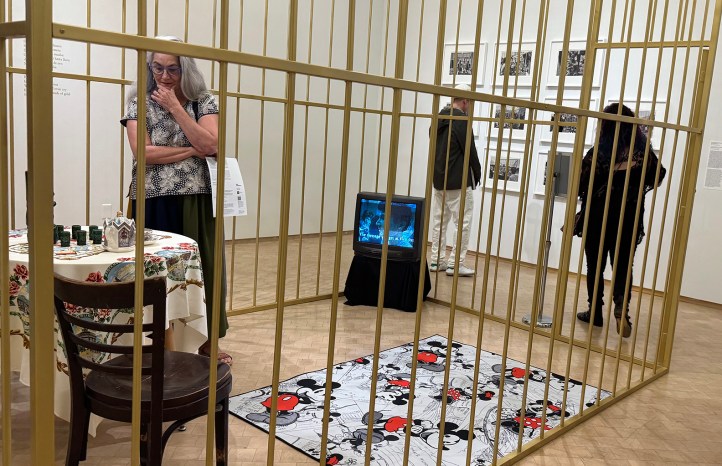
Moving further in, I stumble upon a golden cage installed in the gallery – an echo of Fusco’s Two Undiscovered Amerindians Visit the West (1992). In that infamous performance, Fusco and Guillermo Gómez-Peña donned pseudo-Indigenous costumes and sat inside a cage, as if “undiscovered” specimens on display. Visitors back then didn’t know whether to laugh or recoil; some even tried to feed the performers bananas. Here, the cage sits like a haunting remnant and a punchline at once. I catch myself half expecting ghosts of that satirical duo to appear, whispering witty retorts to the bemused onlookers in my imagination. The piece’s spirit lingers as a foundation of Fusco’s career – her blend of confrontation and dark humor established early on.
From that point, the exhibition fans out into a survey of Fusco’s work spanning more than three adventurous decades. It’s hard to believe this is her first major U.S. survey, given how influential she’s been. As I meander through videos, photographs, and installation works, I feel I’m leafing through a living diary of political and cultural truths. One moment I’m watching a video of an empty plaza in Havana at dawn, the sky big and silent – Fusco’s way of probing post-revolutionary Cuban reality. In another room, I’m met by the stern gaze of “a U.S. military interrogator” – actually Fusco herself in performance, clad in Army fatigues, delivering a deadpan lecture that slyly morphs Virginia Woolf’s words into a chilling commentary on women’s roles in the War on Terror. The range is staggering, yet the voice is consistently hers.
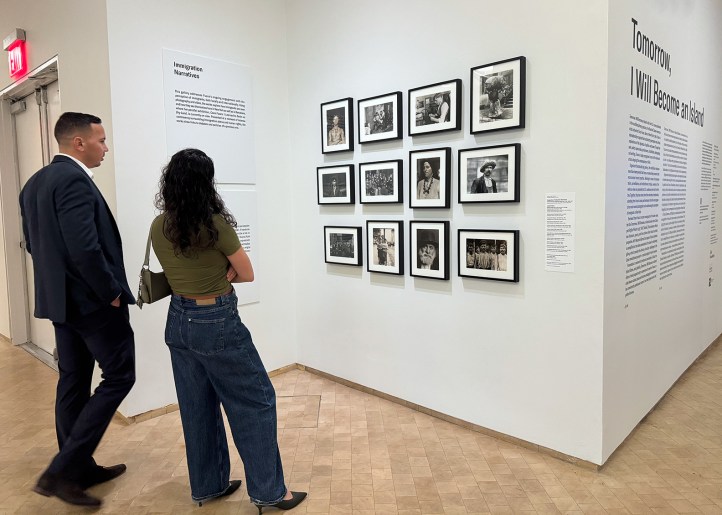
Fusco has a penchant for personae in her performances. In A Room of One’s Own: Women and Power in the New America (2006–2008), she dons a U.S. Army uniform and addresses the audience with ironic civility, highlighting the unsettling realities of gender and power in the military. The exhibition features such performative works through video and photography, pulling the viewer into Fusco’s sharp social commentary.
Every work feels personal and political in equal measure. Fusco doesn’t shy away from the injustices that compel her art – “the denial of dignity to workers and immigrants; the twisted misuses of feminine sexuality; and the state’s abuses of power” are all confronted here. Yet, walking through the show is far from a grim march; it’s more like an absorbing poem with shifting tones. One installation makes me chuckle at its audacity, another makes me pause in quiet horror. Her video piece La Plaza Vacía, for instance, quietly mourns the emptiness of public life under oppressive regimes, while her satirical Dr. Zira lecture (performed in full Planet of the Apes prosthetics) skewers the excesses of Wall Street with absurdist wit. These contrasts shouldn’t blend, but in Fusco’s island they somehow do – unified by her incisive, truth-seeking vision.
Intimate City, Expansive Conversations

Despite the exhibition’s global political sweep, it remains a very New York experience too. Fusco herself is a New Yorker, and perhaps that’s why I sense an urban sharpness in her work – a kind of streetwise observation amid the poetry. At the opening, clusters of visitors switch seamlessly between English and Spanish, much like the bilingual text on the walls. I overhear an older man explaining one piece to a teen, the way you might explain a tough bit of city history to a newcomer. The vibe is intimate and conversational, true to Fusco’s style as both artist and writer. This “multifaceted practice” of hers, fearless and uncompromising, has always challenged dominant narratives, yet here it invites dialogue rather than didactic preaching. We’re all islanders in this space, each bringing our own context, connecting through the art.
As I move between the galleries, it strikes me that Manhattan itself is an island—crowded, restless, buzzing with unrest—while inside El Museo, Fusco has carved out a quieter, more reflective shore of her own. In one corner, a pair of students lean together over the meaning of a photograph; in another, someone sits on a bench, eyes closed, letting the sound from a video installation wash over them. The atmosphere feels like a small community gathered on this island of art, momentarily “far removed from all unrest,” as Piñera wrote, gazing toward new horizons.
There’s a Piñera-like quality to this moment—the sense that the city itself is preparing to sprout branches and roses, to become an island in its own right. His fantastical imagery—“árboles en los brazos, rosas en los ojos y arena en el pecho”—echoes in Fusco’s work as ideas bloom unexpectedly in the concrete jungle of New York. Walking through the galleries, I almost hear the invisible Chopin nocturne he imagined, playing softly between the works, carrying us from one island-room to another “igual que un andante chopiniano“. In this reverie, poetry and art are no longer separate—they fold into each other, as natural as the wind taking over when words fall silent.
So, It Was True?
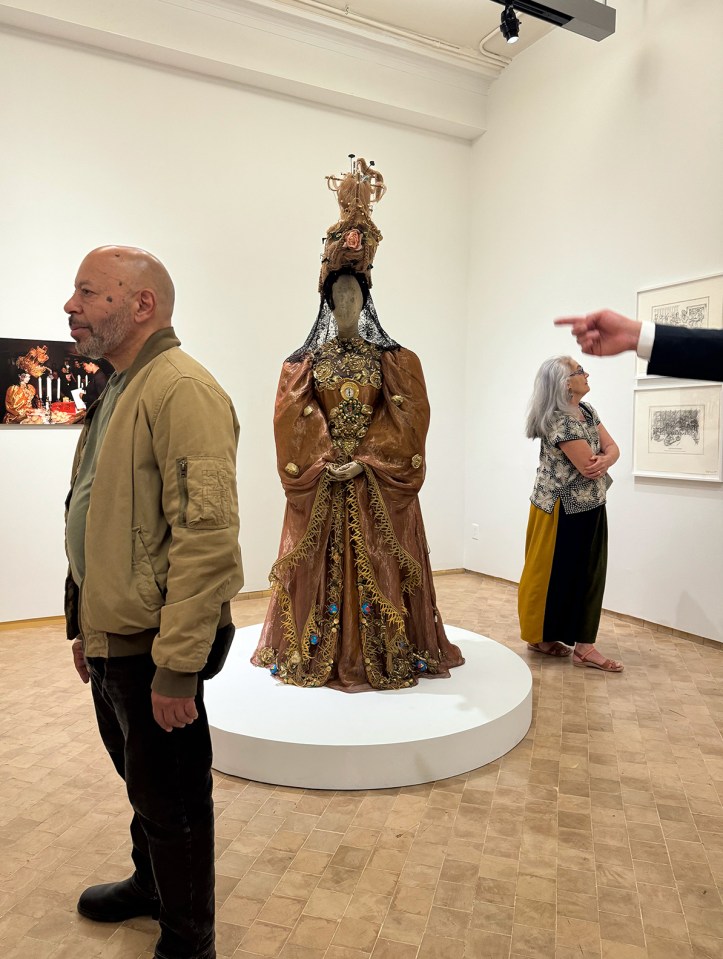
By the time I leave the exhibition, the moon has risen over Central Park. I feel both challenged and oddly comforted. “Tomorrow, I will become an island,” Fusco declared, and in doing so, she has shown us what that means: to stand apart and speak clearly, to transform one’s isolation into a beacon. El Museo del Barrio has given us one of those New York art events not to be missed – an expansive survey that is at once an education in history and a lyrical journey through an artist’s soul. Fusco’s work offers the kind of insight that makes you stop on the museum steps afterward, looking at the city anew, replaying certain images in your mind with fresh understanding.
In the final lines of Piñera’s poem, after the speaker has turned into an island – “tendido como suelen hacer las islas, miraré fijamente al horizonte, veré salir el sol, la luna, y lejos ya de la inquietud, diré muy bajito: ¿así que era verdad?”
Standing there on Fifth Avenue, I find myself whispering the same. So it was true? Yes, it was true: art really can transform you, even if only for an evening. And as I walk down the block, back into the urban tide, I carry a bit of that island with me – a gentle, persistent voice in the city’s roaring wind, reminding me of all I learned and felt on this extraordinary night.
The exhibition, organized at El Museo del Barrio and magnificently curated by Susanna V. Temkin, interim chief curator, and Rodrigo Moura, former chief curator, carries the clarity and depth of their vision. Their thoughtful selection and presentation allow Fusco’s decades of work to unfold with both urgency and lyricism, guiding us through each island of her career while keeping the horizon of her influence in sight.
Coco Fusco: Tomorrow, I Will Become an Island will be on view from September 18, 2025 through January 11, 2026. For more information, please visit El Museo del Barrio
Discover more from Art Sôlido
Subscribe to get the latest posts sent to your email.
 Art Sôlido