

 It’s Friday, November 7, 2025. Member Preview day for Wifredo Lam: When I Don’t Sleep, I Dream at MoMA. I arrived very early, and without thinking I walked straight up the stairs to the third floor, where I was immediately greeted by an old friend: Lam. The Jungle. Wifredo Lam’s iconic 1943 painting first appeared at MoMA on June 20, 1945, barely two years after it was created.
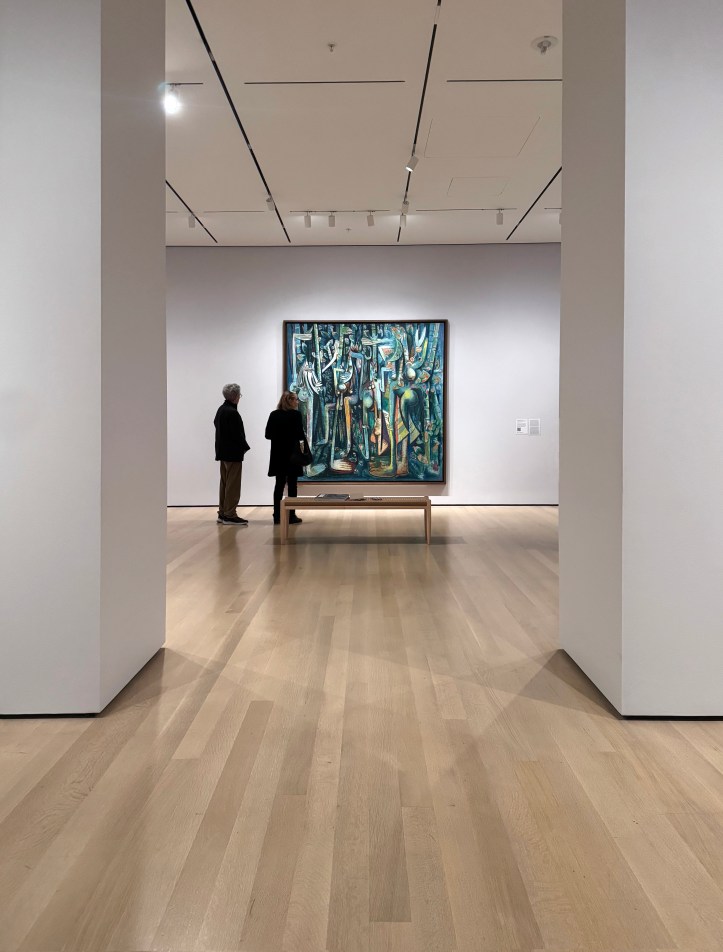
I still remember the first time I saw La Jungla in the early ’90s, tucked into a collection show beside Pollock’s One: Number 31. I was a young Cuban artist then, seeing Lam’s masterpiece hanging next to Pollock’s, suddenly overwhelmed with pride. It gave me energy, conviction, hope. I used to joke with my Cuban friends that you had to escape the island and come to the Concrete Jungle to see the real Cuban Jungle. And now, thirty-two years later, I feel that same excitement rise in me again. Lam’s masterpiece hasn’t lost its mystique; if anything, it feels more radiant than ever, surrounded by an entire army of the artist’s finest works, reclaiming the pride of place it has always held at MoMA.
A Lyrical Journey Through Lam’s World
Moving through the galleries feels like drifting through a series of dreams, each room its own distinct atmosphere, yet part of a larger, seamless conversation. The exhibition spans more than 150 works from the 1920s through the 1970s, a sweeping trajectory that positions Lam as a truly transnational modernist, bridging the European avant-garde and the Afro-Caribbean imagination.

In one gallery, early canvases from his years in Spain appear, including the 1937 La Guerra Civil, bristling with the angst of war. Step into another, and I’m surrounded by the lush symbolic imagery he developed upon returning to Cuba, Santería-inflected figures with mask-like faces and limbs morphing into jungle flora. Lam’s shapeshifting forms seem to oscillate between human, animal, and spirit, always in flux; there’s a fluency in his work that makes it feel alive and profoundly relevant today.
It becomes clear that Lam expanded modern art’s horizons not by imitating Europe, but by introducing lo afrocubano on its own terms. He famously called his art “an act of decolonization,” a way to disrupt colonial aesthetics. Indeed, he insisted on placing Black diasporic culture at the heart of modernism, not as a footnote or exotic influence, but as a foundational force in 20th-century art.

What’s remarkable is how intimate and approachable the show feels even as it tackles these grand themes. The curators, Christophe Cherix and Beverly Adams, have done a magnificent job making each section flow like a chapter in a novel or a long whispered poem. We see Lam in Paris trading ideas with Picasso and Breton, absorbing Surrealism’s liberating chaos. We see him back in Havana channeling the orishas, painting La Jungla as a spiritual retort to both colonialism and Cubism. We follow him to postwar Europe, where his style evolves yet again, into tangled, abstracted line drawings, visionary ceramics, and brooding later paintings that speak of exile and reinvention.
Walking through, I feel as if I’m having a personal conversation with Lam across time. The walls hum with his collaborations, illustrated poems, exquisite-corpse drawings, evidence of a life lived at the confluence of cultures and friendships. There’s a universal quality to Lam’s vision: he bridged continents effortlessly, speaking the language of modern art with a Cuban accent that is unmistakable. As I wander, I overhear visitor chatter in Spanish, English, French, Cantonese, a fitting polyglot chorus for an artist who embodied the global before globalization had a name.
Each Gallery a New Exhibition
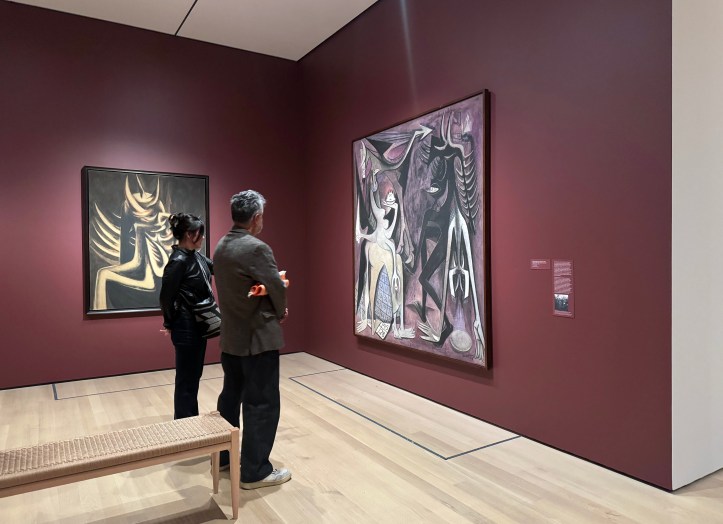
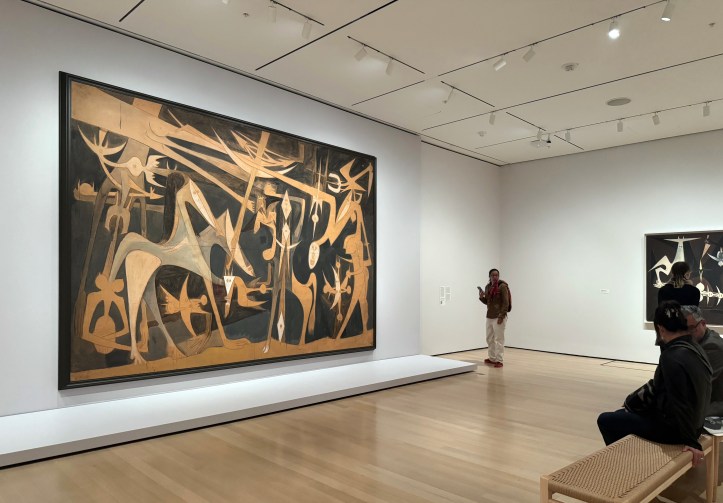
This retrospective doesn’t unfold in a straight line so much as it invites you to hopscotch through Lam’s imagination. Each room feels like a self-contained exhibition, with its own mood, color, and tempo. I find myself doubling back often: Did I fully absorb those ghostly figures in the dark burgundy room? Have I spent enough time with the massive Grande Composition (1949), its sepia-toned deities stretching across an entire wall?
The installation encourages this wandering. You loop around and discover unexpected connections, like reading a Julio Cortázar novel out of sequence and finding a new story each time. I walked through the show once, then found myself retracing my steps from the end back to the beginning, and it felt entirely new. In one gallery, a 1960s canvas echoes the curves of a 1940s ceramic nearby, a dialogue I missed on the first pass.
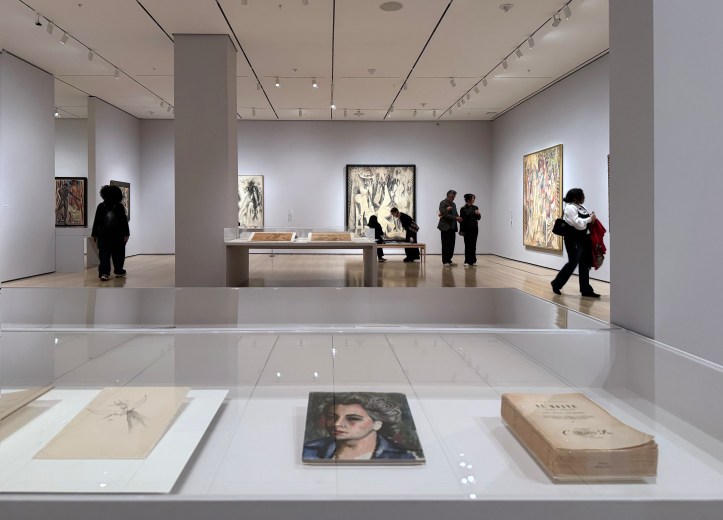
The pacing is so engaging that hours slip by without fatigue. It’s rare to find a retrospective you want to re-read immediately, but this is one. You can follow Lam chronologically, or jump freely, letting your mind make its own connections. Either way, the narrative holds. As in Rayuela, there is no single path, you build your own route through Lam’s world, and the reward is an ever-deepening sense of his genius.
Crucially, this non-linear delight doesn’t sacrifice coherence. Each section illuminates a facet of Lam’s evolution, forming a vivid portrait of an artist in perpetual reinvention. One moment you face Mother and Child (1939), a tender, almost monochromatic elegy painted after Lam lost his wife and son, the first Lam ever acquired by MoMA. The next moment you’re confronted with the explosive colors of the late 1940s, where figures stretch and dissolve into sweeping diagonals, “celebrations of liberation,” as the curators write. Then come the 1960s works like Les Abalochas… (1970), where earlier jungle spirits resurface in new guises, dancing for a vodou god of unity.
By the final gallery, filled with collaborations with poets like Aimé Césaire and contemporary reflections on Lam’s legacy, you realize the show has quietly woven politics, poetry, and painting into one continuous narrative. It’s an odyssey and an art-historical banquet at once. And yet, it always feels personal. Lam poured his mixed heritage (Afro-Cuban, Chinese, European), his contradictions, and his convictions into his art. This exhibition lets that authenticity rise to the surface.
When I Don’t Sleep, I Dream… in MoMA
There’s a wonderful irony in the show’s title. When I don’t sleep, I dream. After wandering these galleries, it becomes clear that Lam dreamed with his eyes wide open. He had to. His life spanned wars, revolutions, exile, pilgrimages, returns, and burials; nightmares he transformed into visionary art. And here in MoMA’s halls, those visions feel awake, alert, electric.
The retrospective, the first of its kind in the U.S. invites us to see the world anew, just as Lam intended. “I knew I was running the risk of not being understood… but a true picture has the power to set the imagination to work, even if it takes time,” he once said. Standing before La Jungla, I can almost hear him whisper it. Back in 1945, MoMA took a leap of faith by acquiring this wild, magical painting, recognizing a true work of art when it saw one.

Now, in 2025, La Jungla is surrounded by an entire rainforest of Lam’s creations, and the effect is simply sublime.
Stepping out of the exhibition, reluctantly, after a third lap through the clamor of Midtown rushes back in: honking cabs, a burst of salsa from a passing pedicab, skyscrapers rising like giant bamboo stalks. New York, our own concrete jungle, feels different now: a little more enchanting, a little less monolithic.
Wifredo Lam expands our field of vision, slipping the depth and beauty of Cuban culture into the very core of modern art’s story. This MoMA show, with its lyrical curation and sweeping scope, doesn’t just honor Lam’s legacy, it makes you feel as if you’ve shared a dream, as if you’ve been part of an intimate conversation between a Cuban painter and the city that embraced him. I leave MoMA wide awake, yet dreaming still.
Organized by Christophe Cherix, The David Rockefeller Director, and Beverly Adams, The Estrellita Brodsky Curator of Latin American Art, with Damasia Lacroze, Curatorial Associate, Department of Painting and Sculpture, and Eva Caston, Curatorial Assistant, Department of Drawings and Prints.
MoMA Wifredo Lam: When I Don’t Sleep, I Dream
Nov 10, 2025–Apr 11, 2026
Discover more from Art Sôlido
Subscribe to get the latest posts sent to your email.
 Art Sôlido