

A personal reflection on tradition, light, and a neighbor who never really left
“The commonplaces of America are to me the richest subjects in art.”Norman Rockwell
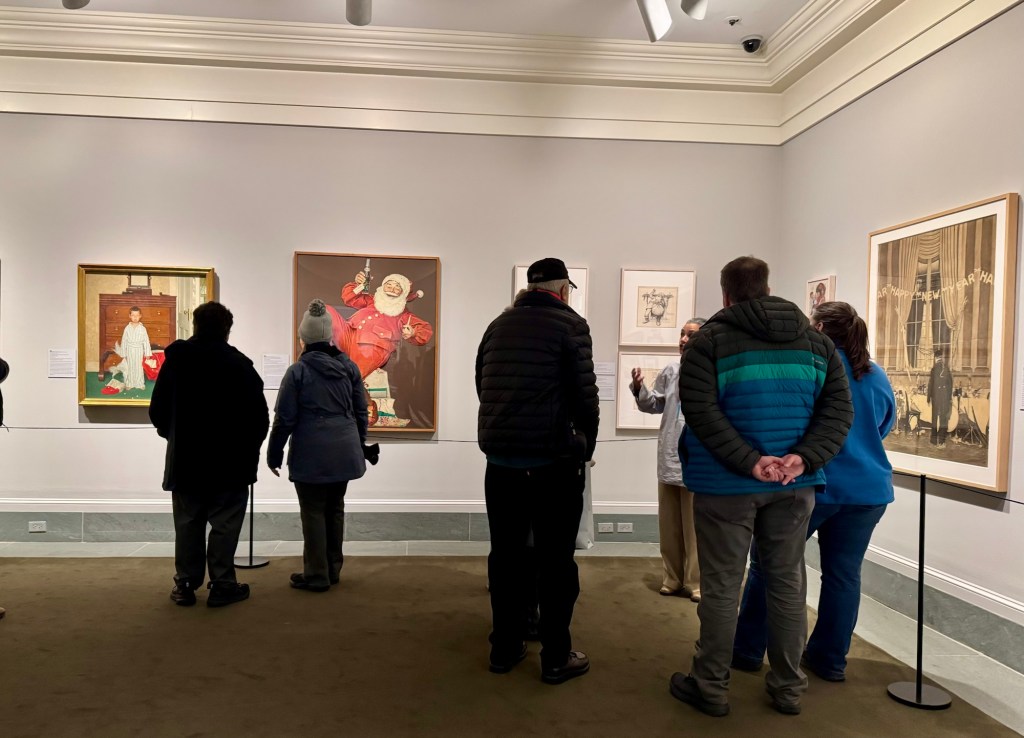
Visiting the Norman Rockwell Museum is not simply a museum experience. It is a threshold, a return, a kind of quiet homecoming. The moment I stepped into “Norman Rockwell: Home for the Holidays,” I felt the familiar warmth of Rockwell’s world, that mixture of humor, tenderness, and careful observation that has shaped the visual imagination of generations.
But for me, the visit was also deeply personal. It carried me back to my years as an art student, those long days of illustration and design classes when my professors insisted on looking beyond the surface, into the gesture, the glimmer in a character’s eye, the tiny detail that sustains a whole narrative. It carried me back to Manhattan, to my own neighborhood on Broadway and 103rd Street, where Rockwell once lived. He has always felt like a quiet companion on my daily path, not physically present anymore, but still there in the streets that hold his name.
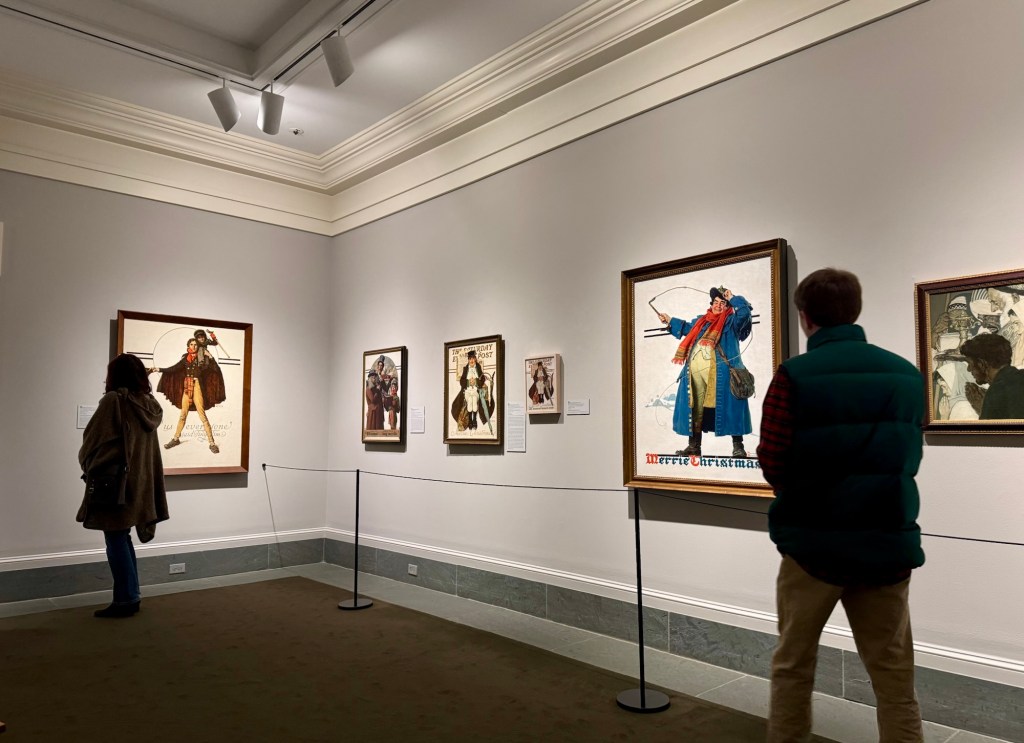
Holiday Rituals, American Stories
The curators of Home for the Holidays center the exhibition on a truth that defined Rockwell’s practice: he understood ritual. He understood that holidays are more than dates. They are stories, small domestic theaters in which families rehearse belonging, humor, chaos, and tenderness.
The exhibition draws from decades of his work for The Saturday Evening Post, which trusted him with the most cherished covers of the year, Christmas, Thanksgiving, and New Year’s. Even before that, at fifteen, Rockwell was already designing Christmas cards for a parishioner at his family’s church. Later, Hallmark would immortalize his midcentury images as part of the nation’s holiday vocabulary.
Seen together here, the paintings regain their original power:
snowy New England evenings, returning veterans embraced on the doorstep, intergenerational families crowded around a table, children plotting winter adventures. Rockwell’s humor is gentle and never naïve. His technique is exact. His empathy is unmistakable.
He often said, “the story concept was the first and the last thing,” and this exhibition proves it. Each painting is a crystallized narrative, a quiet drama illuminated by his unsentimental yet deeply humane eye. His holiday scenes are not idealized fantasies. They are aspirational mirrors, reflections of what Americans hoped, or still hope, to see in themselves.

Illustrators of Light: The Other Revelation
Another show on view, “Illustrators of Light: Rockwell, Wyeth, and Parrish from the Edison Mazda Collection,” added an unexpected brilliance to my visit.
These early twentieth century advertisements, created for Edison Mazda Lamps, a division of General Electric, bring together some of the greatest illustrators of the Golden Age:
Maxfield Parrish, N.C. Wyeth, Dean Cornwell, Stanley Arthurs, Worth Brehm, Charles Chambers, and a young Norman Rockwell.
Commissioned to promote the new tungsten filament bulbs, the images are luminous, exquisitely painted, and steeped in the optimism of modern electric light. Rockwell collaborated with advertising legend Bruce Barton of BBDO, whose poetic copy merged seamlessly with the evocative imagery produced by these artists. The campaign, designed to celebrate the “miracle” of electric illumination, became a visual hymn to progress and a resounding commercial success.
To see these works reunited, many on loan for the first time thanks to GE Aerospace, is to witness another chapter of American visual culture. It is the moment when light itself became modern.
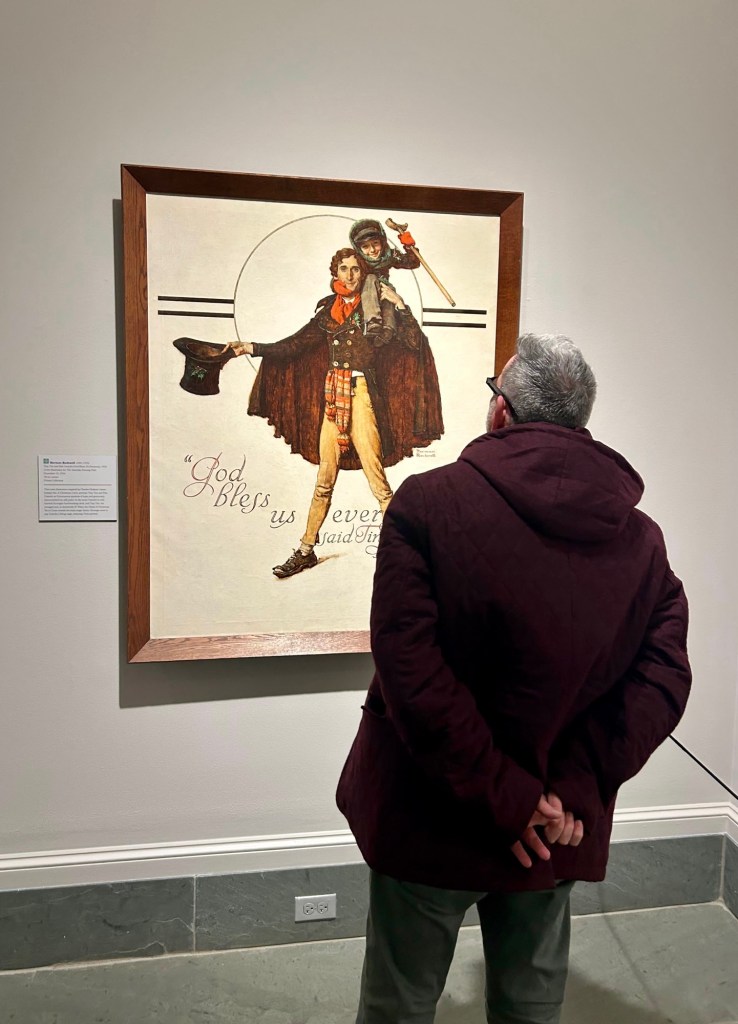
Leaving the Museum, Carrying the Light
Walking out of the museum felt like leaving an old conversation, one that had been waiting patiently for me to return. Rockwell reminded me of something we often forget in today’s art world: that technique can be a gesture of love, that sincerity is not weakness, and that a simple family ritual can be a work of art.
He reminded me of my own Christmases, the old magazine covers, and the roots of my first artistic training. And he reminded me that every time I walk through my neighborhood, past Broadway and 103rd, I am walking with a neighbor who, even in absence, still illuminates my path.
Norman Rockwell is at home for Christmas. And in a way, so am I.
The exhibition will be on display from November 22, 2025 through February 22, 2026. For more information, visit the Norman Rockwell Museum
Discover more from Art Sôlido
Subscribe to get the latest posts sent to your email.
 Art Sôlido