
The Yale University Art Gallery, founded in 1832, is the oldest university art museum in the United States. Nestled at the heart of the New Haven campus, its galleries weave together centuries of global art: African sculpture, Italian painting, American decorative arts, modern and contemporary works. Designed partly by Louis Kahn, the museum has long served as both a public cultural anchor for New Haven and a living classroom for Yale students. Its mission feels clear the moment you enter; art here is not only preserved, it is lived with.
Among the museum’s many strengths, the third-floor galleries of Modern and Contemporary Art and Design offer one of the most quietly powerful encounters in the building: a focused selection of four paintings by Edward Hopper, displayed with a restraint that lets each canvas breathe. Seeing Hopper in this setting, without fanfare, without crowds, and within an academic environment, creates the ideal atmosphere for contemplating his signature themes of solitude, stillness, and suspended narrative.

Hopper at Yale: Four Windows into Silence
The paintings on view form a compact yet remarkably complete constellation of Hopper’s concerns. They speak to one another across the gallery, each carrying a different shade of quiet.

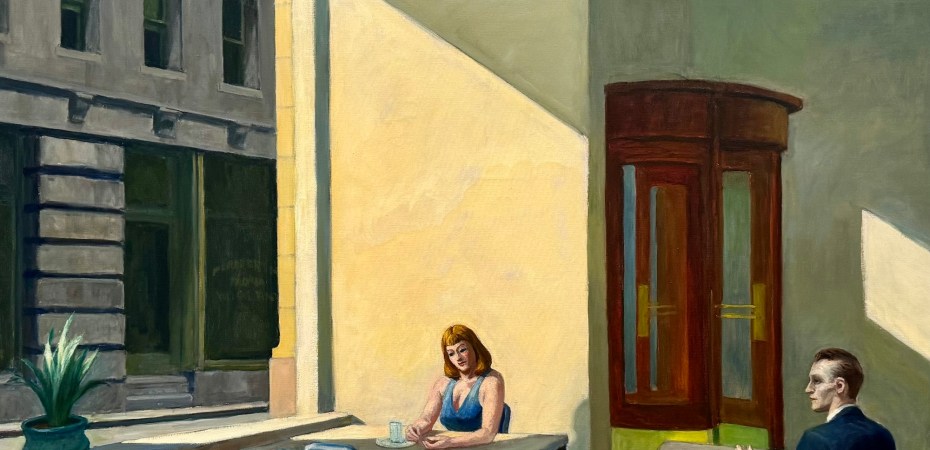
Sunlight in a Cafeteria (1958)
A man and a woman share a public space yet remain emotionally unreachable. The room is filled with bright, almost surgical light, Hopper’s way of exposing the fissures in human connection. The viewer senses the tension between presence and non-presence, between the possibility of contact and the resignation of silence. It is a painting about people together, yet alone.

Western Motel (1957)
Here, the transient architecture of American travel becomes a stage for introspection. A woman sits in a sparsely furnished motel room, her suitcase packed, a car waiting outside. The composition is so stripped down that the emptiness becomes psychological: a moment of waiting, departure, or internal pause. The motel, a symbol of mobility, feels paradoxically still, even claustrophobic. Hopper captures the loneliness of spaces meant to be temporary.

Rooms by the Sea (1951)
Perhaps the most enigmatic of the group, this image shows a door opening directly onto an expanse of blue ocean. Bright light pours across the bare floor, creating an atmosphere that is both serene and uncanny. Although inspired by Hopper’s studio in Cape Cod, the painting moves quickly beyond realism into metaphor. It becomes a meditation on threshold moments: between isolation and the world, interior and exterior, self and possibility.
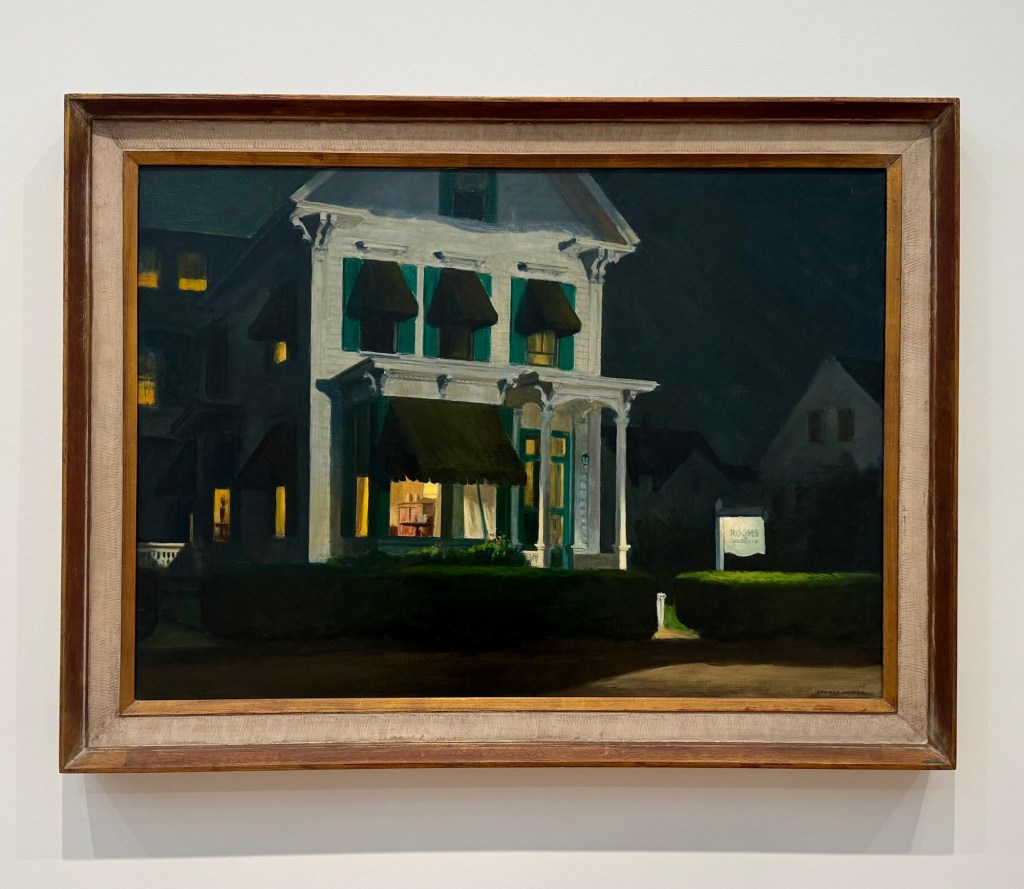
Rooms for Tourists (1945)
A nocturnal house in Provincetown glows from within. We see no figures, but we feel them. The contrast between the warm artificial light and the deep darkness outside evokes the stillness of American nights, motels, inns, temporary shelters, places full of strangers whose stories we will never know. Hopper transforms architecture into emotional landscape.
Together, these works create an unexpectedly intimate mini-retrospective. They are not loud masterpieces; they are whispers that linger. In the Yale gallery, their quiet becomes a kind of presence, almost a pulse.
The Meaning of Hopper in New Haven and at Yale
For New Haven, having these paintings permanently on view is a cultural privilege. In a city of modest size, their presence elevates the local arts scene and gives residents, students, and visitors access to one of the defining voices of American painting without the need to travel to a major metropolis. Hopper’s world, urban interiors, coastal houses, half-empty rooms, resonates strongly here. New Haven, with its mix of academic intensity and New England melancholy, feels like a natural home for Hopper’s introspective vision.
For students at Yale, these paintings function as more than artworks on a wall. They are study partners. They spark conversations about narrative ambiguity, lighting, composition, and the psychology of space. Many students encounter Hopper here for the first time not as a famous American painter, but as a personal discovery, a moment of recognition in a silent gallery. The museum’s pedagogical mission enriches this: students of art, architecture, literature, psychology, and film often return to these works again and again, finding new meanings in their stillness.
Having Hopper on campus shapes sensibilities. It teaches a way of looking: slowly, attentively, openly. It invites contemplation rather than spectacle.

Hopper’s on My Own Work
My connection to Edward Hopper is both artistic and emotional. His understanding of absence, its weight, its resonance, has long stayed with me. In my own project Echoes of Absence, I intentionally reentered Hopper’s spaces to explore what happens when the figures disappear entirely. I took Nighthawks and imagined the diner empty, its fluorescent glow spilling over an abandoned counter. I reimagined Morning Sun without the woman, leaving only the stark geometry of the light.
Removing the human presence was not an act of subtraction, but of amplification. By clearing the room, I wanted to let the space speak more loudly, to let the viewer feel the echo of someone who is no longer there. Hopper taught me that light can be an emotional protagonist and that the structure of a room can carry loneliness as powerfully as a figure.

In my paintings, the absence becomes the subject. The room becomes the memory. The light becomes the story.
This dialogue with Hopper continues to shape my work. Each visit to the Yale gallery, each return to Sunlight in a Cafeteria, Western Motel, Rooms by the Sea, or Rooms for Tourists, is a way of tracing my own artistic lineage. These paintings remind me that silence has texture, that stillness has narrative, and that emptiness can be profound.
Seeing Hopper at Yale is not simply an aesthetic experience; it is an encounter with the emotional architecture of American life. In the quiet of the third floor, his paintings feel like rooms we have all entered at some point, rooms full of light, loneliness, memory, and possibility. For New Haven, for Yale, and for artists like myself, these works continue to illuminate the delicate line between presence and absence.
And in that light, we find ourselves.
For more information, please visit the Yale University Art Gallery.
Discover more from Art Sôlido
Subscribe to get the latest posts sent to your email.
 Art Sôlido