

I was fourteen the night John Lennon was murdered. I was living in a remote, sad town in the center of Cuba, at a time when almost everything was forbidden, and dreaming most of all. News traveled differently then: slowly, heavily, like a blow that arrived hours later but landed all the same. That night, a small group of friends, Beatles fans to the core, dressed in black and walked together to the town cemetery. We carried guitars. We sang among the graves, quietly, reverently, as if the dead themselves needed to hear what we were losing. We sang to remember. We sang to mourn. We sang to honor our hero.

John Lennon had taught us how to imagine a different world precisely in a place where imagination itself was treated as a crime.
Not long after that night, we formed a band to play Beatles music, in the same town, in the same country where The Beatles were officially forbidden.
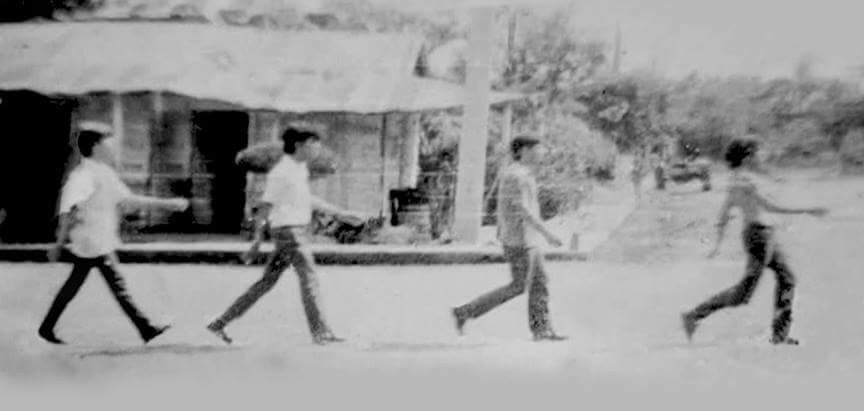
Playing that music felt dangerous and brave at once. Every chord was an act of faith, every lyric a small rebellion. Lennon was gone, but his voice kept insisting that another way of living was possible. That love could be radical but survive. That peace was not naïve. That you could still say imagine even when the word itself was unwelcome.
In 1994, when I finally scape and arrived in New York City, I followed an instinct I didn’t question. Before the Statue of Liberty, before the postcard landmarks, I went to the Dakota, that 72 West that we all heard about. And then to Strawberry Fields Forever, in Central Park. It felt like paying respects before beginning a new life. Lennon had crossed borders long before I ever could. In many ways, he had already prepared me for this city.

Today, my friend Wilfre reminded me, during one of those phone calls that feels like a continuation of an old conversation, that for the last thirty-two years, December 8 has remained sacred to us. Distance, time, different lives, none of that broke this ritual. It is the one date we never forget. Our private holiday. Our shared silence.
This year marks forty-five years since Lennon was killed outside the Dakota, where he lived, loved, raised his son, and wrote some of the most intimate music of his life. I live on the Upper West Side too, close to the park and to that building whose name will always carry an echo. I walk through Strawberry Fields often. There are always people there, singing, sitting on the ground, holding hands, leaving flowers, whispering lyrics. October 9, his birthday, and December 8 are different. They become moments when the city slows down just enough to remember.

Those of us who lived through that night in real time are now in our sixties. We carry the memory in our bodies. And yet, every year I am struck by the same thought and the same image: the quiet persistence of youth. Young faces gathering at Strawberry Fields, singing songs written decades before they were born, proving that Lennon’s voice has outlived his death.
People from everywhere, from all beliefs, or none at all. Strawberry Fields is not a memorial for one day; it is alive all year long. It belongs to everyone. To the faithful and the faithless. To those with a nation and those without one like me. To anyone who still feels that music can tell the truth when politics cannot.
Lennon once said that a dream you dream alone is only a dream, but a dream you dream together is reality. What lives here, between the Dakota and Central Park, is proof of that. This is not nostalgia. This is love.

I am from the generation of dreamers. From those who grew up believing that songs could be maps, that lyrics could teach you how to breathe, how to resist, how to love. I am from the generation that still believes John Lennon is not gone, that he is only sleeping.
Please, don’t spoil my day
I’m miles away
And after all
I’m only sleeping.
Discover more from Art Sôlido
Subscribe to get the latest posts sent to your email.
 Art Sôlido