
 There are museums where history is displayed, and others where it seems to have never left. Fraunces Tavern belongs to the second category. You walk in from the financial district — glass towers, coffee in paper cups, phones vibrating — and suddenly the eighteenth century refuses to stay in the past. Wood floors creak with intention. The air feels narrated.
For the United States 250th anniversary, the exhibition Path to Liberty: The War Reimagined does not attempt to update the Revolution with contemporary spectacle. Instead, it trusts something older: painting as memory technology.
The show centers on six canvases by John Ward Dunsmore (1856–1945), a painter who believed history painting required research with the rigor of archaeology and the staging of theater. A descendant of a Revolutionary War veteran and member of the Sons of the Revolution, Dunsmore did not imagine the past — he reconstructed it. Costumes were recreated, poses rehearsed, gestures composed. His Revolution is not abstract patriotism; it is choreography.
And perhaps that is what makes the exhibition unexpectedly contemporary. We live in an era suspicious of grand narratives, yet here we are, in a tavern where Washington once spoke his farewell, looking at a 20th-century artist reconstructing the 18th century for viewers in the 21st. History becomes a relay of imagination.
The Moment Before the Story Begins
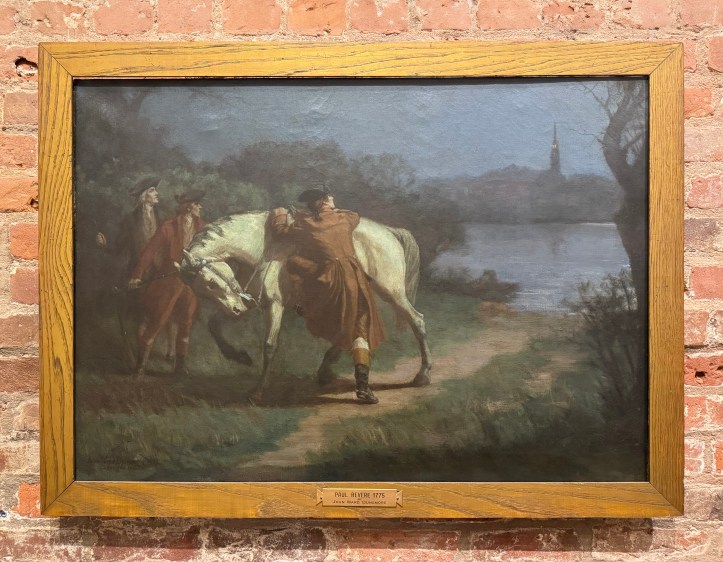
Paul Revere, 1775 (1910)
The famous ride is not shown. Dunsmore paints hesitation — the instant before legend.
Revere stands with one foot in the stirrup, turning toward the church signals across the water. The composition suspends action. This is not heroism yet; it is awareness. A man about to become history without knowing it.
The Revolution here begins as information — light in a tower, a message carried by a body. Liberty, the painting suggests, starts with someone noticing.
John Ward Dunsmore paints not the ride but the hesitation that makes the ride possible. Revere’s foot has not yet committed to the stirrup; his body twists between mounting and waiting. The horse shifts its weight, the companions lean forward, the path curves into darkness — every element suggests movement, yet nothing actually moves. The composition vibrates with imminent action. We are held in the elastic second before history begins, when awareness is stronger than heroism and destiny still feels like a decision.
What we do not see becomes the subject of the painting. The distant signal across the water remains small, almost uncertain, forcing the viewer to ask: what are they looking at, what have they understood, what is about to happen? We are accustomed to Revere in motion, forever riding through textbooks and national memory, but Dunsmore interrupts the myth and gives us anticipation instead of speed. This is the last moment he is only a man — not yet the messenger of a nation, not yet the legend — just someone listening carefully before choosing to move.
When the Myth Becomes Collective
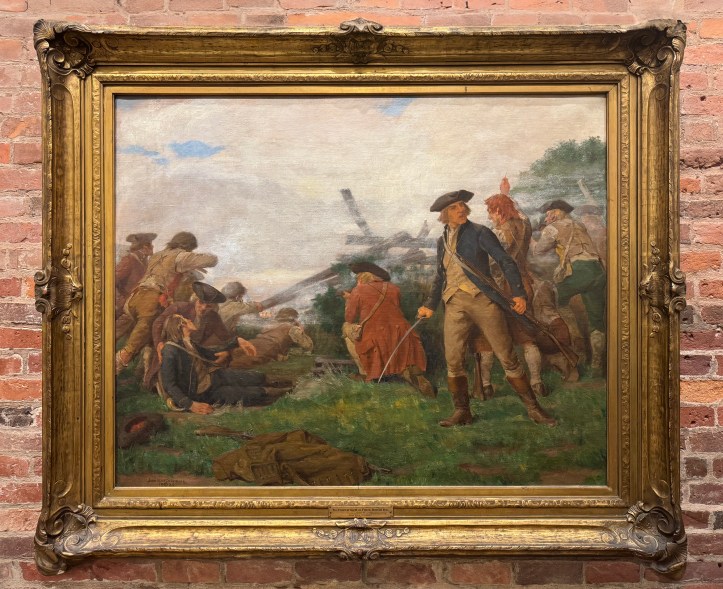
Bunker Hill – The Fight at the Rail Fence, 1775 (1924)
Now the war becomes physical. Smoke thickens the canvas; bodies push forward and fall backward. Dunsmore avoids the neatness of textbook illustration. The battle is chaotic but organized around resolve.
This was the moment the colonies understood they could resist the British army. The painting is less about victory than realization — the psychological birth of a nation.
Logistics as Destiny
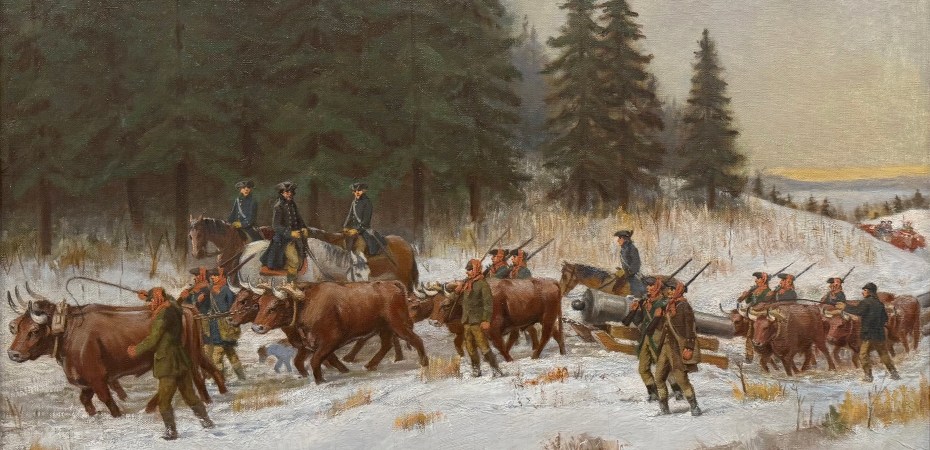
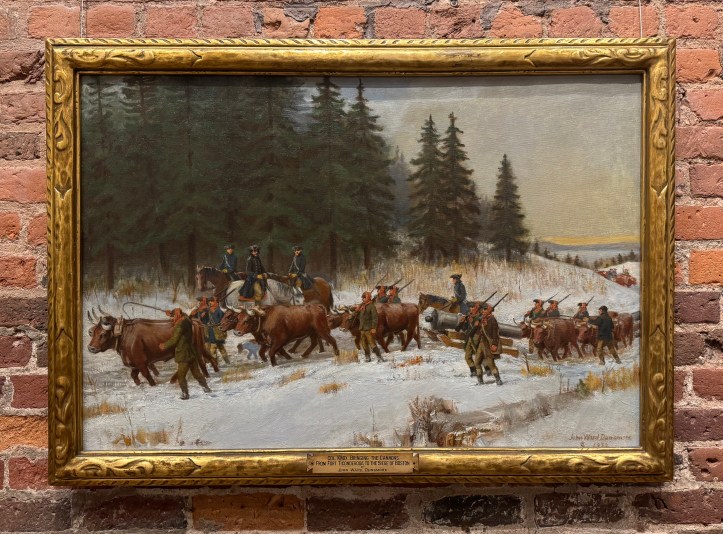
Col. Knox Bringing the Cannons from Fort Ticonderoga (1932)
No battle, no explosion. Oxen pulling artillery across winter terrain.
It may be the most modern painting in the room. A portrait of infrastructure.
Knox’s 300-mile transport of cannons made victory possible; Dunsmore understands wars are won not only by courage but by coordination. The American narrative here becomes practical — the revolution succeeds because someone solved a transportation problem.
Dunsmore abandons the spectacle of battle and paints endurance instead. The line of oxen advances slowly across a frozen landscape, men wrapped in heavy coats leaning into the labor rather than the glory. Nothing explodes, no flags rise — history moves at the pace of weight dragged over ice. The Revolution here depends not on heroism but on persistence, on the physical negotiation between bodies, metal, and winter.
Seen in the cold of this January 2026 — a season when we have watched the Hudson River freeze again — the painting feels less distant. The white ground is not picturesque snow but resistance: slippery, numbing, indifferent. Dunsmore reminds us that independence was carried mile by mile through weather that did not care about ideals. Before victory there was exposure, before myth there was frost, and the birth of a nation looked, for a long time, like men walking beside animals trying simply not to stop.
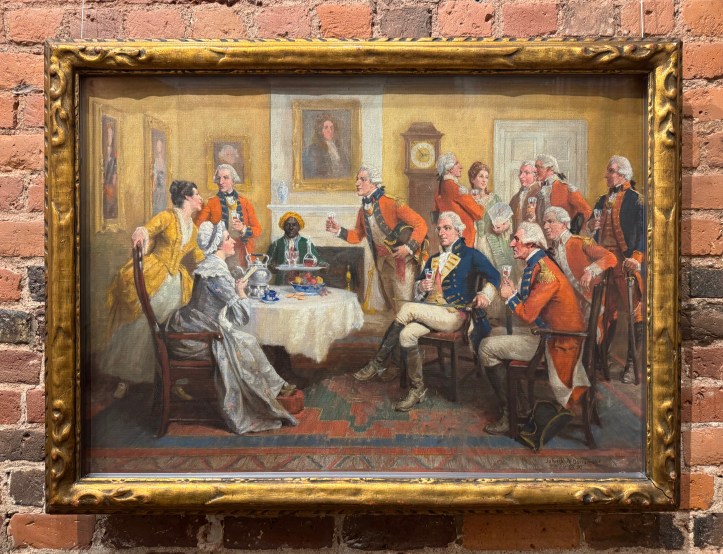
The War in the Parlor
Mrs. Murray Entertaining the British Officers, 1776 (1930)
A domestic interior interrupts military chronology. Mary Murray serves wine and sweets to British generals, delaying them long enough for American troops to escape.
It is the quietest painting and perhaps the most radical. Liberty advances through hospitality, deception, social intelligence — not only muskets. A woman’s conversation alters military time.
History becomes human scale again with a Quiet Radical Gesture.
At first glance the painting narrates a familiar patriotic anecdote: Mary Murray delays British officers with polite conversation. Yet John Ward Dunsmore composes the scene so the true visual center is not the hostess but the seated servant at the table. All compositional forces converge on him: the vertical axis of fireplace, clock, and table, the brightest whites of porcelain and cloth surrounding his figure, and the contrasting tones that draw the eye repeatedly back to his stillness. While the officers speak and gesture, he anchors the image. The story unfolds in dialogue, but the painting rests in silence.
This choice transforms the work into a meditation on attention itself. Murray’s strategy depends on social invisibility, and Dunsmore mirrors that mechanism by placing visual authority in the only figure ignored by the participants. The officers watch the hostess; the viewer watches the servant. In doing so, the painting quietly suggests that history is often shaped not only by heroic action but by unnoticed presence — by those structurally within the event yet outside its official narrative.
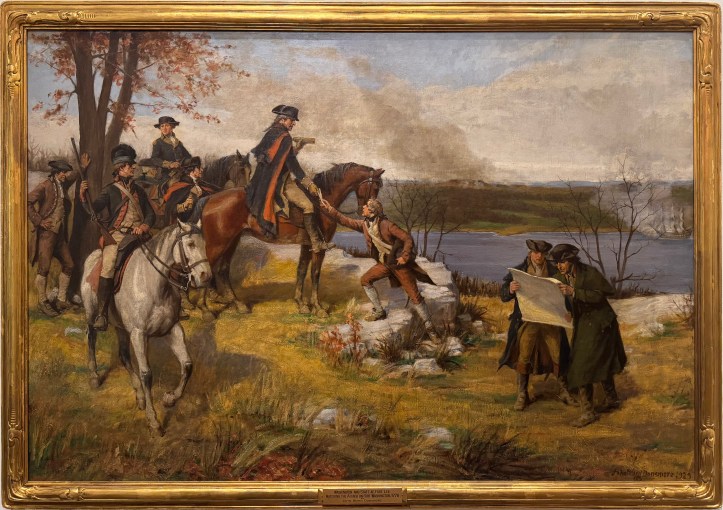
Watching Defeat
Washington and Staff at Fort Lee Watching the Battle of Fort Washington, 1776 (1936)
Washington does not command. He observes.
Across the river, smoke marks a loss he cannot prevent. The composition isolates leadership in helplessness. The Revolution includes retreat, uncertainty, and miscalculation. Dunsmore removes the comfort of inevitability; independence is not guaranteed.
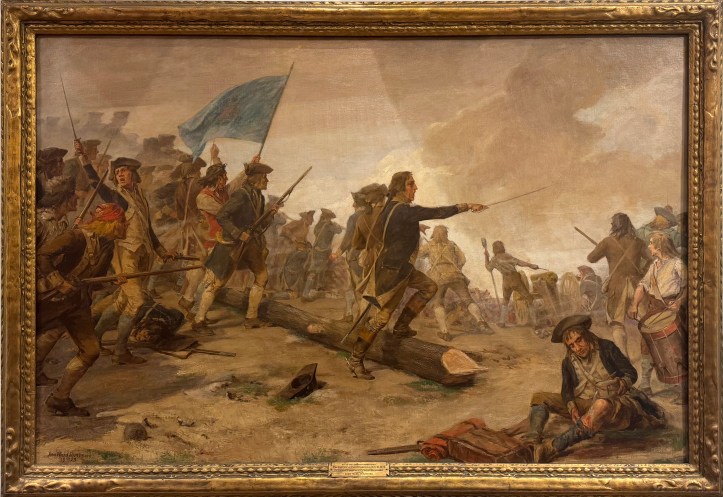
Occupation
The Defense of Fort Washington, November 16, 1776 (1936)
The final painting is surrender. Soldiers captured, New York under British control for seven years.
Ending the exhibition here is deliberate. The path to liberty passes through occupation. The nation, in this telling, is not born in triumph but in endurance.
Painting as Civic Memory
Fraunces Tavern itself completes the exhibition. Built in 1719, transformed into a tavern in 1762, government offices after independence, and later preserved by the Sons of the Revolution, the building functions as an artifact rather than a container. In the Long Room upstairs, Washington delivered his farewell in 1783 — and suddenly the paintings downstairs feel less illustrative than documentary.
Dunsmore’s works were once widely reproduced in books and magazines, shaping how generations pictured the Revolution. Seeing them together now reveals their real achievement: they do not monumentalize the past; they stage it so viewers can enter it.
The exhibition’s subtitle, The War Reimagined, is precise. The Revolution is not being retold but continually rewritten by each era that needs it. In 1907 these paintings taught schoolchildren civic identity. In 2026 they ask a quieter question: how does a nation remember itself without turning memory into myth?
Walking back onto Broad Street, the skyscrapers return instantly. Yet the feeling lingers that the city is layered rather than changed — the colonial tavern still coexists with the financial capital.
Liberty, like New York, is cumulative.
And in Fraunces Tavern, it is still being rehearsed.
Art-Sólido Magazine would like to express its sincere gratitude to Melissa Valenzuela, Curatorial Associate at the Fraunces Tavern Museum, for opening the doors of the institution to us and generously offering a guided visit filled with knowledge, passion, and a deep admiration for both her work and the paintings of John Ward Dunsmore. Her insight enriched our understanding of the exhibition and transformed the visit into a memorable and meaningful experience.
For more information, please visit the Fraunces Tavern Museum
Discover more from Art Sôlido
Subscribe to get the latest posts sent to your email.
 Art Sôlido