
There are exhibitions that present works, and there are those that construct environments. Spectral Gardens, the two-person exhibition of Beca Acosta and Lena Hawkins, curated by Sally Beauti Twin at Stephen Street Gallery, belongs unmistakably to the latter. It is not merely a juxtaposition of sculpture and painting. It is an ecosystem. One that breathes, mutates, and quietly unsettles.
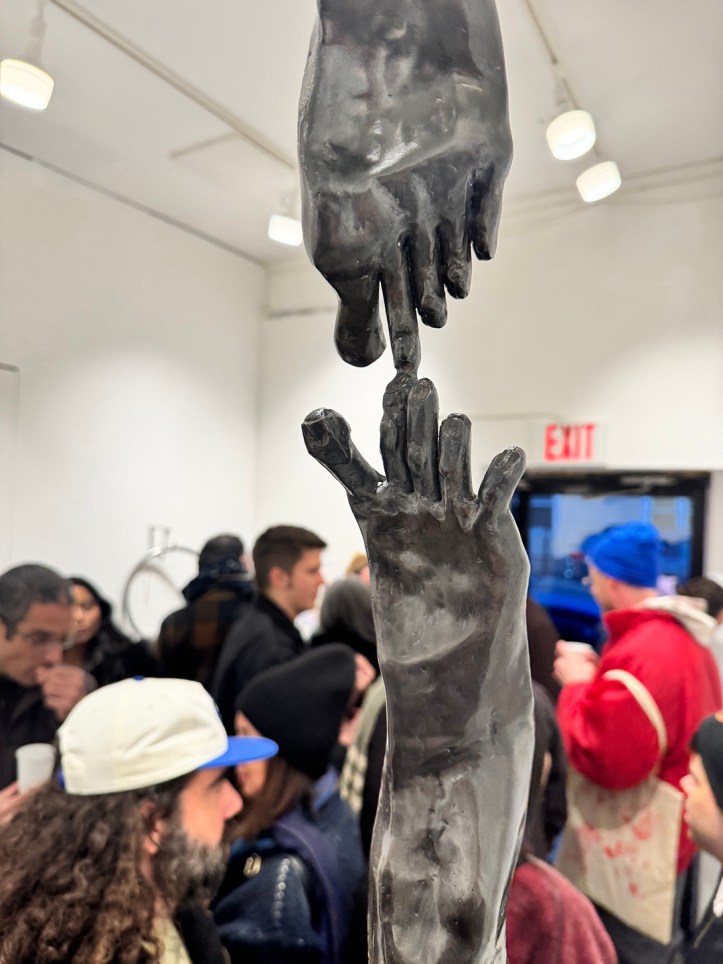
On opening night, the small Ridgewood space swelled beyond its modest scale. The crowd, dense and animated, moved shoulder to shoulder through the gallery with the kind of energy that signals something more than attendance. A shared recognition. Stephen Street Gallery, still young but already sharply defined in its mission, has cultivated precisely this kind of moment. A space where emerging voices are not just exhibited but activated. The room felt communal, alive, almost conspiratorial in its intimacy.
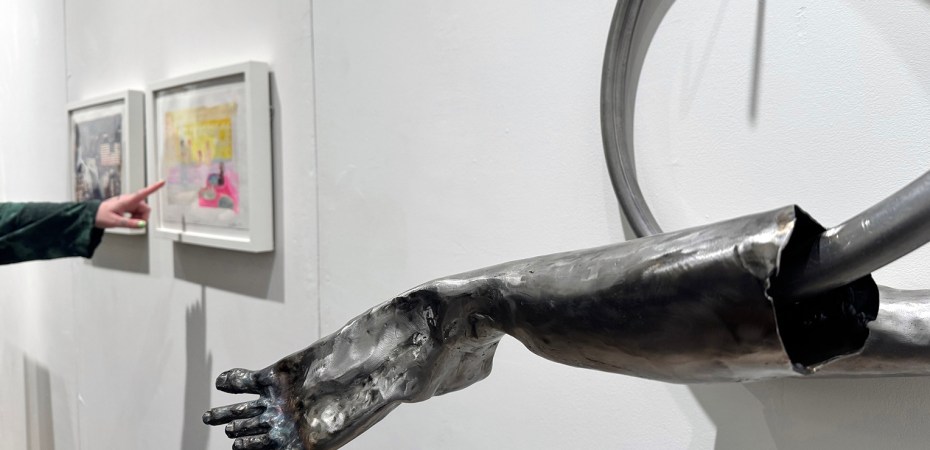
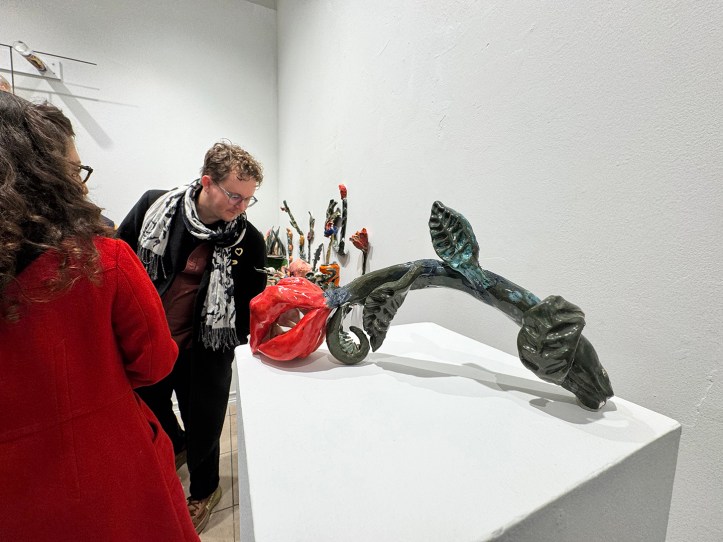
At first glance, Acosta and Hawkins appear to operate in entirely different registers. Beca Acosta, working in metal and ceramic, constructs objects that are at once corporeal and estranged. Dismembered limbs, hybrid flora, forms that feel forged rather than sculpted, as if they had survived some unknown process rather than been made. Her surfaces bear the marks of labor. Scorched, dented, insistently physical. A metal arm extends from a circular frame, both trapped and emerging. Elsewhere, hands reach toward one another in suspended contact, never quite touching. These gestures hover between violence and tenderness, between fragmentation and desire.
Acosta’s work is absurd, yes, but it is an absurdity anchored in the body. Her sculptures insist on presence. They occupy space with conviction, but more importantly, they test that space, probing its limits and its vulnerabilities. The body here is not whole. It is negotiated, interrupted, politicized. And yet there is humor, even play, in the grotesque. A quiet refusal to surrender entirely to severity.
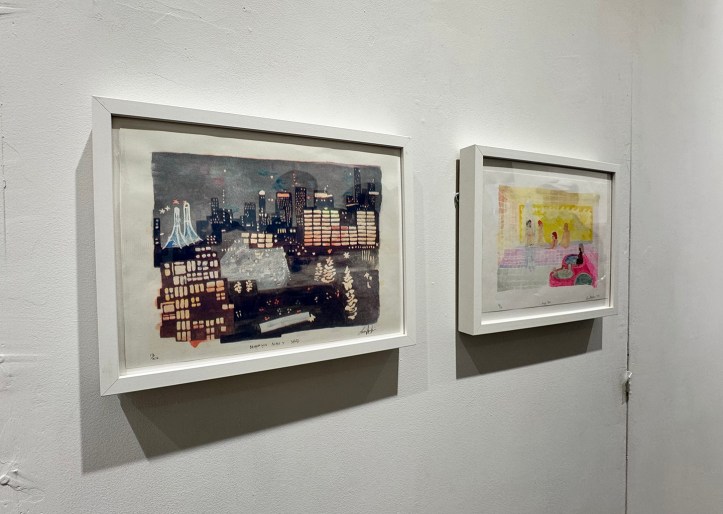
In contrast, Lena Hawkins works on a more intimate scale. Her gouache paintings operate like whispered transmissions. Small, framed, almost devotional in their presentation, they invite close looking. Her imagery, fountains, figures, nightscapes, symbolic interiors, feels less constructed than received. Hawkins paints as if recording something already present but not immediately visible. A residue of place. A spiritual afterimage.
Drawing from Hermetic traditions such as astrology, tarot, and archetypal language, her works move fluidly between the mundane and the mystical. A city skyline glows not as architecture but as aura. A quiet interior becomes a site of ritual. These are not illustrations of belief systems but visualizations of perception itself. How the unseen insists on coexisting with the everyday.
What is remarkable, and what elevates Spectral Gardens beyond a simple pairing, is how these two practices begin to speak to one another across the gallery. Acosta’s sculptures, with their tactile insistence, seem to emerge from Hawkins’ painted worlds. Conversely, Hawkins’ images feel like echoes or memories of Acosta’s objects, translated into another dimension.
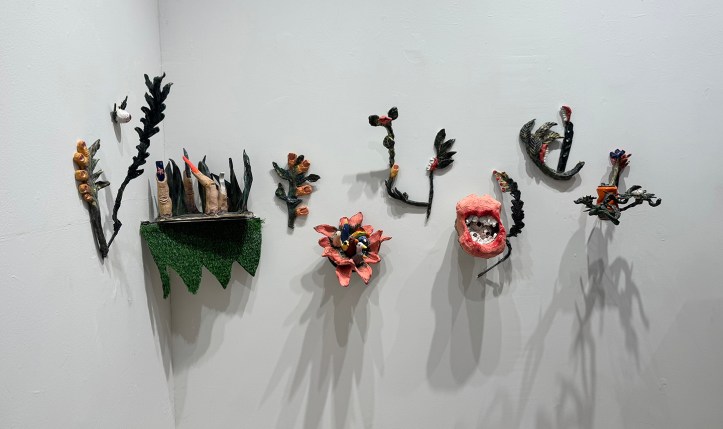
There are moments where the dialogue becomes almost literal. A sculpted botanical form finds its counterpart in a painted garden. A severed hand reaching outward mirrors the gesture of a figure half dissolved into color. It is as if one artist is working in the language of matter, the other in the language of spirit, and the exhibition exists precisely in the space where those languages overlap.
This interplay creates a subtle but persistent disorientation. Where does the body end and the vision begin. Which works are grounded, and which are speculative. The exhibition refuses to answer. Instead, it proposes a continuum. A garden, as the title suggests, where the corporeal and the otherworldly are not opposites but co-dependent states.
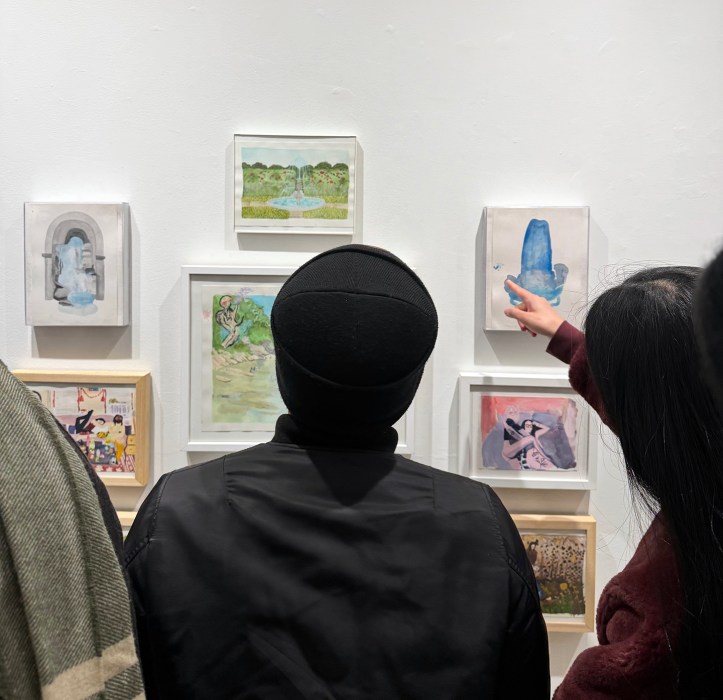
Stephen Street Gallery proves itself here not only as a venue but as a framework. Its commitment to experimental, non-commercial, and community-driven practices is palpable in every aspect of the show. From the density of the hang to the openness of the reception. This is a space that does not impose hierarchy. It allows works to coexist, collide, and converse.
In Spectral Gardens, Acosta and Hawkins do not merely complement one another. They complete one another. One offers the weight of the body, the other its echo. One insists on touch, the other on perception. Together, they construct a space that feels at once immediate and elusive. A place where the visible world is only the beginning.
Spectral Gardens is on view from March 13 through April 12, 2026, at Stephen Street Gallery, 16-79 Stephen Street, Ridgewood, Queens. Gallery hours are Saturday and Sunday, 2 pm to 7 pm.
For more information, please visit stephenstreetgallery.com
Discover more from Art Sôlido
Subscribe to get the latest posts sent to your email.
 Art Sôlido