
A Selfie of Artexpo New York and the Shifting Soul of the Art Fair
 The first work you encounter arrives almost by accident. Or maybe not.
You stand in front of it longer than expected. You look. You examine. And then the question comes, quietly, almost with suspicion: what is this doing here? Is it lost? Has it wandered into the fair by mistake? Or is it winking at the entire structure around it, at the machinery of the art market itself?
At the entrance, before anything else has had time to settle, you are greeted by a sculpture that feels less like a welcome and more like a smirk. It stands there with the confidence of something that already knows how it will be consumed. Bright, seductive, almost playful, it invites the inevitable gesture: the phone rises, the body adjusts, the image is captured. A selfie before the art has even begun.
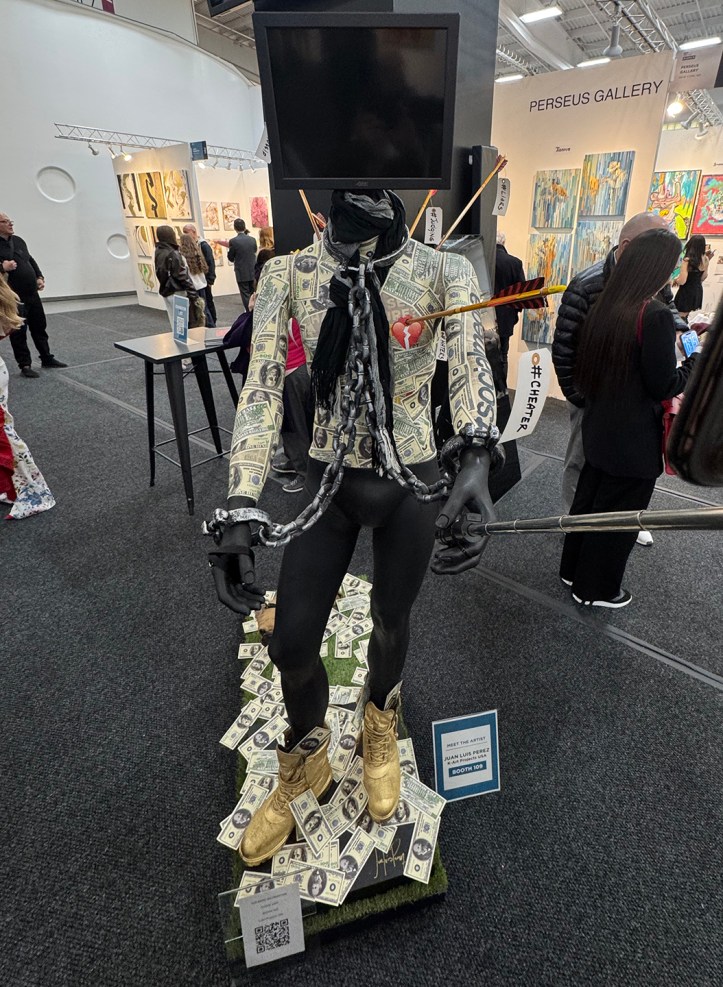
But the work is not innocent. It exaggerates the language of visibility, of spectacle, of instant recognition. It seems to mock the very system it inhabits, turning the viewer into participant, and the participant into product. The sculpture understands that in today’s economy of attention, the image is currency. And so it offers itself as both object and mirror. You do not just look at it, you perform it. And somewhere between the pose and the post, between the artwork and its circulation, the question lingers: is this a critique of the market, or its most perfect expression?
The artist is Juan Luis Pérez, who won the 2017 Artexpo New York Poster Challenge with his mixed-media work Worlds Unite.
I did not come looking for something serious. But the serious is here too. It is also for sale. And in that moment, the thought becomes unavoidable: maybe this is New York, where everything has a price.
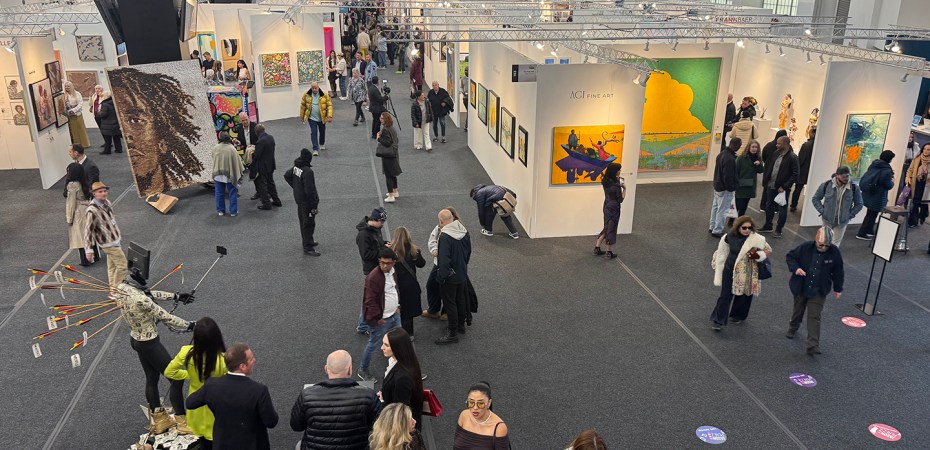
Artexpo New York returns for its 49th edition at Pier 36 on Manhattan’s Lower East Side, bringing together more than 200 galleries and over 1,000 artists in what remains one of the largest art marketplaces in the world. The scale alone is overwhelming. Booth after booth, image after image, gesture after gesture. It is a city within a city. A temporary one, but no less real.
And like all art fairs, it contains everything.
There is the tiger that wants to attack you and you want to kill it. There is the decorative. The obvious. The seductive. The excessive. But there is also the good, the refined, the work that questions and the work that inspires. The kind that slows you down. The kind that resists being consumed quickly.
This tension is not accidental. It defines the very nature of the art fair.
The Fair and the Biennial
Art fairs and biennials have always existed in opposition, almost like two different languages trying to describe the same world.
A biennial speaks in curatorial sentences. It constructs arguments. It proposes ideas. It does not need to sell you anything. It invites you to think, to disagree, to return.
A fair speaks in transactions. It is immediate, direct, unapologetic. It asks: do you want this? Can you afford it? It is built on proximity between artist, object, and buyer.
And yet, something is changing.
Fairs like Artexpo are no longer satisfied with being only marketplaces. Increasingly, they are staging moments of authenticity that feel closer to the logic of a biennial. Not in structure, but in intention. The presence of installations, conceptual works, and socially engaged practices suggests a shift. Not a transformation, but a subtle expansion.
The fair is learning to speak another language.
Encounters Inside the Noise
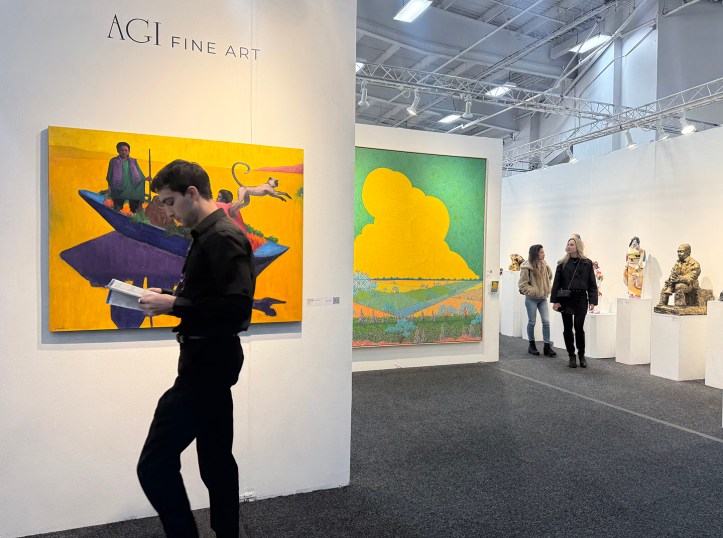
At AGI Fine Art, Muhammad Luqman’s work occupies a threshold space.
There is a sense of quiet negotiation in his presence. His work does not demand attention immediately. It lingers. It asks for a slower reading, which in the context of a fair feels almost subversive. In a space designed for quick decisions, his work delays them.
That delay becomes its strength.
K-Art Projects USA — Caridad Sola Pérez and Juan Luis Pérez
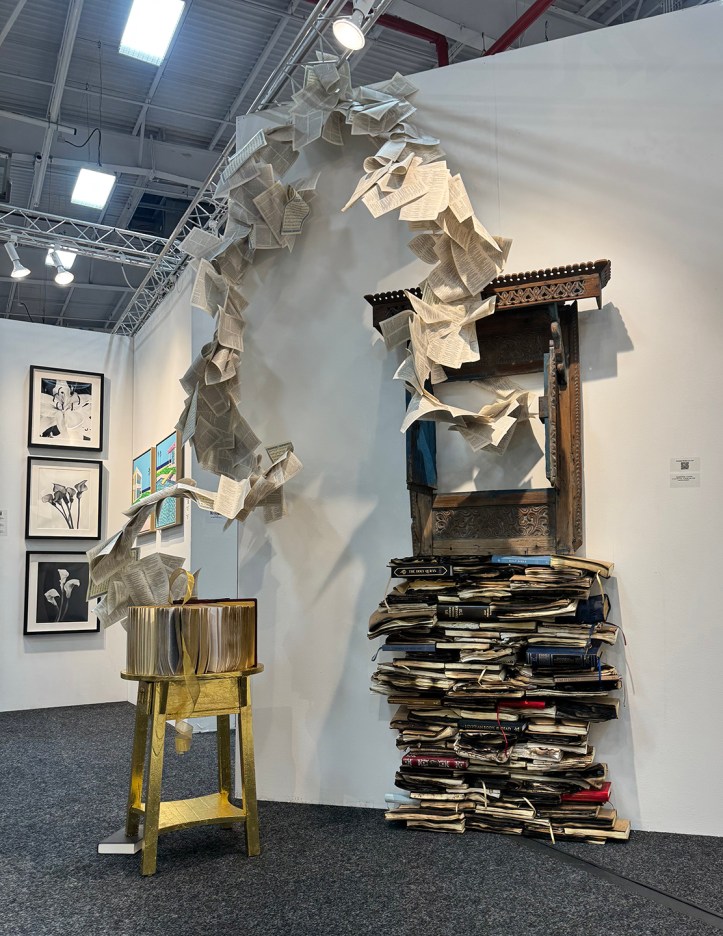
Caridad Sola Pérez presents one of the most conceptually grounded works in the fair.
In Gods We Trust unfolds as both object and argument. Nineteen sacred texts bound together in chronological order rest on a gold-leafed night table, stabilized by Darwin’s Origin of Species. The gesture is precise, almost surgical.
Pages descend from above, evoking both revelation and collapse.
The work refuses hierarchy. It suggests that belief systems, despite their differences, share a common structure. But it also exposes the tension between faith and knowledge, between devotion and evolution. Its proximity to Ground Zero is not incidental. The work carries the memory of collapse without illustrating it.
It is one of the few moments in the fair where silence feels heavier than noise.
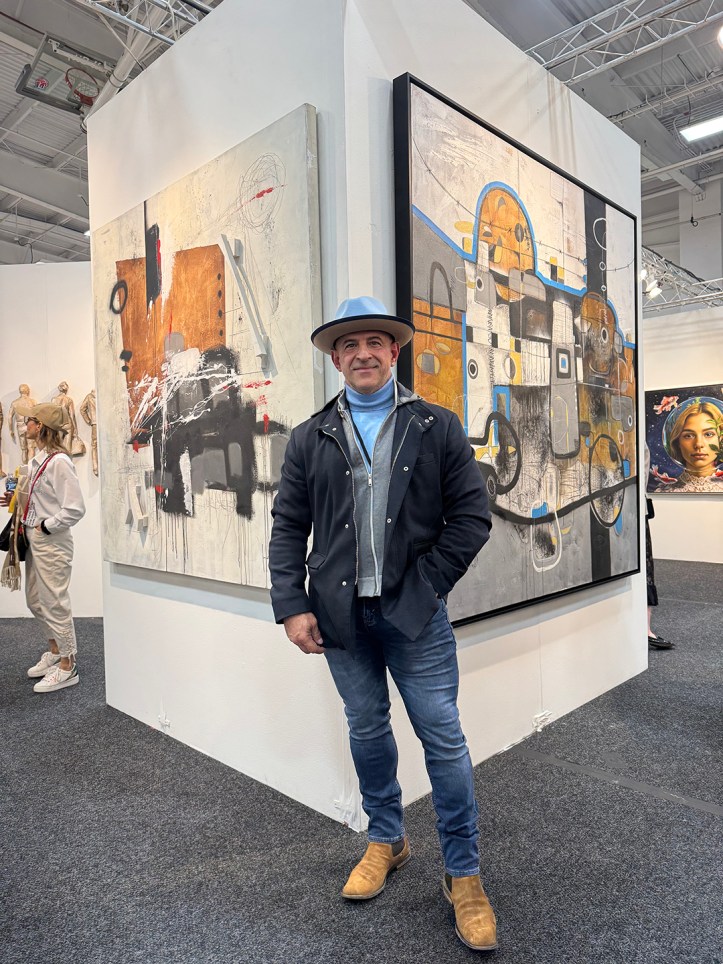
Nearby, Juan Luis Pérez moves in a different direction entirely.
His abstract paintings are not quiet. They do not hesitate. They arrive fully charged, saturated with color and movement. There is something deeply intuitive in the way he constructs the surface. Layers accumulate without becoming heavy. Color collides without collapsing.
His palette carries memory. Tropical, yes, but not nostalgic. It is a living palette, one shaped by displacement, by travel, by a life lived across geographies. Havana, Spain, Miami, Europe. These are not references. They are residues.
What is striking is how his abstraction avoids coldness. It remains emotional, almost physical. The brushwork feels immediate, but not careless. There is control beneath the spontaneity. A tension between instinct and structure.
His sculpture extends this language into space.
Where the paintings compress energy onto a surface, the sculptures release it. They occupy space with the same intensity of color and gesture, but now the viewer must move around them. The work is no longer frontal. It becomes relational.
There is a continuity between painting and sculpture, but also a shift. The sculpture introduces weight, balance, gravity. It negotiates with the physical world in a way the painting does not have to.
And yet, both share the same core impulse: an insistence on presence.
Juan Luis Pérez does not illustrate ideas. He generates experience.
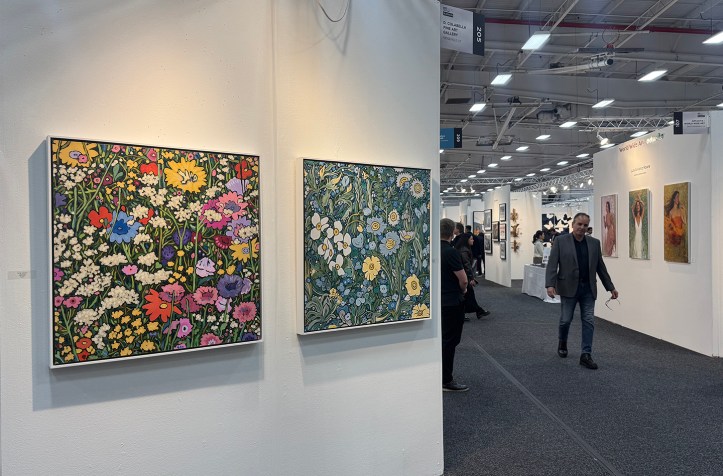
D. Colabella Fine Art Gallery — Chris Arnold
Chris Arnold brings the natural world into the fair, but not as decoration.
His work carries a narrative impulse. Animals, plants, environments. But they are not passive subjects. They are active presences. His visual language, influenced by illustration and Art Nouveau, creates compositions that feel both accessible and layered.
There is playfulness, but also urgency.
Arnold’s work reminds the viewer that nature is not outside the system. It is within it, affected by it, dependent on it. In the context of the fair, this becomes a subtle critique. A reminder that what is being sold is not only image, but attention.
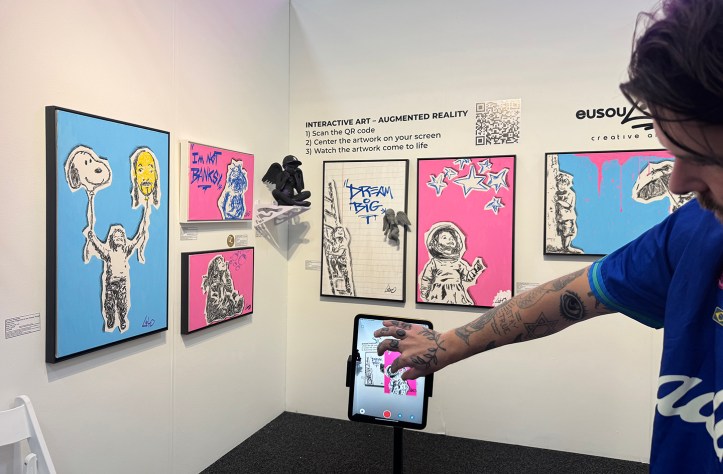
Eusoulito — Expanded Reality
Eusoulito operates between worlds.
Rooted in street art, his work carries the immediacy of urban visual culture. But it does not remain static. Through augmented reality, the image expands. The viewer activates it. The artwork responds.
This interactivity transforms the experience.
The work exists simultaneously as object and event. It invites participation, but also raises a question: does this deepen engagement, or does it align too easily with the speed of contemporary consumption?
Perhaps both.
Authenticity in a Marketplace
What is striking is not the presence of strong work. There has always been strong work. What is striking is how it coexists with everything else.
The fair does not curate in the traditional sense. It accumulates. It layers. It allows contradictions to exist side by side. And within that accumulation, something unexpected happens. Moments of authenticity emerge not because they are isolated, but because they resist the logic around them.
You begin to notice them differently.
The work that seemed out of place at the beginning no longer feels lost. It feels intentional. It feels like a small act of resistance. A reminder that even within the market, something can still exceed its price.
New York, Again
There is a temptation to dismiss fairs. To reduce them to commerce. To see them as diluted versions of something more serious.
But that would be too easy.
Artexpo New York reveals something more complex. It shows a system in negotiation with itself. A space where the commercial and the critical are no longer entirely separate. Where buying and thinking happen in the same breath.
And perhaps that is the real condition of the city itself.
You leave the fair with the same question you had at the beginning, but it has changed slightly. It is no longer about the artwork. It is about the structure that contains it.
What is this doing here?
Or maybe, more honestly:
What are we doing here, looking at it, deciding what it is worth?
Discover more from Art Sôlido
Subscribe to get the latest posts sent to your email.
 Art Sôlido