
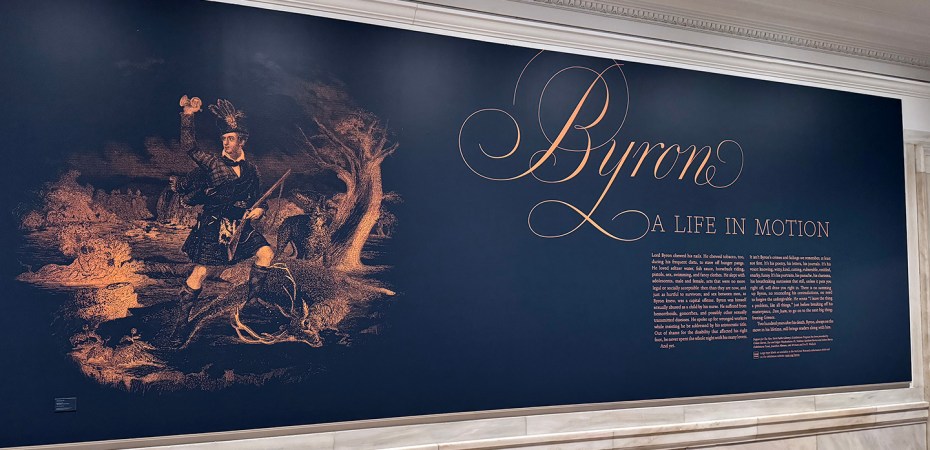
 The exhibition Byron: A Life in Motion at the New York Public Library’s Stephen A. Schwarzman Building offers a rich, multifaceted view of Lord Byron, a poet whose short yet eventful life continues to captivate audiences two centuries after his death. Running from September 7 through January 12, this thoughtfully curated collection delves into the tumultuous life of George Gordon Byron, exploring not only his literary achievements but also the contradictions and complexities that defined him. Through a carefully arranged selection of personal letters, literary manuscripts, paintings, prints, and everyday items like wine bills, the exhibition constructs a vivid portrait of a man whose life was marked by fame, scandal, and a profound engagement with the political and cultural revolutions of his time. Byron’s fame, first ignited by the publication of Childe Harold’s Pilgrimage in 1812, forms the central arc of the exhibition. Childe Harold, a lengthy and semi-autobiographical poetic travelogue, catapulted the young poet into the public eye and made him a celebrity almost overnight.

The exhibition captures the scale of this momentous shift in Byron’s life, with items like letters from admirers and newspaper clippings detailing his sudden rise to fame. These documents, which bring to life the poet’s early literary success, also serve as a reminder that Byron’s life was as much about his public persona as it was about his private writing. His flamboyant lifestyle, widely reported in the gossip columns of his day, became inseparable from his literary output, and the exhibition reflects this duality through artifacts that chronicle both the poet’s creative genius and his lavish, often scandalous existence.

One of the most compelling aspects of Byron: A Life in Motion is its exploration of Byron’s contradictions. As curator Elizabeth Denlinger aptly points out: “Byron was a fascinatingly mixed character. Despite his well-earned reputation as a party boy and misogynist, he was also a committed writer for whom writing wasn’t the most important thing in life; his ultimate commitment, expressed in joining the Greek war for independence, was to the principles of self-determination and liberty”. The exhibition provides a nuanced view of Byron’s engagement with political causes, culminating in his ill-fated journey to Greece in 1823, where he hoped to aid the Greeks in their fight against Ottoman rule. Byron’s letters from this period, displayed alongside maps and prints depicting the war-torn region, reveal a man driven by ideals larger than himself. He never saw battle, succumbing to illness before he could fight, but his death at the age of 36 immortalized him as a hero in Greece and marked a significant chapter in his complex legacy.
“I mean to marry, prudently if possible; that is, wealthily; I can’t afford anything to Love. […] I am here boxing in a Turkish pelisse to prevent obesity, and as usual very much yours, Byron” To John Cam Hobhouse August 30, 1811. Quote on the gallery walls

The exhibition also traces Byron’s physical movements throughout his life, which were extensive. Born into a family of declining nobility, Byron spent his early years in Aberdeen, Scotland, before attending school in Nottinghamshire and later Cambridge. But it was his travels abroad that shaped both his life and his writing. After his initial success with Childe Harold, Byron spent time in Switzerland, where he famously joined a group of fellow writers that included Percy Bysshe Shelley and Mary Shelley. This summer gathering in Geneva, immortalized in literary history as the moment when Mary Shelley conceived of Frankenstein, was also a turning point for Byron, allowing him to refine his poetic voice and experiment with new forms. The exhibition beautifully captures this period of creativity and camaraderie through manuscripts and portraits of Byron’s circle, offering visitors a glimpse into the fertile intellectual environment that surrounded the poet. From Switzerland, Byron’s travels took him to Venice, where he embarked on his most ambitious work, Don Juan.
“Then I have fallen in love with a very pretty Venetian of two and twenty, with great black eyes. She is married— and so am I—which is very much
to the purpose.” To Augusta Leigh December 18, 1816. Quote on the gallery walls
The exhibition’s section on Byron’s Venetian years showcases manuscripts from Don Juan, alongside letters to and from his lover and muse, Contessa Teresa Guiccioli. These years in Italy were characterized by both literary productivity and personal turmoil. Byron, by this time estranged from his wife and living in self-imposed exile, cultivated an air of romantic melancholy that permeated both his life and his work. The exhibition does not shy away from these contradictions—here was a man whose genius was matched by his self-destructive tendencies, who could pen a biting satire like Don Juan while simultaneously engaging in affairs that would add to his notorious reputation.
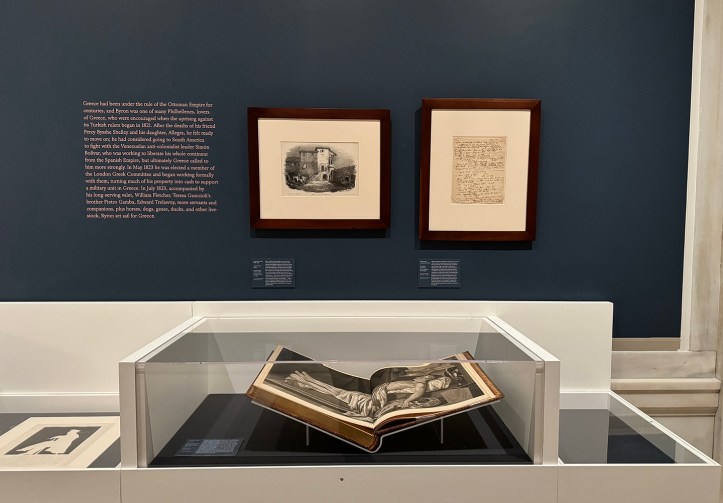
Perhaps the most poignant part of the exhibition is its conclusion, which looks at Byron’s final turn away from poetry and toward military action. The artifacts from this period, particularly Byron’s letters and documents relating to his preparations for the Greek campaign, reveal a man seeking redemption and purpose beyond the written word. His death in 1824, at the age of 36, marked the end of a short but dazzling life, and the exhibition’s final room reflects on his posthumous fame. Byron’s remains, which were paraded through London before being interred in the family vault in Nottinghamshire, shook the public one last time, and the exhibition captures this moment of national mourning and fascination. In its final section, Byron: A Life in Motion turns its gaze to the poet’s enduring legacy. Byron’s influence on literature, politics, and even pop culture is addressed through a selection of modern responses to his work, reminding visitors that Byron remains a figure of fascination long after his death. His life, lived in constant motion both physically and emotionally, continues to inspire, provoke, and challenge readers and artists alike.

In sum, the exhibition Byron: A Life in Motion is a masterful tribute to one of the most iconic and enigmatic figures of the Romantic era. It captures the many contradictions that defined Byron’s life—his hedonism and his heroism, his literary genius and his personal failings—and presents them in a way that allows visitors to appreciate both the man and the myth. For anyone interested in the intersections of art, politics, and personal identity, this exhibition is not to be missed.
The exhibition is organized by The New York Public Library and curated by Elizabeth Denlinger, Curator of the Carl H. Pforzheimer Collection of Shelley and His Circle.
Byron: A Life in Motion
New York Public Library
September 7, 2024– January 12, 2025.
Discover more from Art Sôlido
Subscribe to get the latest posts sent to your email.
 Art Sôlido
Brilliant work and so nice coverage
LikeLike