

 I walk into The Metropolitan Museum of Art, and there’s Caspar David Friedrich, waiting for me with his fog-draped cliffs and moonlit reveries, his silhouettes standing like thoughts against the sky. I should have stopped for a coffee, but no, I’m pulled straight in, because Friedrich does that—he’s a tide, a hush, a voice inside your chest that tells you to be quiet and look.
And then there are the people—standing, shuffling, pausing before each canvas as if waiting for something to be revealed. The room breathes with them, their silhouettes becoming part of Friedrich’s landscapes, their murmured observations dissolving into the hush of snow-laden branches and moonlit waters. The curators have left space, enough space to feel alone with each piece, but not so much that you forget you are part of a quiet congregation, gathered in reverence. The lighting is soft, deliberate—shadows pooling in the corners, light catching on the ridges of oil paint like the last glow of dusk before night swallows it whole. In a way, the gallery itself becomes a Friedrich painting, a moment of contemplation framed by walls, by movement, by time slowing just enough to be felt.
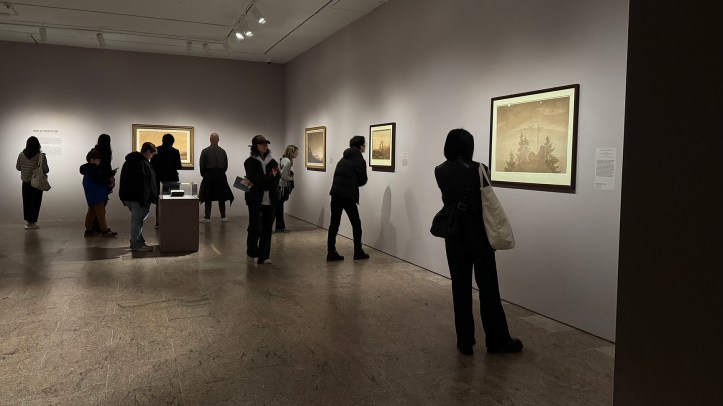
It’s called “The Soul of Nature,” but really, it’s the soul of Friedrich, or maybe our own, refracted back at us through a sky smeared with god-light. The first gallery feels like an overture, soft notes of ink and wash, sketches that whisper before the symphony swells. Here’s Friedrich as a young artist in Dresden, tracing the edges of his own sensibility—lines that waver but don’t hesitate. There’s a longing already, a reaching. He’s learning how the land breathes, how a horizon can be more than a line—it can be an invitation, a dare.
Then we move into the 1800s, and Friedrich begins to play his chords in full force. “Monk by the Sea” hangs in its own silence, vast and weightless, a prayer swallowed by the wind. The monk is just a smudge, really, a punctuation mark between the fathomless blue above and the earth below, but you feel his presence like you feel your own breath when everything is still. Friedrich called it “the unknowable hereafter,” and maybe that’s what this whole show is about—what’s out there, just beyond reach, just beyond words. It’s a landscape and it’s a question, and maybe it’s an answer too, but Friedrich won’t say. He only paints the feeling of it.
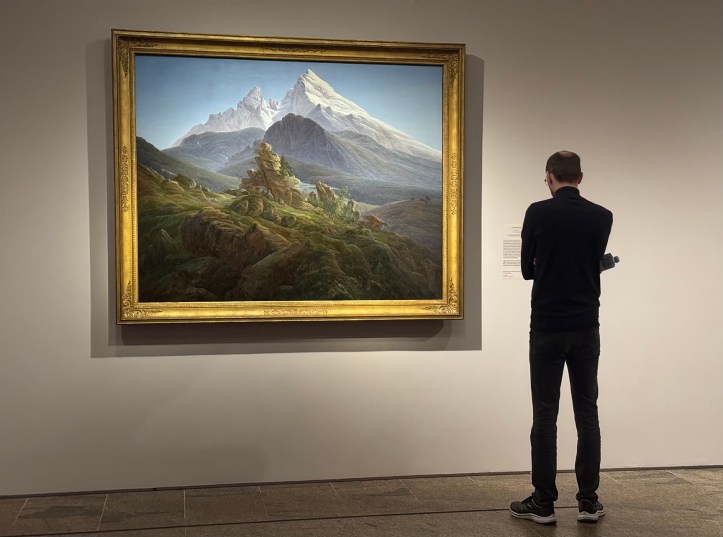
Romanticism, they tell us, was about nature, about emotion, about the sublime—but in Friedrich’s hands, it’s also about solitude, that specific human ache of standing small before something infinite. And yet, he’s not alone. Look at “Two Men Contemplating the Moon.” Side by side, wrapped in cloaks, they’re staring into that silver glow, lost in the pull of it. You can almost hear them breathe, hear the quiet between their words. Friedrich’s companionship isn’t the loud kind; it’s the kind that lets you be alone together, which is maybe the most intimate thing of all.
He paints time like it’s something you can touch. “The Stages of Life”—a shoreline, ships at sea, a family scattered across the sand, childhood to old age in a single sweep of canvas. You see it, and something inside you stirs—nostalgia for something you haven’t lost yet, an ache for the inevitability of departure. Friedrich knew how time moves, how it circles back in the rhythm of waves, how it slips through your hands no matter how tightly you hold.
And then there’s winter, that hush of white, of trees frozen in their reaching. “Dolmen in Autumn” speaks in the language of seasons, of endings. And “Wanderer above the Sea of Fog”—you’ve seen it a hundred times, on postcards, in textbooks, but here, in this moment, it’s new again. He stands there, the wanderer, looking out, and you stand behind him, looking too. You’re both caught in the vastness, both leaning into the unknown.

By the final galleries, Friedrich is older, quieter. His work has fallen out of favor, his strokes have grown unsteady, but the vision—the vision is still burning. There are graveyards now, tombs, empty shores. He’s thinking about death, and so are we. But there’s no fear in it, only the soft murmur of something beyond the frame.
I step back into the city, and it’s different now. The light slants in a way I hadn’t noticed before, the clouds drift slower. Friedrich has a way of following you out. You think you’ve left him in the museum, but no—he’s out here too, in the spaces between buildings, in the hush before the crosswalk light changes. And isn’t that the whole point? That nature, that time, that endless horizon—it’s not just in the paintings. It’s in us, in the way we look, in the way we feel the weight of sky on our skin.

Caspar David Friedrich: The Soul of Nature. Go see it. Go stand inside it. And when you walk out, don’t be surprised if the world looks a little different, a little wider, like the trees of Central Park stretching their bare arms into the winter air, the lake holding the sky in its rippling hands, the paths winding like brushstrokes through golden leaves. You’ll look up at the buildings beyond the park’s edge, softened by mist, and wonder if Friedrich might have painted them too, had he stood here, watching the city dissolve into the horizon.
Caspar David Friedrich: The Soul of Nature is co-curated by Alison Hokanson (Curator, Department of European Paintings, The Met) and Joanna Sheers Seidenstein (Assistant Curator, Department of Drawings and Prints, The Met).
Discover more from Art Sôlido
Subscribe to get the latest posts sent to your email.
 Art Sôlido
He had TB as did several other family members, died at 61, out of fashion. A brother died in a drowning accident when they were children. In his painting he found peace, I think.
LikeLike