

 Today marks the opening of ¡WEPA! Puerto Ricans in the World of Comics at The New York Public Library, now officially inaugurated and open to the public.
After more than twenty-five years of dedicated work, in 2022 Manuel Martínez Nazario donated his remarkable archive to The New York Public Library, where it now serves as an invaluable resource for researchers, students, and the general public. What began as a personal project has grown into one of the largest collections of its kind, documenting Puerto Rican presence in the comics industry across both Puerto Rico and the United States.
Now, that legacy takes shape in a vibrant exhibition that celebrates imagination, identity, and resilience through the lens of Puerto Rican creators. ¡WEPA! Puerto Ricans in the World of Comics, drawn from the Manuel Martínez Nazario Collection, brings together legends of the comics industry alongside independent and emerging artists. Their works narrate stories of displacement and belonging, of creativity and cultural pride—an act of resistance against erasure and, at the same time, a joyful celebration of Puerto Rican life.
With this context in mind, Art-Sólido spoke with Manuel Martínez Nazario about the origins of his collection, the cultural power of comics, and the future of Puerto Rican creators within a global landscape.

Art-Sólido Interview
Manuel Martínez Nazario
WEPA! Puerto Ricans in the World of Comics — The New York Public Library
1. Identity and Belonging
You were born in Brooklyn and raised in Puerto Rico; do you consider yourself more New Yorkrican or more Boricua?
It is difficult to answer this question because both societies were decisive in my development as a person. My parents met in New York City; they were part of that migratory group of the fifties that came to work in the factories, and it was in that city that they met. The City of New York allowed the Martínez Nazario family to be formed. Then, Puerto Rico raised me, provided my education, and ensured my health. It was in Puerto Rico where I raised my family. I have always been clear about my origin, and that is why I also include my Spanish ancestors in this identity equation—specifically those from the Canary Islands and Asturias, Spain.
2. First Encounters
What is your earliest memory of comics, and what drew you into that universe?
I started reading comics in the late seventies. Although I don’t remember which was the very first comic I read, I do remember my favorites: El Conejo de la Suerte (Bugs Bunny); Archie; Tom & Jerry; La Pequeña Lulú (Little Lulu); Gasparín (Casper); Periquita (Nancy); Súper Ratón (Mighty Mouse); La Zorra y el Cuervo (Fox & Crow); El Pájaro Loco (Woody Woodpecker); and La Pantera Rosa (Pink Panther), all published by Editorial Novaro in Mexico. I reread them with great enthusiasm and happiness.

3. Becoming a Collector
When did you begin collecting comics in a conscious and organized way?
I began collecting comics in a conscious and organized way in 1990, the year I started working full-time at the University of Puerto Rico. I didn’t limit myself to U.S. comics; I also collected comics from Mexico, Argentina, and Spain.
4. The Scope of the Collection
How extensive is your collection today? Could you describe its size in terms of numbers, rare pieces, or highlights?
The collection consists of approximately 1,600 comics and about fifty original artworks. Many of the comics are first editions, and many others are signed by their creators, such as George Pérez, Kenneth Rocafort, Dave Álvarez, Rangy García, Martín Gaudier, Ricardo Álvarez, José Cruz, Jonathan Collazo, and Eliana Falcón, among others. Among the most important pieces are several works by Ismael Rodríguez Báez, the father of Puerto Rican comics, who began publishing in 1953. The collection also includes the most extensive series made in Puerto Rico, Tato & Kenepo, which consists of 50 issues.
5. The Decision to Donate
Why did you choose the New York Public Library as the home for your important donation?
I selected the New York Public Library as the new home for this collection because it can provide the physical facilities, trained staff to manage a special collection, security, preservation, and the promotion of this resource for researchers.

6. The Coquí as a Superhero
When we see the Coquí portrayed as Superman, are we witnessing a form of cultural appropriation or a creative act of syncretism?
Beyond seeing it as a creative act of syncretism, I also see it as a way of giving importance to natural resources, particularly wildlife. The coquí, an endemic species of Puerto Rico, is portrayed as a figure who protects our environment. I also see it as a tribute to such an important character in American popular culture, Superman.
7. Two Perspectives
Do Puerto Ricans on the island and in New York interpret Puerto Rican representation in comics in the same way, or do you notice tensions and differences?
The representation of Puerto Ricans in comics is very diverse and has changed through the decades, both in New York City and in Puerto Rico. I have noticed that for a Puerto Rican comic to succeed in New York City, it must often include elements of identity such as El Morro, the maga flower (Thespesia grandiflora), Old San Juan, the Puerto Rican flag, native food, salsa lyrics, and everyday expressions like wepa, acho, ay bendito, mano, etc. However, there are also many comics produced in Puerto Rico that do not include these elements and are still 100% Puerto Rican, such as Dokyo (by Jonathan Collazo), Cosmic Fish (by Eliana Falcón), NonPack (by Rangy García), and Crimson Maiden (by Javier Cruz).
8. Cultural Impact
What impact have comics had on Puerto Rican culture and its diaspora?
The most significant impact is that they have served as a mechanism of unity and a way of expressing, in some cases, the issues that affect us on the Island. For example, Hurricane Maria was devastating in every sense of the word: more than 4,300 people died, the government was extremely incompetent, and aid for the most vulnerable never arrived. Another interesting fact is that the number of Puerto Ricans living in the diaspora is now greater than the number residing on the island.

¡WEPA! Puerto Ricans in the World of Comics, New York Public Library. Photos by Art-Sôlido
9. Island vs. City
What differences or defining characteristics do you see between comics created in New York and those produced in Puerto Rico? Are there different trends or interests? Would you say one tends to be more political than the other?
One distinguishing feature is the editorial process. Many of the comics produced in Puerto Rico, though not all, are handmade or short-run editions, while those created in the United States often benefit from a higher editorial level. There are, of course, exceptions. As for political criticism, I perceive it to be present in both contexts.
10. Festivals and Gatherings
What role has the Puerto Rico Comic Con played in giving visibility to local artists and readers?
There are fewer and fewer local comic creators participating in Puerto Rico Comic Con. The reasons are diverse, but the two most common are the high cost of participation and the lack of strong support from visitors. Although this type of event is supposed to give visibility to creators, these factors carry considerable weight.
11. Censorship and Resistance
How did comics or caricature function during the period of the Gag Law (Ley Mordaza) in Puerto Rico?
During the period of the Gag Law in Puerto Rico, the production of comics was almost non-existent, and the only person publishing comics at the time was Ismael Rodríguez Báez. In fact, the comics he published were educational and informative. It should also be noted that sequential art critical of politics was limited to newspaper editorial cartoons, created under the protection of press freedom.

12. Golden Eras
From your perspective, what would you consider the most significant period in Puerto Rican comics, and why?
The most significant period was between the fifties and seventies, because it marked the formal beginning of comic book production in Puerto Rico, with Ismael Rodríguez Báez as its sole exponent.
13. Boricua Icons
In your opinion, who is the most popular character in Puerto Rican comics?
Selecting a single popular character would undoubtedly produce a heated debate. I prefer to mention several very popular figures over the years, such as Turey El Taíno (by Ricardo Álvarez), Tato & Kenepo (by Martín Gaudier), Yenny (by Dave Álvarez), and Pepito (by Harold Jessurun and Aníbal Quiñones).
14. Key Creators
Which artists do you consider the most influential or admired in Puerto Rican comics, both on the island and in the diaspora?
Undoubtedly, the most influential Puerto Rican artists today include Rubén Moreira, George Pérez, Rangy García, Kenneth Rocafort, and Dave Álvarez.

15. The Collection as a Political Act
You have said that these comics represent an act of resistance against forgetting. In what ways is your collection also a cultural and political statement?
The collection is also a cultural and political statement because it refuses to fall into oblivion and serves, in some cases, to document the cultural, economic, and political history of Puerto Ricans. It is also a way of telling the world that we have lived under—and survived—the colonial regimes of Spain and the United States for more than five hundred years.
16. The Future of Puerto Rican Comics
Looking ahead, what do you see in the new generation of artists? Where do you think Puerto Rican comics are headed in a global context?
I see in the next generation of artists a bright and promising future. There are many talented Puerto Ricans with a strong desire to learn and grow—two essential elements in art. On a global level, I believe they have the ability to integrate into other artistic fields and markets, such as those in Mexico, France, Spain, and Italy.
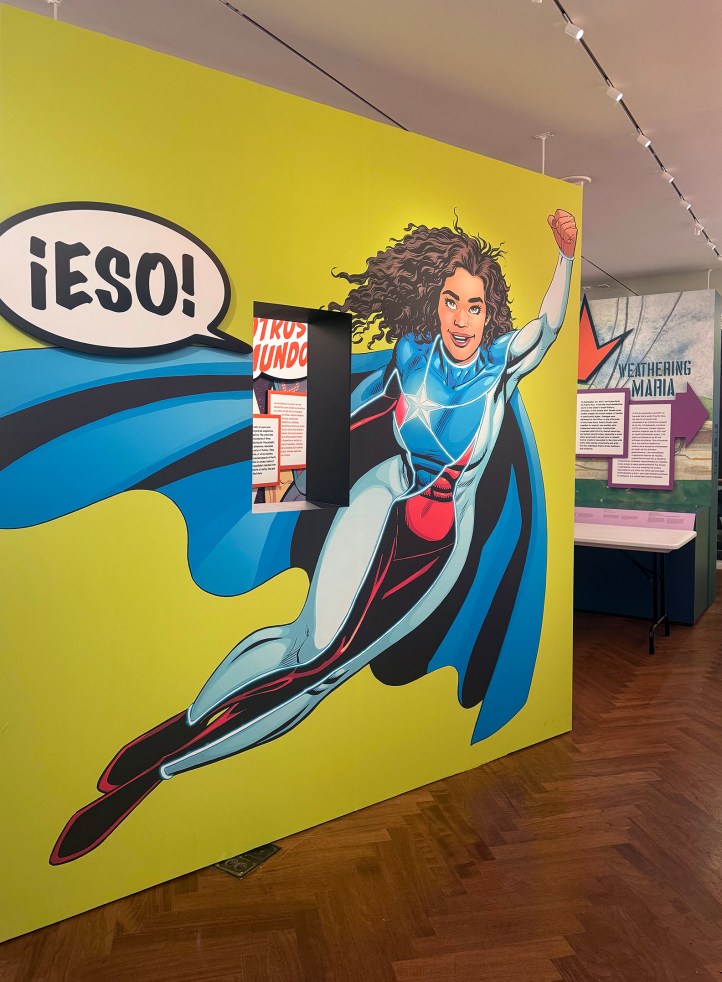
The conversation with Manuel Martínez Nazario makes clear that comics are more than entertainment—they are archives of memory, imagination, and cultural survival. The only limits to comic book storytelling are the imaginations of the creators. The comics in this exhibition push the boundaries of those limits, venturing into far-flung planets, fantastic dimensions, impossible realities, and sci-fi futures. These other worlds—otros mundos—often weave in elements of Puerto Rican culture and convey a powerful sense of puertorriqueñidad. Freed from the constraints of reality, they open space for hope and possibility.
This exhibition is organized by The New York Public Library and curated by Paloma Celis Carbajal, Curator for Latin American, Iberian, and U.S. Latino Collections, and Charles Cuykendall Carter, Assistant Curator in the Carl H. Pforzheimer Collection of Shelley and His Circle.
Beyond its historical and cultural significance, ¡WEPA! Puerto Ricans in the World of Comics stands out for its exceptional exhibition design and curatorial vision. From the layout and installation to the graphic presentation, every detail invites visitors to step into a magical world—one that feels both intimate and expansive, rooted in memory yet alive with imagination. The thoughtful design reveals the care, respect, and scholarly precision with which this collection has been handled, affirming that it is, indeed, in the best possible hands.
The work of Paloma, Charles, and the entire curatorial team succeeds in giving each piece its rightful importance, creating a space where visitors can fully experience the richness and diversity of Puerto Rican creativity. As a fully bilingual exhibition, it bridges cultures and audiences, marking what will surely be a defining moment in the presentation of Puerto Rican art and identity at The New York Public Library.
¡WEPA! Puerto Ricans in the World of Comics will be on view at The New York Public Library from October 4, 2025 through March 8, 2026. For more information, please visit NYPL
Discover more from Art Sôlido
Subscribe to get the latest posts sent to your email.
 Art Sôlido