
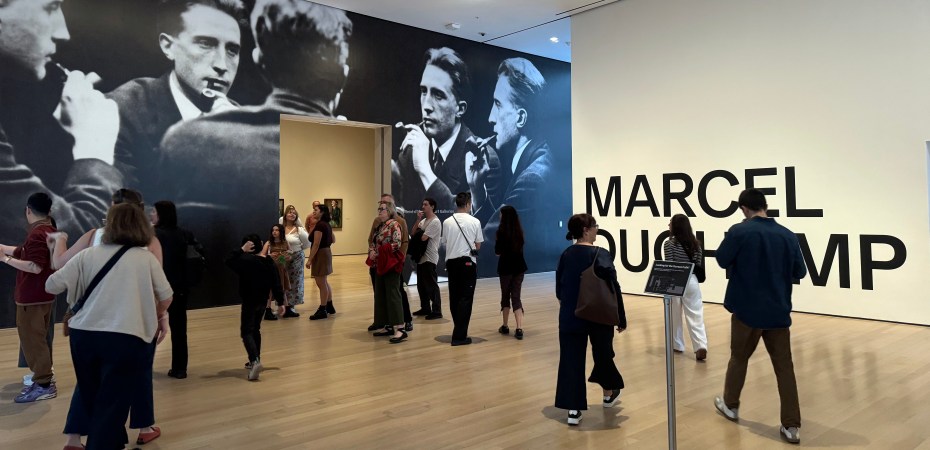
 There are artists we admire, artists we study, artists we imitate, reject, or quietly steal from. And then there is Marcel Duchamp, an artist with whom almost every contemporary artist, critic, curator, and museum visitor maintains some kind of unresolved relationship: a debt, a war, a love story, or perhaps simply an accusation that has never fully disappeared.
Walking up the escalators to the sixth floor of the Museum of Modern Art, toward the monumental retrospective Marcel Duchamp, I felt strangely nervous, almost as if I were about to encounter an old friend I had betrayed, or perhaps an enemy who had changed my life forever. I kept repeating to myself that there was no reason for such excitement. I had already encountered much of this work in other exhibitions, books, documentaries, classrooms, art history lectures, and theoretical essays. I had studied Marcel Duchamp for years. Every contemporary artist has, willingly or not. Yet ascending toward the exhibition felt less like entering a museum show and more like approaching the source of a historical fracture that still has not healed.
Because the truth is simple: contemporary art, as we know it, cannot exist without Duchamp.
Even the exhibition text at MoMA admits this directly, beginning with the eternal question: “Why is this art?” And every road leading to that question eventually arrives at Duchamp’s doorstep. The exhibition wisely frames him not merely as a provocateur, but as the artist who permanently altered the definition of art itself.
The retrospective, the first major Duchamp survey in the United States since 1973, gathers nearly 300 works spanning six decades. It is less a chronological exhibition than an archaeological excavation of modern consciousness. What emerges is not a linear artist career, but a continuous dismantling of certainty.
And perhaps that is why Duchamp still unsettles audiences more than a century later.
Unlike Pablo Picasso, whose genius can still be consumed visually beautifully, Duchamp attacks the very mechanism through which art produces meaning. Picasso expanded painting. Duchamp questioned whether painting was necessary at all.
The review in The New York Times correctly frames the historical rivalry between the two artists as the great contest of modern art. Yet the article ultimately gives the victory to Duchamp, not because he produced more beautiful objects, but because he changed the rules of the game itself.
And walking through the exhibition, you feel this immediately.
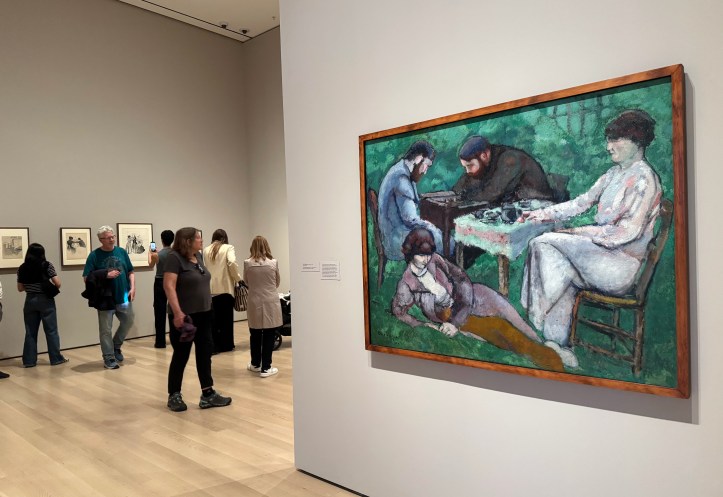
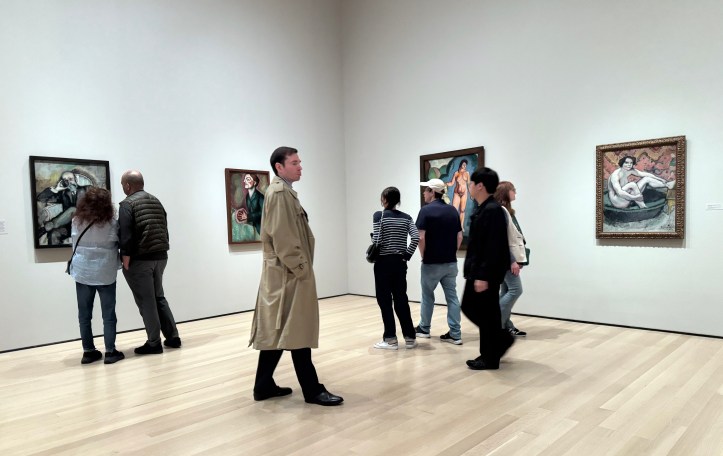
The early rooms are almost deceptive. Watercolors of children. Portraits of his sisters. Impressionistic landscapes. Paintings that seem to promise a relatively traditional artistic future. But then the instability begins. Satire enters. Irony enters. Sexual anxiety enters. The paintings start behaving strangely, as if the artist himself were already becoming suspicious of painting.
And then comes the explosion.
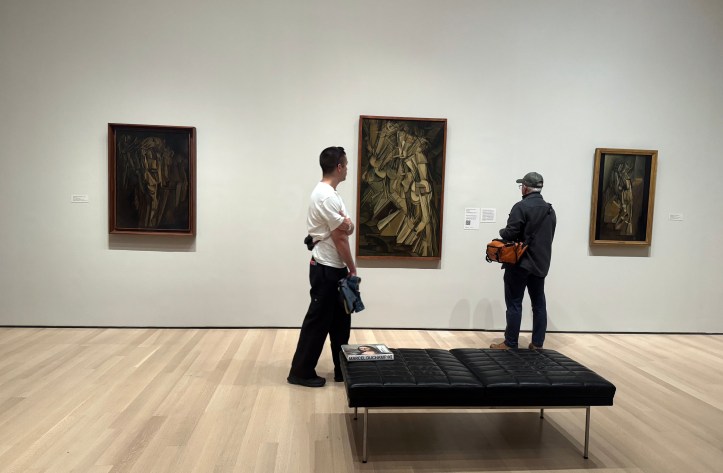
Nude Descending a Staircase (No. 2) still possesses extraordinary power more than a century after scandalizing the 1913 Armory Show. MoMA’s installation allows the painting breathing space, and standing before it one realizes that its true radicalism was never simply formal experimentation. The fractured body descending the stairs is not merely moving physically, it is dissolving historically. The old world of painting is collapsing inside the image itself.
The exhibition and accompanying scholarship emphasize Duchamp’s fascination with motion photography and scientific modernity. But what struck me most was something else: the emotional coldness of the work. Duchamp removes sentiment from art with surgical precision. He replaces emotional expression with intellectual tension. Looking at the painting feels almost clinical, yet strangely thrilling.
And that sensation would define the next century of art.
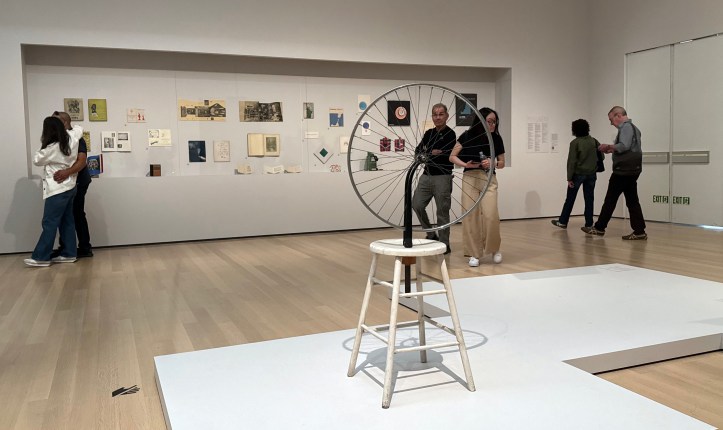
There is an uncomfortable moment many artists eventually experience with Duchamp. Admiration slowly mutates into resentment. Because once he introduced the readymade, once a urinal became Fountain, every future artist inherited both total freedom and total uncertainty.
After Duchamp, anything could become art.
Which also meant that art could become almost nothing at all.
That is the paradox haunting the exhibition.
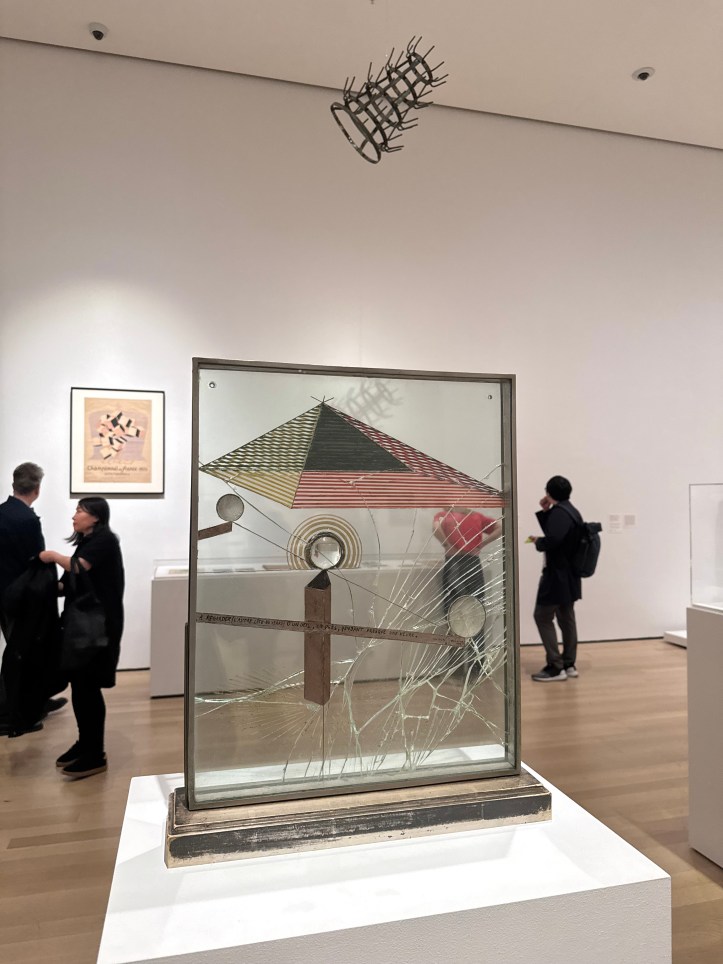
At times, moving through the galleries, I found myself oscillating between fascination and irritation. Some works still feel electrifying. Others feel like conceptual traps from which contemporary art has never fully escaped. Duchamp liberated artists from technique, beauty, and tradition, but he also opened the door to endless cynicism, institutional gamesmanship, and intellectual performance disguised as depth.
And yet blaming Duchamp for contemporary art’s failures feels too easy. Like blaming Nietzsche for bad philosophers.
Because what the exhibition reveals, perhaps unexpectedly, is that Duchamp was never merely mocking art. He was trying to rescue it from becoming decoration.
That becomes especially visible in the sections dedicated to the readymades and the Boîte-en-Valise works. The tiny portable museums, miniature reproductions of his own oeuvre, are among the most haunting objects in the exhibition. They feel simultaneously narcissistic and deeply vulnerable, as though Duchamp understood that modern art was entering an age of reproduction, portability, commodification, and endless circulation long before anyone else.
Walter Benjamin theorized mechanical reproduction. Duchamp practically staged it.
The exhibition also wisely emphasizes Duchamp’s theatricality, his invention of alter egos, especially Rrose Sélavy, his flirtation with gender performance, irony, and self-erasure. Long before identity became central to contemporary discourse, Duchamp understood identity itself as performance.
And perhaps that is why he still feels contemporary while so many of his peers remain trapped safely inside history.
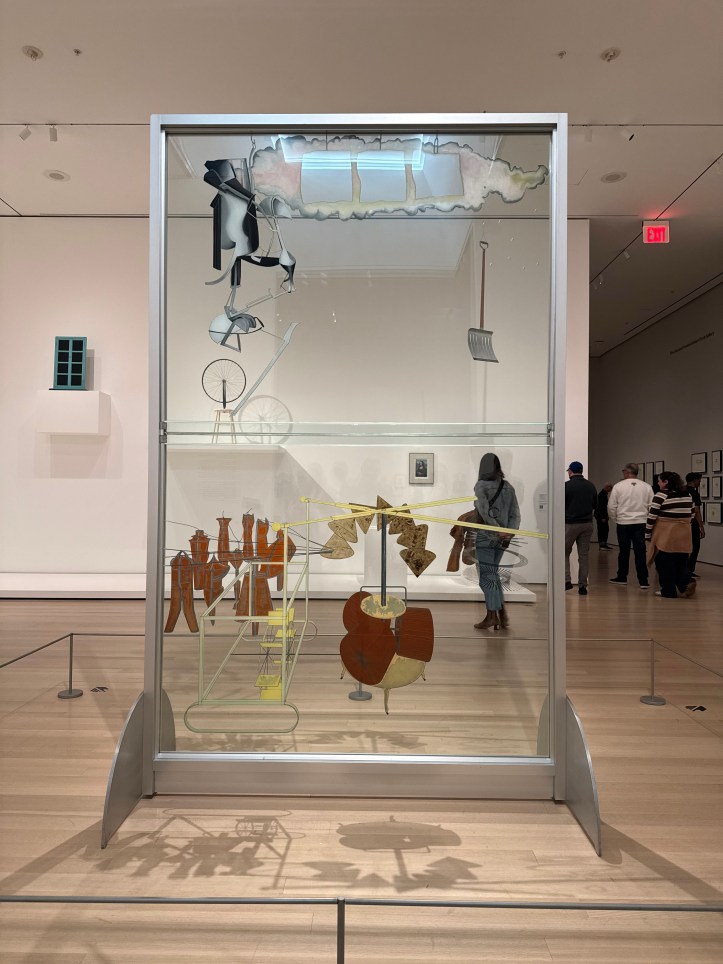
One of the great absences in the show is The Bride Stripped Bare by Her Bachelors, Even, permanently housed at the Philadelphia Museum of Art. Its absence becomes strangely present throughout the exhibition, like a ghost haunting every room. But Duchamp himself likely would have appreciated the irony. He spent his career dismantling the cult of originality. Copies, replicas, miniatures, substitutions, all were acceptable to him.
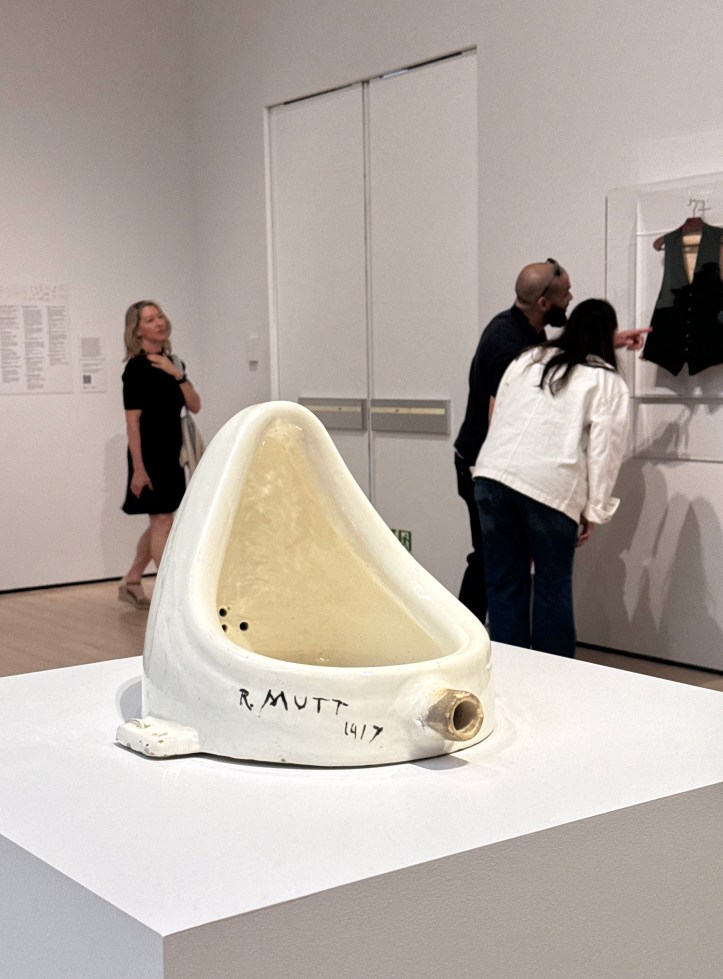
The “original” was never sacred.
Perhaps the most chilling section of the exhibition arrives near the end, with documentation surrounding Étant donnés. Even through photographs and archival material, the work radiates unease. A naked woman sprawled behind a door, visible only through peepholes. Desire transformed into surveillance. Eroticism transformed into evidence.
It feels less like modern art than like the subconscious of the twentieth century itself.
And by then, one realizes something unsettling: Duchamp never really stopped making art. He simply went underground, exactly as he predicted future artists would.
What makes this retrospective extraordinary is not merely its scholarship or historical scale, but its ability to restore Duchamp’s strangeness. Too often he has been reduced to a textbook icon, a convenient intellectual mascot for contemporary art. But this exhibition reminds us how dangerous he once was, and perhaps still is.
Because Duchamp did not simply ask, What is art?
He asked something far more destabilizing:
What happens when belief in art itself begins to collapse?
Leaving the exhibition, descending again through MoMA’s escalators into the noise of Manhattan, I no longer felt as though I had encountered an enemy. Nor exactly a friend.
More like someone responsible for a wound modern art still carries proudly, and painfully.
We all owe something to Duchamp.
Some of us just never forgave him for it.
For more information, visit the website of the MoMA.
Marcel Duchamp is organized by the Museum of Modern Art and the Philadelphia Museum of Art, with the generous collaboration of the Centre Pompidou.
The exhibition is organized by Ann Temkin, The Marie-Josée and Henry Kravis Chief Curator of Painting and Sculpture, MoMA; Michelle Kuo, Chief Curator at Large and Publisher, MoMA; and Matthew Affron, The Muriel and Philip Berman Curator of Modern Art, Philadelphia Museum of Art; with Alexandra “Lo” Drexelius, Curatorial Assistant, Department of Painting and Sculpture, MoMA; Helena Klevorn, Curatorial Assistant, Department of the Chief Curator at Large, MoMA; Danielle Cooke, Exhibition Assistant, Philadelphia Museum of Art; and Julia Vázquez, Andrew W. Mellon Postdoctoral Fellow, Philadelphia Museum of Art.
Discover more from Art Sôlido
Subscribe to get the latest posts sent to your email.

