
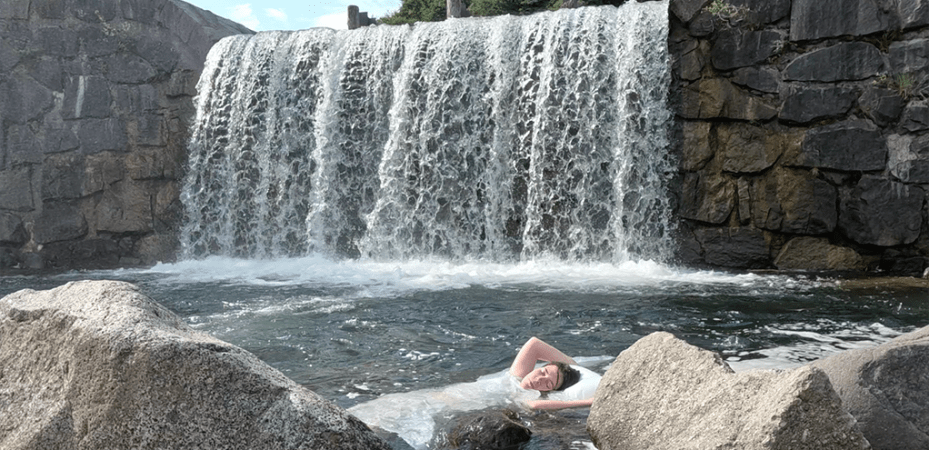
 There is something profoundly unsettling about a body doing nothing. Paola Fiterre, an artist who arrives at a residency presumably to create, decides instead to sleep. In Siesta, developed during her 2026 residency at Bienno Borgo degli Artisti 2.0 in Italy, Fiterre places her sleeping body in different public spaces throughout the medieval town: on a cobblestone street, beneath a white sheet with her head resting on a pillow, or in the river, where the current strikes and slowly shifts her body. Behind this seemingly minimal gesture lies a remarkably complex work.
Born in Havana in 1992 and based in New York since 2017, Fiterre has developed a practice in which the female body, migration, memory, labor, and belonging are continually confronted by forces beyond our complete control. Educated at the Instituto Superior de Arte in Havana and later at the International Center of Photography in New York, she works across photography, performance, video, installation, and sculpture. The body in her work, however, is not simply something to be represented; it becomes a material through which these questions are tested. In Siesta, that body stops producing, and in doing so transforms sleep itself into work.
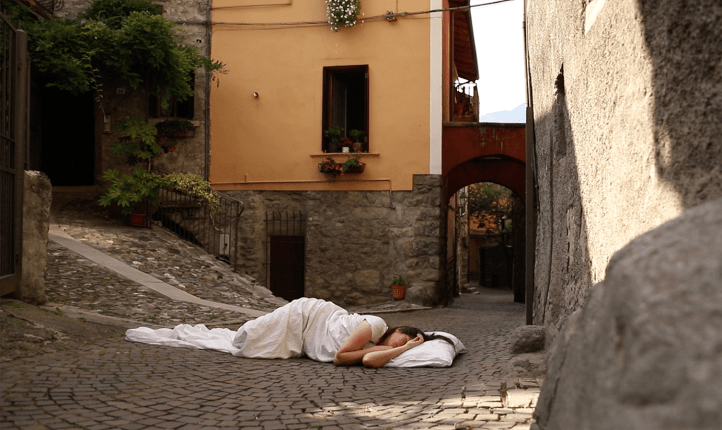
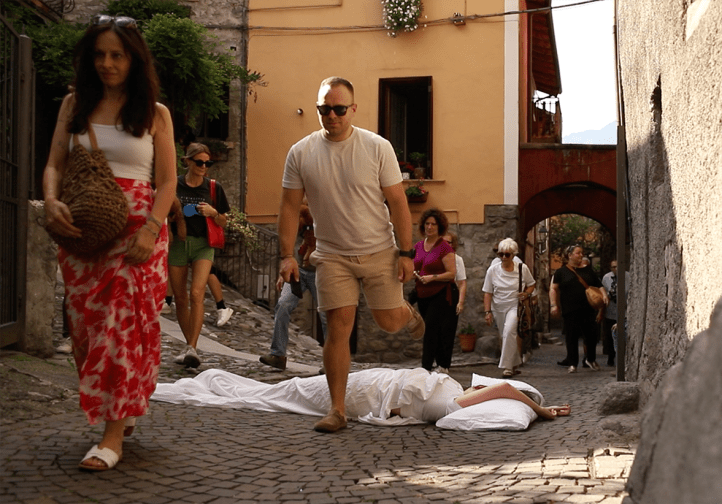
The image is absurd and, at the same time, strangely familiar: a woman sleeps peacefully in the middle of a medieval street while life continues around her. Here one of the most interesting dimensions of Siesta emerges, because the work ceases to belong exclusively to the artist. Every person who stops, looks, asks questions, or attempts to intervene exposes a social rule that normally remains invisible: there are places where a body is allowed to rest and places where it is not. A bed permits sleep, while a street demands movement and a river demands resistance. Once those expectations are disturbed, the resting body immediately becomes suspect.
Fiterre does not need to explain this structure; she simply lies down. She describes her experience in the river with equal simplicity: the body can truly rest only when it stops resisting the current and allows itself to be carried. At that moment, Siesta moves beyond a reflection on productivity and begins to address something larger: surrender as a form of adaptation. For an artist whose practice has been profoundly transformed by migration, the image inevitably carries another resonance. To migrate is also to enter a current whose direction we cannot entirely control: language, city, institutions, memory, distance, belonging. There are moments when survival does not mean defeating these forces, but learning how to move within them.
It is difficult to encounter Fiterre’s performance work without, at some point, sensing the presence of Ana Mendieta. Not simply because both artists were born in Cuba, or because the female body and the landscape occupy fundamental places in their practices. Mendieta became an essential reference for generations of artists who have used the body as a territory of displacement, memory, and belonging. Her Silueta Series (1973–80), for instance, repeatedly brought the outline of the female body into direct contact with earth, sand, vegetation, fire, and water. In Imagen de Yagul (1973), Mendieta placed her naked body inside a Zapotec tomb in Mexico and covered herself with flowers until the distinction between body and landscape seemed almost to disappear.
There is an echo of that relationship in Siesta, but Fiterre takes it elsewhere. She works from another time and through a distinctly photographic consciousness. Her training as a photographer transforms the documentation of the performance into something more than evidence that an action occurred. The images of Siesta have an autonomous visual strength: the white sheet stretched across the cobblestones, the horizontal body interrupting the perspective of a medieval street, pedestrians continuing on their way while others stop to look, and later that same white form caught between dark rocks and moving water. The photographic and cinematic documentation does not simply come after the performance; it becomes part of the work itself.
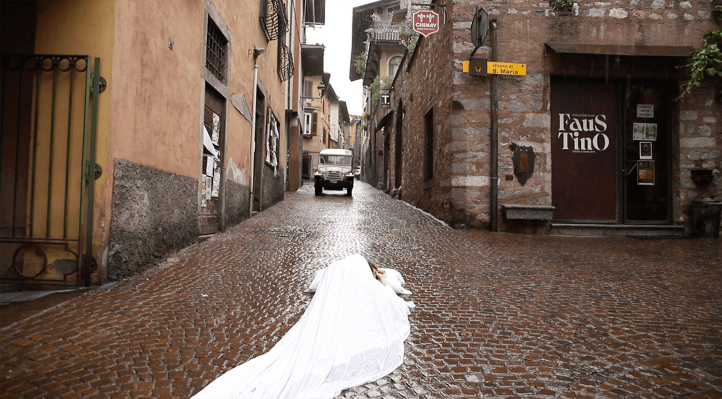
Perhaps this is also where Fiterre establishes a language distinctly her own. Mendieta often used the body, or the trace left by its absence, to establish an almost elemental relationship with the landscape. Fiterre seems interested in a different question: what happens when the body stops attempting to control its surroundings and accepts the conditions those surroundings impose upon it? In the river, the current cannot be defeated if the intention is truly to rest. The body must negotiate with it. What initially appears to be surrender therefore becomes another kind of agency.
We live within a culture that has managed to turn even rest into productivity. We sleep so we can perform better tomorrow, walk to count our steps, travel to produce images, and rest so that we can return to work. Siesta opens a small crack in that logic by proposing another relationship between body and environment: not to conquer the landscape, but to inhabit it. Fiterre does not manufacture an object or represent someone resting. She rests, and by doing so publicly transforms one of the body’s most private and vulnerable acts into a social question. Who has the right to stop? Where are we allowed to do so? When does an immobile body provoke solidarity, and when does it become invisible? How much of our identity depends upon constantly proving that we are useful?
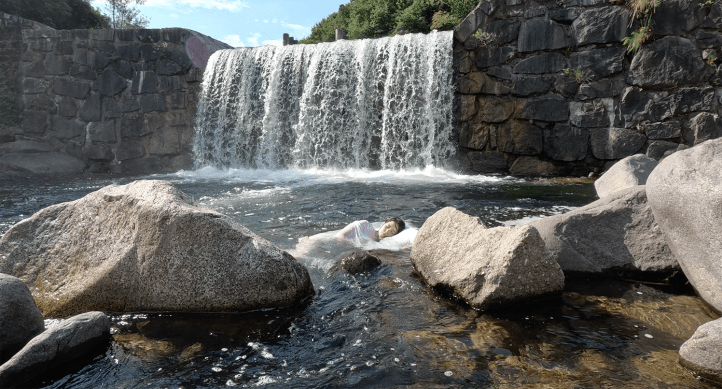
Perhaps this is why the images of Siesta remain with us: a woman sleeps while the town continues around her, and then sleeps again while the water continues to move around her. The world insists on movement, usefulness, resistance and speed, while Fiterre temporarily withdraws from those demands. In that apparently simple decision lies the strength of the work. Siesta reminds us that sometimes refusing to move at the speed imposed upon us, allowing the body simply to stop, can itself become an act of resistance.
Discover more from Art Sôlido
Subscribe to get the latest posts sent to your email.
 Art Sôlido