

 There are places where one expects to encounter art, and then there is the New York subway, where expectation itself is usually reduced to a simpler question: When is the train coming? At Times Square–42nd Street, amid fluorescent light, steel columns, directional arrows, hurried bodies, and the low mechanical anxiety of transit, Nick Cave has installed something almost unreasonable in its exuberance.
Each One, Every One, Equal All (2022), commissioned by MTA Arts & Design and fabricated in glass mosaic by Mayer of Munich, spreads through the Times Square station as a procession of Cave’s celebrated Soundsuits. More than four dozen figures inhabit the installation, their bodies transformed into extravagant accumulations of color, pattern, texture, and movement.

The setting matters enormously. In a museum, Cave’s figures would be objects of contemplation. Underground, they become fellow travelers.
Seen across the tracks, as in this photograph, the mosaic is repeatedly interrupted by the station’s architecture. Columns slice through bodies. Steel beams obscure faces. Signs compete for attention. You cannot possess the work in a single glance. You catch it in fragments, exactly as you catch other people in New York: briefly, incompletely, between departures.
This fragmentation is not a weakness. It may be the work’s greatest strength.

Cave developed his first Soundsuit in response to the 1991 police beating of Rodney King. The suits eventually became a means of concealing the identifying markers by which bodies are so quickly classified: race, gender, class. They can protect the individual while simultaneously making that individual spectacularly visible. The contradiction remains central to Cave’s work. To disappear inside a Soundsuit is also to become impossible to ignore.
At Times Square, that contradiction becomes public and architectural. Cave takes bodies that refuse easy classification and inserts them into one of the most intensely regulated systems in New York. The subway is a machine for organizing human beings. Uptown. Downtown. Local. Express. Enter. Exit. Stand clear of the closing doors. Yet within that machinery, Cave gives us figures that seem gloriously unwilling to behave.
They dance.
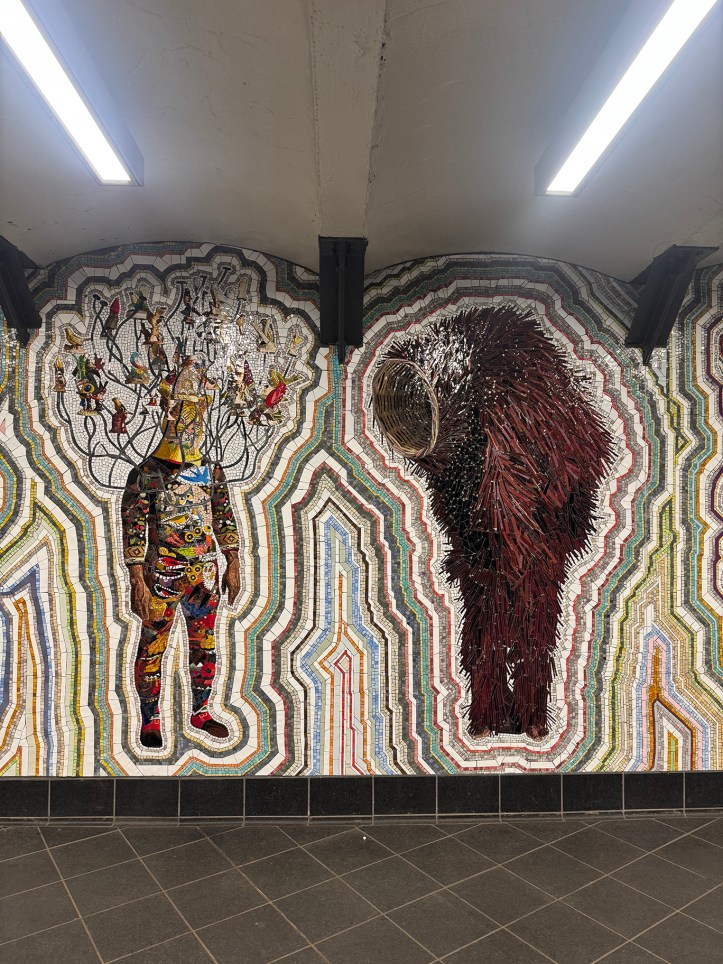
Or at least the mosaics convince us that they do. Glass becomes fabric; tesserae become feathers, hair, beads, embroidery, and fur. The hard wall pretends to be soft. Static figures appear caught mid-gesture. Cave has transferred the theatricality of the Soundsuit into a material designed to survive millions of passing bodies.
This is where Mayer of Munich’s fabrication becomes more than technical accomplishment. Mosaic is one of civilization’s ancient technologies of permanence. Cave uses it to preserve something fundamentally unstable: movement. The figures seem perpetually on the verge of changing position, as though the wall itself has joined the restless choreography of Times Square.
And then there is the title.

Each One, Every One, Equal All.
It risks sounding like a slogan. Cave saves it from becoming one because the work itself is stubbornly specific. Equality here does not mean sameness. Quite the opposite. No figure needs to resemble another in order to belong. Difference is not corrected; it is amplified.
That idea becomes particularly sharp in the subway. Few places in New York produce such accidental democracy. Underground, distinctions that appear enormous above ground are temporarily compressed. The banker, the tourist, the student, the dishwasher, the museum director, the exhausted nurse, the undocumented worker, and the billionaire may all wait on the same platform for the same delayed train. The subway does not eliminate inequality, of course. New York would never make things that easy. But it stages proximity.
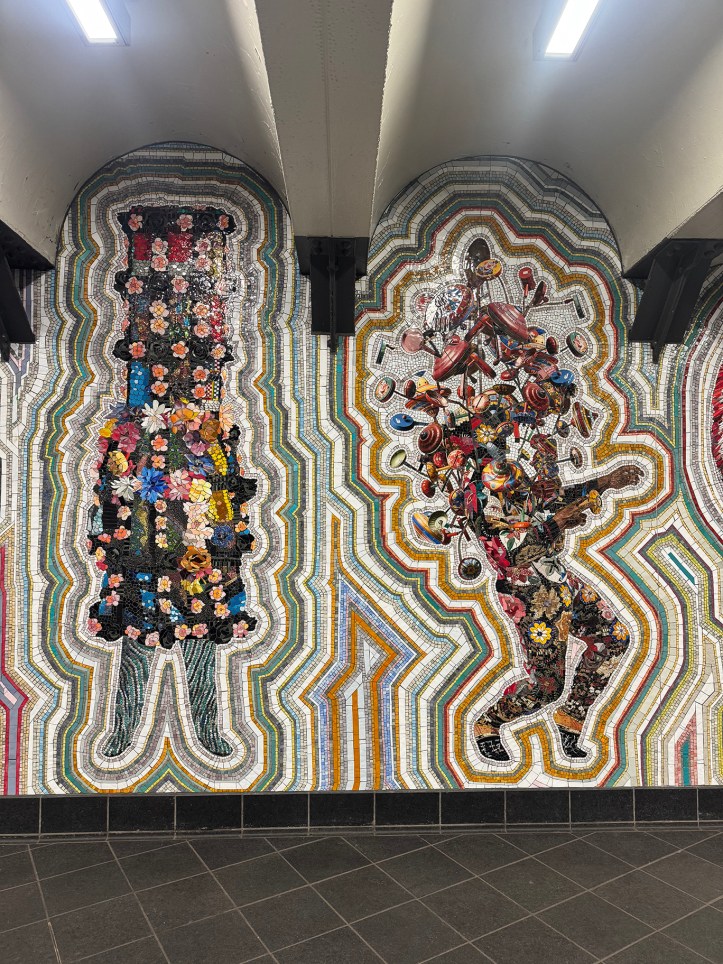
Cave turns that proximity into an image.
MTA Arts & Design describes the commission as connecting travelers to the street above and to one another, while bringing color and movement permanently into the Times Square experience. But the work accomplishes something more psychologically interesting. It asks us to reconsider the anonymous body.
Normally, the stranger in the subway is someone we train ourselves not to see. Cave reverses the arrangement. His anonymous figures demand attention precisely because we cannot identify them. They possess no readable face, race, age, profession, or social rank. Identity has been withheld, but individuality has exploded.
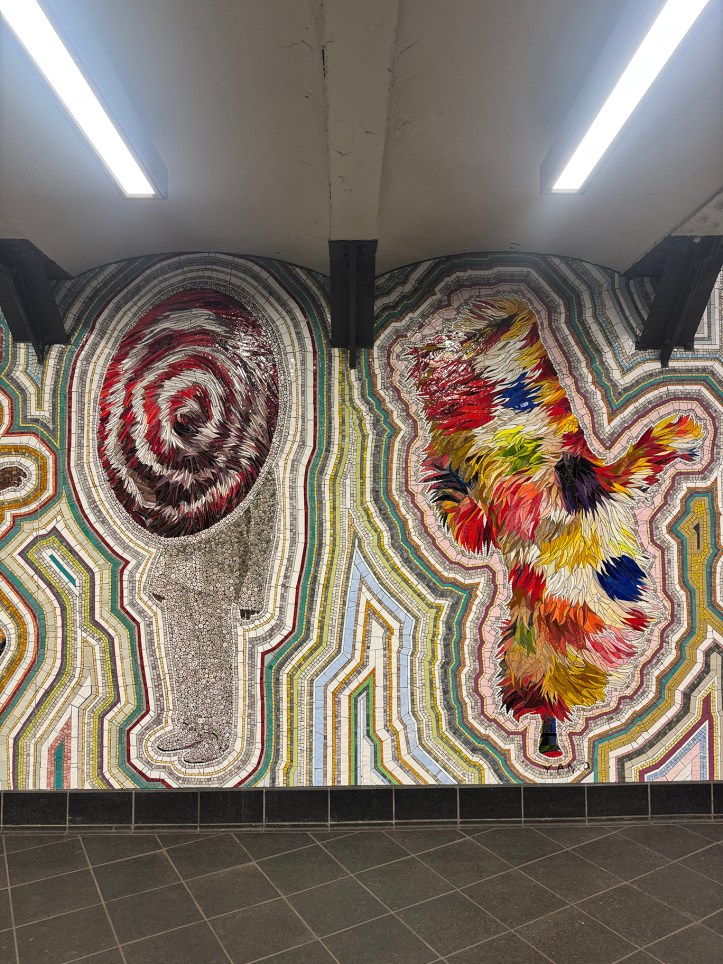
The result is joyful, but the joy is not innocent.
Behind all that color sits the knowledge of why the Soundsuits began: a Black body subjected to violence because it had already been socially identified and judged. Cave answers that history not with an image of victimhood but with excessive presence. Ornament becomes armor. Beauty becomes defense. Visibility becomes power.
And perhaps that is why Each One, Every One, Equal All feels so convincing underground. New York’s subway carries millions of individual lives while reducing them administratively to riders. Cave restores the extravagance of the person.

You may pass the work without knowing Nick Cave’s name. You may never know what a Soundsuit is. You may be late for work and notice only a flash of red behind a column.
That is enough.
For a second, the wall moves.
And so do you.
Discover more from Art Sôlido
Subscribe to get the latest posts sent to your email.

