
Faith, Authority, and What Remains
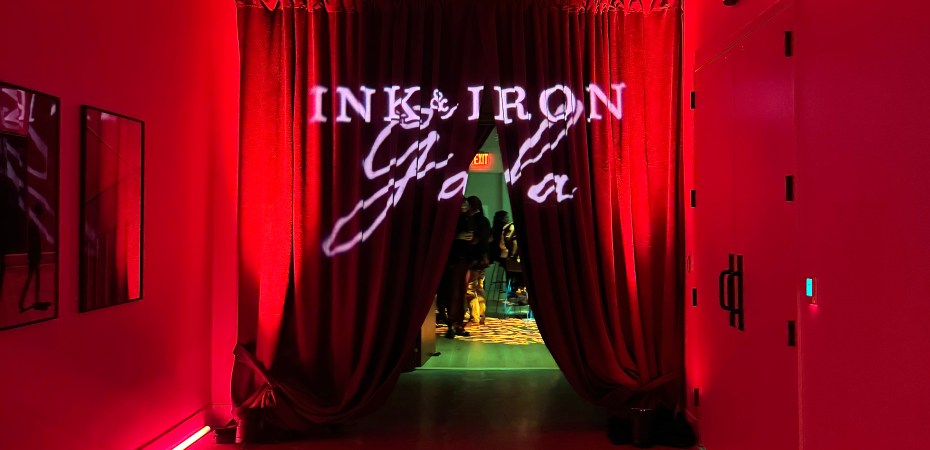
 At the center of the INK & IRON Gala at 555 Broadway, amid fashion, architecture, music, conversation, and the carefully orchestrated pleasures of a New York opening night, Caridad Sola placed a monument to uncertainty.
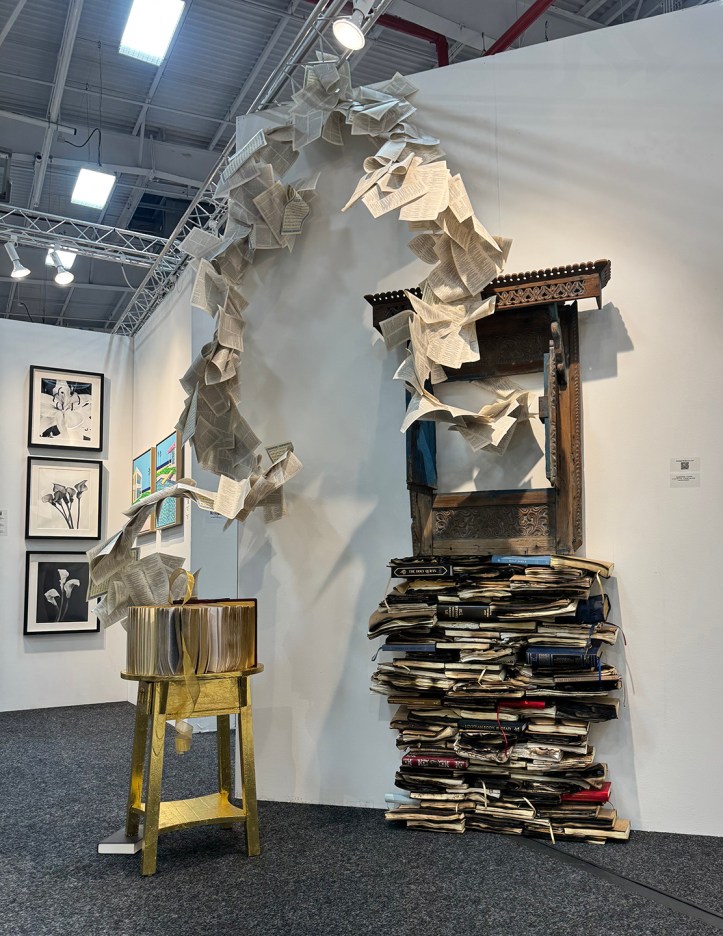
We had encountered In Gods We Trust before at Artexpo New York, where its physical construction could be examined under the neutral illumination of an art fair. A dense accumulation of sacred books rises beneath an elaborate wooden architectural fragment, while nearby a gold-leafed table supports another concentration of pages. Between them, hundreds of printed sheets break free from the stability of the book and travel through the architecture in a vast suspended arc. Or perhaps they are falling. That uncertainty is essential. Books, objects invented to contain and organize thought, seem suddenly unable to contain themselves.
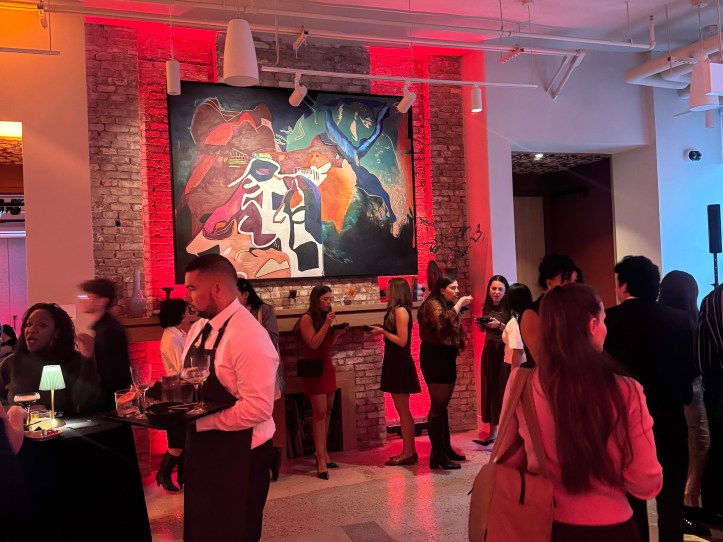
At the INK & IRON Gala, the same installation became something else. Under red and amber light, the books appeared scorched and the pages almost incandescent. Guests talked, drank, and moved through the rooms while this enormous current of language passed above them. What had seemed archaeological at Artexpo became theatrical, almost ritualistic, at 555 Broadway.
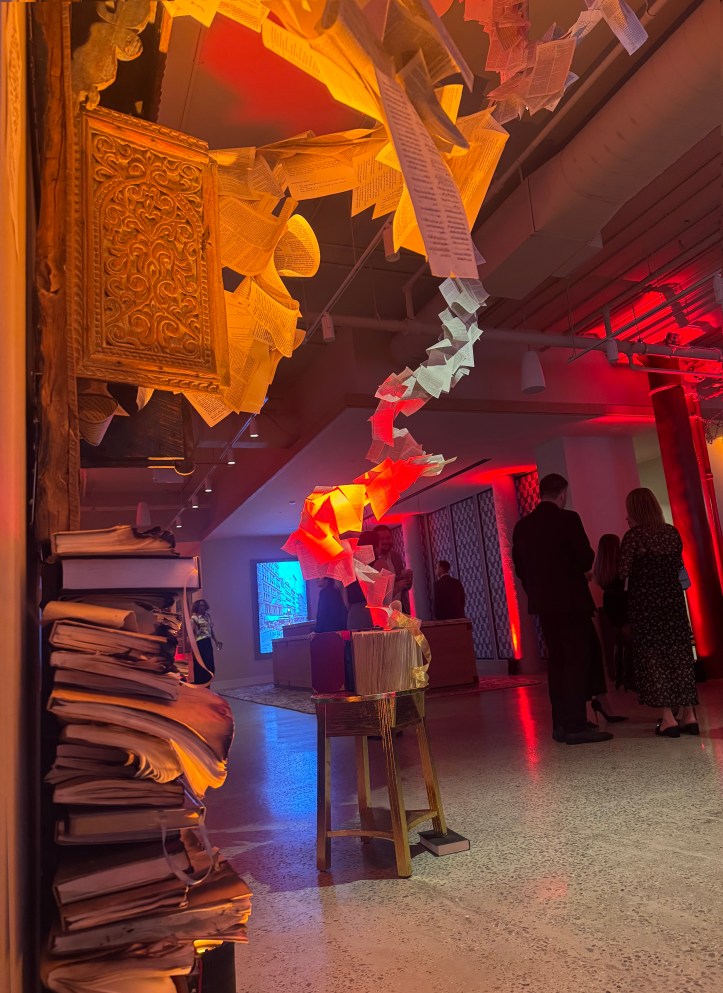
In Gods We Trust brings together nineteen sacred texts representing fourteen religions, arranged chronologically rather than according to theological authority. Darwin’s On the Origin of Species enters the construction as well, physically helping to stabilize it. The gesture is provocative but more complex than a familiar confrontation between religion and science. Darwin does not arrive to defeat God. Instead, Sola places systems of knowledge into physical dependency. Religion, science, history, and human memory occupy the same unstable structure. Darwin does not destroy the sacred texts; he helps hold them up.
For an artist who is also an architect, structure is particularly significant. There is the literal structure of books, furniture, architectural fragments, and pages suspended through space, but there are also invisible structures: religion, gender, science, history, and institutions. These too are constructed, require support, and, despite our tendency to imagine them as permanent, can collapse.
The title performs the work’s smallest and perhaps most consequential intervention. The familiar American declaration is “In God We Trust.” Sola gives us In Gods We Trust. With the addition of a single letter, the singular becomes plural, and a phrase so familiar that Americans encounter it almost without seeing it becomes a question: Which God? Whose God? Who possesses the authority to allow one conception of the divine to speak for everyone?
It is here that a feminist reading becomes particularly productive. Linda Nochlin’s fundamental intervention into art history was not simply to recover forgotten women and insert them into an existing canon, but to examine the structures that created that canon in the first place. The same question can be brought before Sola’s accumulation of sacred texts. Instead of asking only where the women are, we might ask: Who was authorized to speak for God?
Across centuries and very different religious traditions, women have been extraordinarily present as symbols while disproportionately absent from institutional authority. They have appeared as virgins and mothers, saints and sinners, temptations and martyrs, goddesses and witches. Their bodies have been interpreted endlessly while their authority to interpret has often been restricted. Sola does not illustrate this history or reduce it to a feminist slogan. More effectively, she places before us systems that have organized human existence for millennia and allows us to consider who constructed them, who interpreted them, and who was required to live within their rules.
This relationship between religion, ritual, and the female body has appeared elsewhere in Sola’s work. In Our Lady of Apparitions, she embodies her own interpretations of La Virgen de la Caridad, La Virgen de las Mercedes, and Santa Bárbara, three Catholic figures whose names she carries. Traditionally, an apparition reveals itself to the believer; Sola reverses that relationship and produces the apparition herself. Rather than rejecting the religious imagery she inherited, she occupies it, performs it, and acquires authority over its representation.
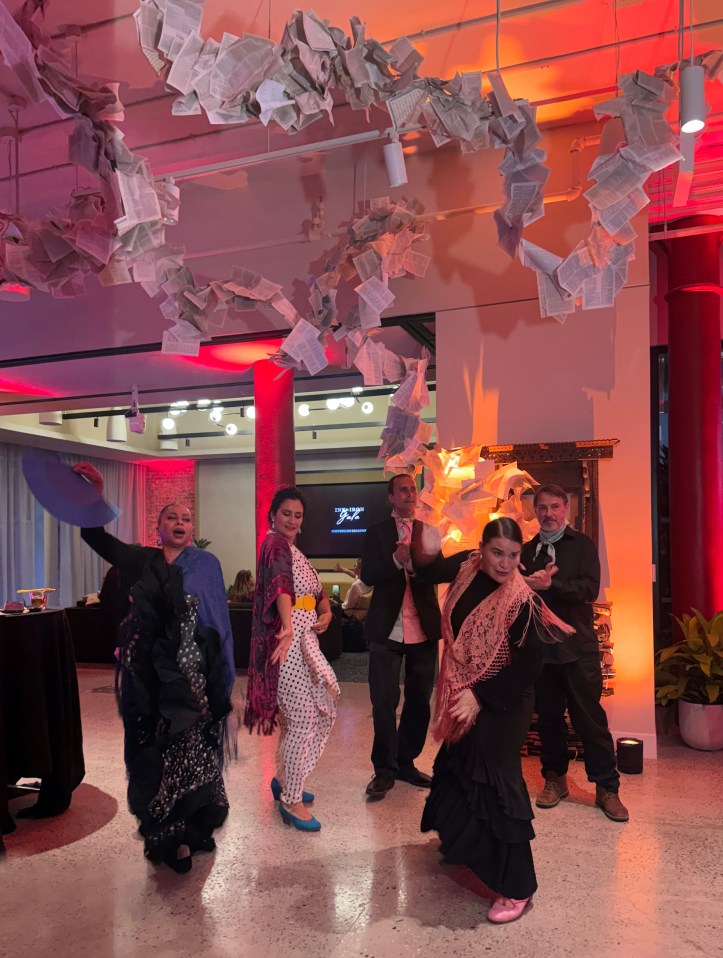
That theatricality is central to her practice. “I create experiences,” Sola has said. “I have a passion for the grandiose, the dramatic, and the theatrical.” Religion understands spectacle. Politics understands spectacle. Fashion and architecture understand spectacle. Art does too. This made In Gods We Trust particularly appropriate for INK & IRON, an evening in which all these languages of presentation seemed to converge.
The setting added another layer. The Rouss Building at 555 Broadway carries the name of Charles Broadway Rouss, who arrived in New York financially ruined after the Civil War, rebuilt his life through commerce, and eventually constructed the building that still bears his name. The site had already accumulated other histories: the building it replaced housed Taylor’s Saloon, frequented by figures including Walt Whitman, while an upper floor was associated with the radical League for Free Love. Commerce, literature, sexuality, ambition, architecture, and dissent had occupied this address long before Sola brought her gods into it.
There is also a biographical dimension that makes the architectural instability of In Gods We Trust difficult to overlook. Before returning to Miami, Sola maintained an artistic and architectural practice in New York and served as a construction project manager for the National September 11 Memorial & Museum at the World Trade Center site. This does not make the installation a work about September 11, nor should its suspended pages be read literally as representations of collapse. But it gives additional resonance to Sola’s engagement with architecture, destruction, reconstruction, memory, and impermanence. The wooden element in the installation can appear simultaneously as frame, doorway, ornament, fragment, or ruin, while language moves through and around it as though architecture itself can no longer contain it.
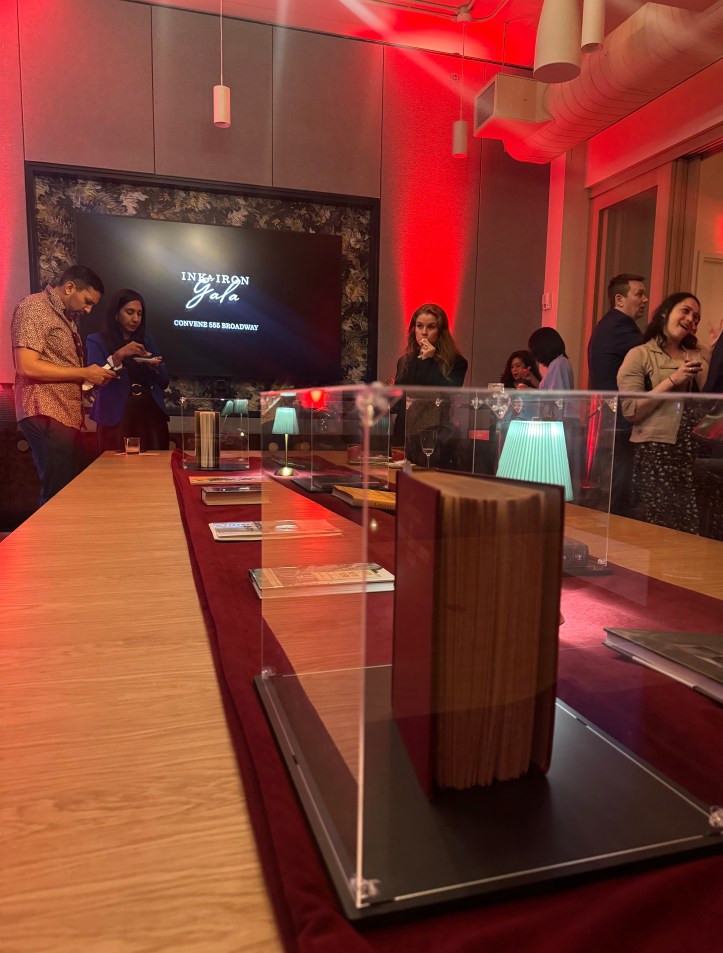
At 555 Broadway, these ideas acquired an unexpected immediacy. INK & IRON was a celebration of a newly transformed space, yet at its center stood what could be read as an archaeology of what survives. Guests conversed beneath the suspended pages, sometimes barely aware of the torrent of words above them. The scene became almost an extension of the installation itself: contemporary life continuing beneath the accumulated beliefs of civilizations. We inhabit histories we did not write, structures we did not design, and institutions created before we were born. We also inherit gods.
Sola has described her installations as ephemeral experiences: once dismantled, what remains are memories, documentation, and artifacts. In Gods We Trust turns that observation into something larger. History does not preserve everyone equally. Some people become monuments while others disappear. Some beliefs become institutions while others are forgotten. Some bodies become icons while those inhabiting them are denied authority over their own representation.
At Artexpo New York, In Gods We Trust appeared as a material collision between belief, knowledge, architecture, and language. At 555 Broadway, surrounded by red light, fashion, conversation, and celebration, it became more haunting. The books remained heavy, the pages continued their ambiguous movement between revelation and collapse, and beneath them the party continued. Eventually the guests left, the lights went out, and the installation would disappear.
What remains, as Caridad Sola understands throughout her practice, is memory.
Discover more from Art Sôlido
Subscribe to get the latest posts sent to your email.

