
 There is a peculiar insistence to the men in Teddy Sandoval’s work. They return again and again: mustached, shirtless, muscular, dressed as cowboys, cholos, leathermen, or homeboys. Sometimes they have no faces at all. What identifies them is not individuality but a collection of signs—the mustache, the torso, the open shirt, the chaps, the pose. Sandoval understood something remarkably contemporary about masculinity: before it is an identity, it can be an image.
He enters the history of American art as a gay Chicano man with remarkable confidence, courage, irreverence, and humor. He does not attempt to separate the homosexual from the Chicano, the erotic from the political, or the maricón from the artist. Instead, he takes precisely those identities—and even the words, stereotypes, and images historically used to diminish them—and turns them into signs of presence. The maricón is no longer hiding at the edge of the image. He occupies its center.
And Sandoval does something even more audacious: he gives that identity authority. He makes it an institution.
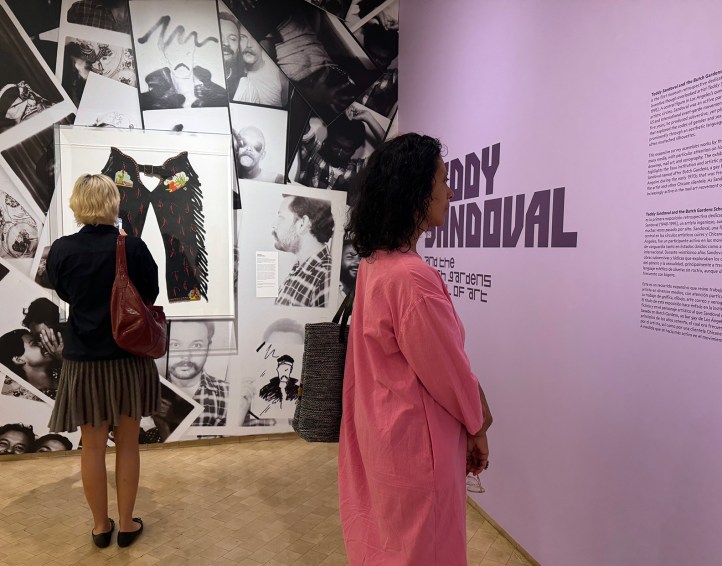
In Teddy Sandoval and the Butch Gardens School of Art, arriving at El Museo del Barrio after presentations in Los Angeles, Williamstown, and Austin, these bodies appear almost like logos. They are immediately recognizable and endlessly reproducible. Sandoval could draw them, photograph them, photocopy them, print them on postcards, place them in the mail, alter them, and send them back into circulation. The exhibition, curated by C. Ondine Chavoya and David Evans Frantz, makes clear how central these inexpensive technologies of reproduction were to his practice and to the community he constructed around it.
The fictional Butch Gardens School of Art, named after a Los Angeles gay bar frequented by Sandoval and other Chicano patrons, is perhaps his greatest joke and one of his most intelligent conceptual gestures. There was no campus, no administration, no faculty in any conventional sense. Sandoval invented the school, assumed its authority, and circulated its name through his artistic practice.
The joke, however, should not obscure the seriousness of the gesture. Artists historically excluded from institutions had learned to wait for institutions to recognize them. Sandoval simply invented his own. He could be its student, professor, administrator, archivist, and star.
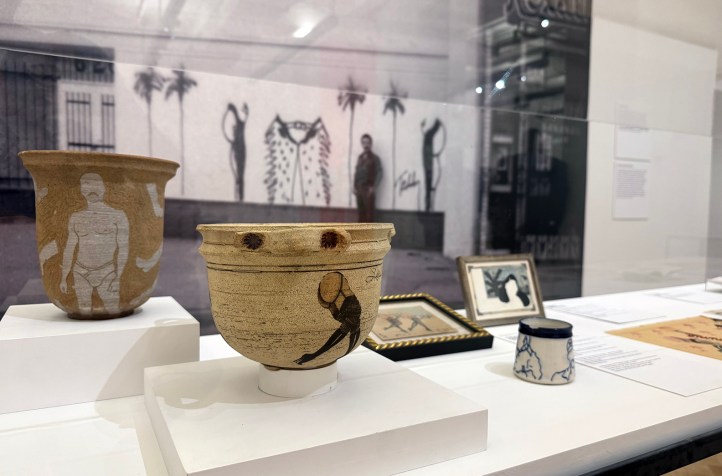
There is enormous humor in this, but also enormous courage. The queer Chicano artist who might have remained peripheral to both the predominantly white gay art world and the often heteronormative narratives of Chicano culture declares himself an institution. The margins suddenly acquire their own letterhead.
The mustache is perhaps Sandoval’s most efficient sign. It can signify the macho, the cowboy, the Chicano homeboy, the Castro clone, the porn star, the lover. Remove the face and the mustache remains enough to construct the man. This repetition is not simply stylistic. Sandoval takes masculinity apart by repeating it. Once reproduced often enough, the supposedly natural signs of manhood reveal themselves as costume.
The cowboy is therefore never simply a cowboy. The chaps are never simply chaps.
In Chili Chaps (1978), Sandoval transforms one of the most exaggerated emblems of Western masculinity into something theatrical, erotic, and absurd, decorating cardboard chaps with beans, chiles, cacti, and stereotyped Mexican imagery. The object simultaneously inhabits and ridicules the visual language assigned to Mexican and American masculinity.
This is characteristic of Sandoval. He rarely attacks masculinity from outside it. He enters it, puts it on, exaggerates it, sexualizes it, makes us laugh at it, and makes it desirable at the same time. The macho becomes camp without completely ceasing to be macho. The homeboy becomes an object of homosexual desire without surrendering his Chicano identity. And the maricón refuses to surrender either one.
The Maricón Series: From Insult to Belonging
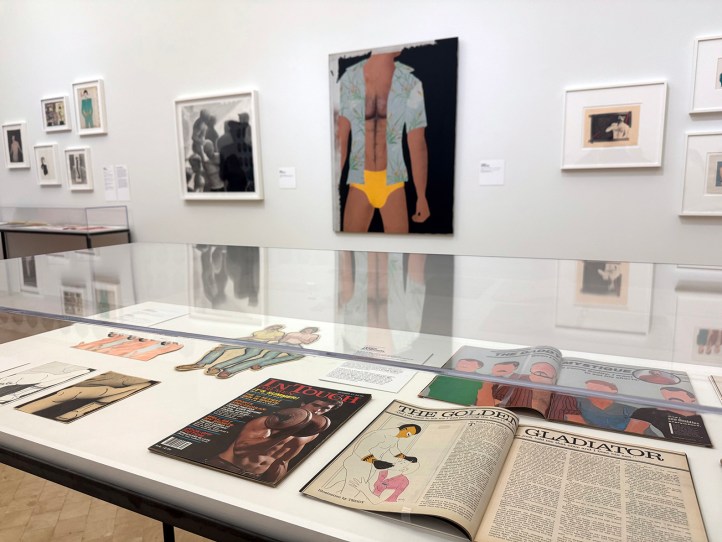
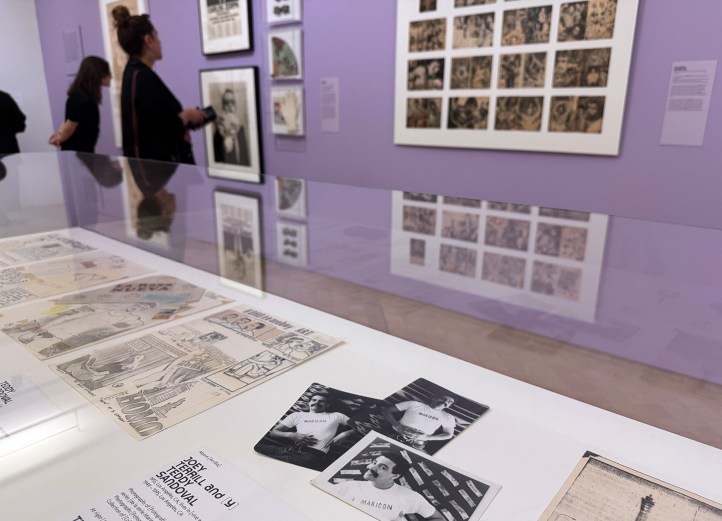
This strategy becomes more radical in the work associated with The Maricón Series, created with Joey Terrill around 1975. The Spanish word maricón carries a long and violent history as an insult directed at homosexual and effeminate men. In a Hispanic context, the word attacks not simply sexuality but masculinity itself: it tells a man that he has failed at being a man.
Sandoval and Terrill turn directly toward that accusation. They do not ask for another word. They take maricón.
This is essential to understanding Sandoval. His gesture is not simply one of representation—I am gay and therefore I will make gay art. It is an act of cultural reclamation. A word intended to produce shame becomes something that can identify friendship, sexuality, community, humor, defiance, and ultimately pride.
Robb Hernández’s concept of mariconógraphy, developed in Drawing Offensive/Offensive Drawing: Toward a Theory of Mariconógraphy, provides an especially productive framework for understanding this operation. Mariconógraphy describes a visual territory in which queer Chicano bodies and signs that dominant cultures had rendered offensive can become the raw material of another visual history.
But Sandoval brings something extraordinarily human to this theoretical proposition: he laughs. His humor is not incidental. It is one of his weapons.
There is courage in publicly identifying with the maricón, but Sandoval refuses the solemnity we often impose retrospectively upon marginalized artists. He jokes. He flirts. He exaggerates. He makes the macho ridiculous and sexy simultaneously. His work understands that humor can dismantle authority—but also that humor can create authority of its own.
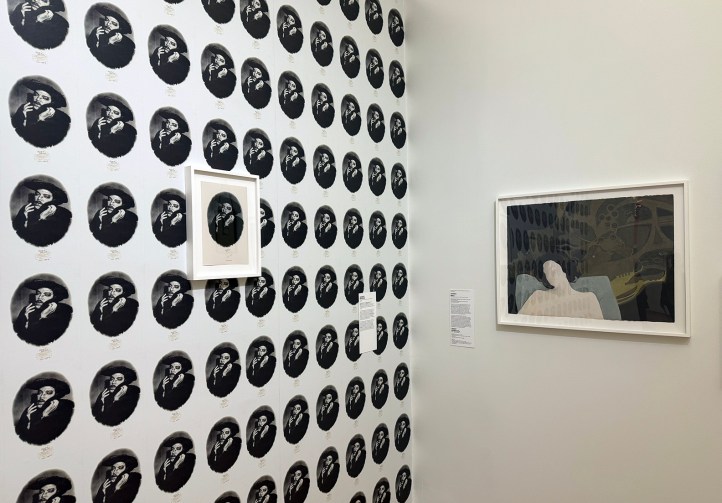
The maricón therefore moves from insult to image, from image to repetition, and from repetition to belonging. To call oneself maricón, to photograph the maricón, to draw him, Xerox him, and mail him to another maricón is to create a community through reproduction. The copy is no longer inferior to the original. The copy is how the community finds itself.
This is where Sandoval’s use of Xerox and mail art becomes inseparable from the politics of his images. Reproduction was not only a technique; it was a social structure. A photocopy could leave Los Angeles. A postcard could enter another house, another city, another circle of artists. The body that dominant culture attempted to make invisible could suddenly multiply. And Sandoval understood that identities themselves could be multiplied.
His feminine alter ego, Rosa de la Montaña, points directly toward Marcel Duchamp’s Rrose Sélavy. Sandoval used Rosa in photocopies, postcards, and prints, adopting the Duchampian gesture of constructing another gendered self through name, costume, and representation.
But the distance between Duchamp and Sandoval is as significant as the homage. For Duchamp, Rrose Sélavy belonged to an avant-garde destabilization of authorship, gender, and the identity of the artist. For Sandoval, a queer Chicano working within the racial and sexual politics of Los Angeles, the gesture acquired another urgency. Gender play was not only an intellectual disruption of artistic identity. It belonged to lived bodies, bars, lovers, streets, and communities.
Duchamp gave the reproduced Mona Lisa a mustache. Sandoval understood that the mustache itself could become a readymade. He could place it on another body and manufacture another man.
From Butch Gardens to Julius
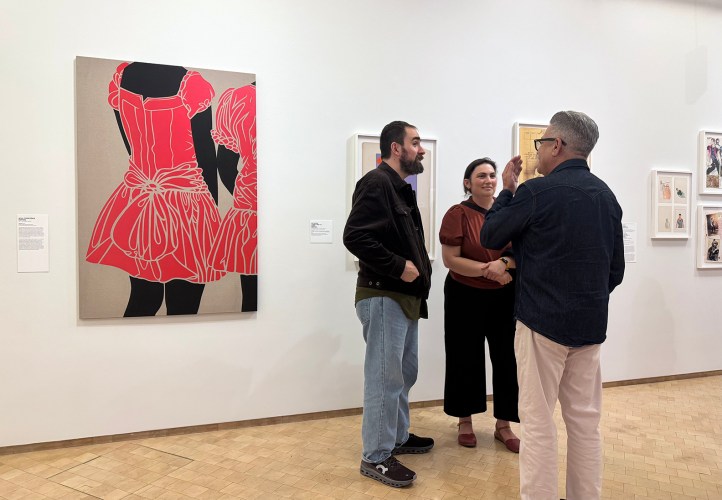
The presentation at El Museo del Barrio makes this mechanism especially visible because it changes the geography of the exhibition. Sandoval remains at its center, but New York now enters the story. If the original exhibition, curated by C. Ondine Chavoya and David Evans Frantz, recovered Sandoval through the context of Los Angeles and the queer and Chicano networks that made his work possible, its arrival in New York opens another conversation.
El Museo’s presentation is overseen by Lee Sessions, Permanent Collections Associate Curator, whose work, together with that of the museum’s curatorial team, has been instrumental in giving this final stop an identity of its own. Sessions does more than adapt a traveling exhibition to a new venue: El Museo’s collection is brought into conversation with Sandoval’s work, connecting the exhibition to the history of the institution and to the communities it serves in New York, particularly the community of El Barrio. In doing so, the museum becomes more than the exhibition’s host; its collection and its own cultural history become active participants in the conversation.
When I asked C. Ondine Chavoya on opening night what made the El Museo presentation different from the exhibition’s previous iterations, he pointed precisely to this expanded dialogue. For this iteration, Sessions and the El Museo team have incorporated additional loans and works related to self-fashioning, gender presentation, and queer spaces in New York during the same period in which Sandoval was working in Los Angeles. New additions include Joe Brainard, Luis Carle, Cielo Félix-Hernandez, LTTR, Ana Mercedes Hoyos, Alice O’Malley, Elle Pérez, Patssi Valdez, David Wojnarowicz, Nahum Zenil, and Carlos Zerpa.
The curatorial intervention is significant because it does not displace Sandoval; rather, it expands the territory from which we can read him. The museum’s collection, New York’s queer histories, and the cultural memory of El Barrio enter into conversation with the Los Angeles world from which Sandoval emerged. Los Angeles begins to look toward New York, and New York responds. The exhibition that began as the recovery of an underrecognized Los Angeles artist thus arrives at El Museo as something slightly different: an East Coast/West Coast conversation about sexuality, race, nightlife, self-invention, community, and the construction of the queer archive.
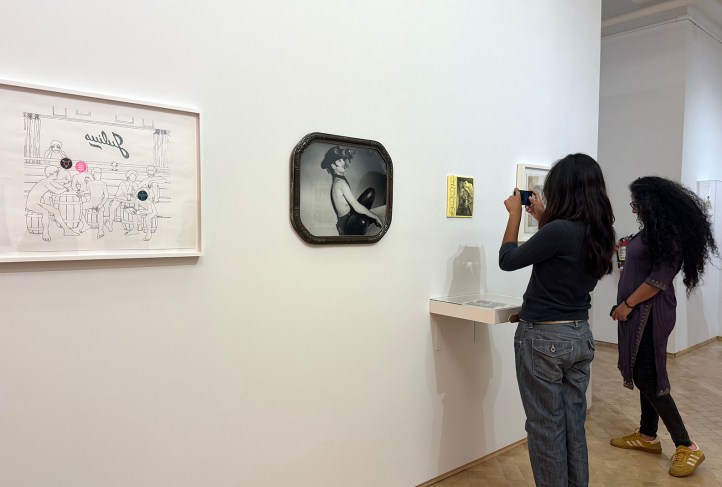
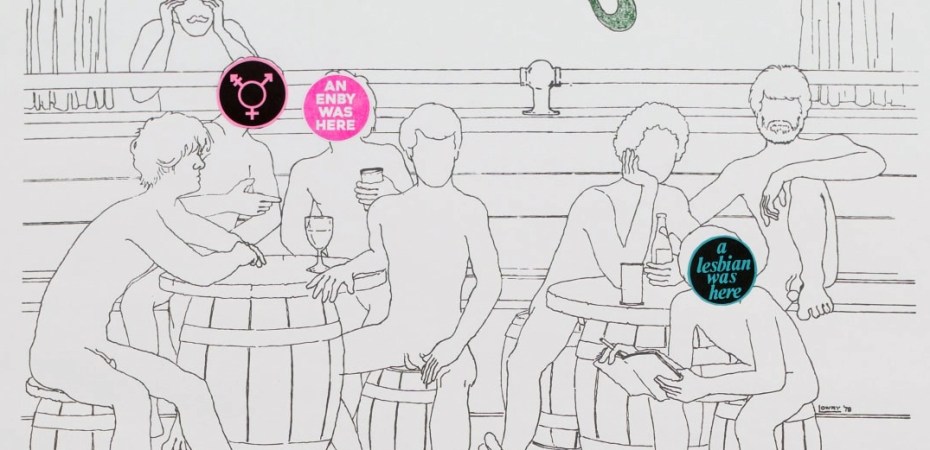
That shift is embodied beautifully by Ginger Brooks Takahashi’s Julius Bootleg (We are here; still seeking Lowry) (1978/2007/2023). The work takes us from the lost or half-remembered geography of Butch Gardens in Los Angeles to Julius in Greenwich Village, one of New York’s historic gay gathering places. Takahashi returns to an earlier representation of male queer sociability and interrupts it with another presence: A lesbian was here.
The statement is almost embarrassingly simple. That is precisely why it works. It is an annotation, but also a correction to the archive. It does not need to replace the men already there. It merely refuses their monopoly over memory. Lesbian and gender-nonconforming histories also inhabited—and continue to inhabit—queer spaces whose surviving visual records can make them appear exclusively male.
And Lowry? I like to think I knew her. She was that friend who could recognize everyone, sometimes even helping them find their way out, while lacking the courage to open her own door. When she finally did, she chose perhaps the most cowardly and treacherous way possible. But that is another story.
Takahashi performs upon queer history something very close to what Sandoval performed upon masculinity: she takes an existing image, reproduces it, marks it, and returns it changed. The dialogue between Butch Gardens and Julius consequently becomes one of the most compelling possibilities of the New York exhibition. One is associated with queer Chicano Los Angeles; the other with the mythology of gay New York. Neither survives in cultural memory as a neutral place.
Bars are also archives, although unstable ones. People enter and disappear. Names change. Buildings close. Lovers die. Photographs remain. Postcards remain. Drawings remain. Sometimes all that survives of a community is the image it managed to circulate.
Artists such as David Wojnarowicz, Joe Brainard, Luis Carle, Alice O’Malley, Elle Pérez, and the collective LTTR extend that conversation in New York. They do not simply provide an East Coast equivalent to Sandoval. Their presence complicates the idea that there was ever a single queer visual culture to begin with. Gay male, lesbian, trans, Chicano, Latin American, and other queer histories overlap, but they do not perfectly coincide. The archive becomes more interesting precisely where those histories refuse to fit neatly together.
This is also why El Museo’s public programming around the exhibition matters. Disco and Desire turns toward dancing, nightlife, and Latin disco culture, while the Open Studio related to Xerox, postcards, and collage returns audiences to the material vocabulary that helped make networks like Sandoval’s possible. The museum is therefore not simply exhibiting the remnants of a social world. It is attempting, however temporarily, to reactivate some of its mechanisms: gathering, dancing, making, copying, exchanging.
Mariconógraphy
Perhaps the most radical thing about Sandoval today is how little interest he seems to have had in producing a respectable image of homosexuality. His men can be vulgar, funny, exaggerated, erotic, ridiculous, masculine, feminine, beautiful, and deliberately stereotypical. They pose. They cruise. They perform masculinity badly and beautifully.
Sandoval understood that liberation did not necessarily require replacing a negative stereotype with a positive one. Sometimes it required taking possession of the stereotype.
That is where mariconógraphy becomes useful beyond its academic definition. It names a visual territory in which the image that was supposed to humiliate the subject can instead become the place where the subject recognizes himself.
The maricón looks at another maricón. The homeboy becomes an erotic object. The cowboy becomes camp. The chaps expose rather than protect. The mustache ceases to guarantee masculinity and begins to reveal masculinity as theater. And the Xerox machine multiplies the evidence.
What makes Sandoval particularly compelling is that he does all of this without asking permission from either side of his identity. He does not abandon Chicano visual culture in order to become gay, nor does he erase his ethnicity to enter a predominantly white gay visual world. He occupies both, contaminates both, and makes something that belongs completely to neither. He is the maricón and the homeboy. He is Teddy and Rosa. He is the artist and the institution.
Seen from New York, nearly half a century later, Sandoval’s repeated bodies feel unexpectedly familiar. We now live inside an unprecedented machinery of self-reproduction. Faces, bodies, identities, and desires are copied and recirculated continuously through screens. The mechanisms have changed, but the question Sandoval posed remains: Who controls the image by which we are recognized?
Sandoval’s answer was wonderfully impure.
Take the image already circulating. Steal it back. Draw on it. Put a mustache on it. Remove the face. Dress it in chaps. Give it another name. Call yourself Rosa.
Call yourself maricón.
Xerox the result.
Then send it to someone who will understand.
And if the institutions that surround you cannot recognize what you are doing, there is one final possibility:
invent the institution yourself.
Perhaps that was the real Butch Gardens School of Art all along. Not a building, not a faculty, and certainly not an institution waiting to grant legitimacy to Teddy Sandoval.
It was Sandoval granting legitimacy to himself.
A gay Chicano artist taking the language of insult, the imagery of masculinity, the technologies of reproduction, and an extraordinary sense of humor and declaring, with complete authority:
We have always been here.
Featured image: Ginger Brooks Takahashi, Julius Bootleg (We are here; still seeking Lowry)
Teddy Sandoval and the Butch Gardens School of Art is on view at El Museo del Barrio from September 10, 2026, through January 10, 2027.
El Museo del Barrio
1230 Fifth Avenue at 104th Street
New York, NY 10029
For exhibition details and visitor information, visit El Museo del Barrio.
Discover more from Art Sôlido
Subscribe to get the latest posts sent to your email.

