
Pip: Art Sôlido, where the art world’s blind spots get their own exhibition catalog — and occasionally their own invented institution.
Mara: Today we’re following into the territory of queer Chicano art, self-invention, and what it means to build a community through reproduction rather than recognition.
Pip: Let’s start with Teddy Sandoval, the mustache, and the school that never had a campus.
Teddy Sandoval: Mariconógraphy and the Art of Being Here
Mara: The central question here is how an artist excluded from institutions — gay, Chicano, working in Los Angeles — doesn’t wait for legitimacy but manufactures it himself, using humor, repetition, and a Xerox machine.
Pip: The post frames this through Sandoval’s recurring figures, and lands on something precise about why the repetition matters. Here’s the line: “Sandoval takes masculinity apart by repeating it. Once reproduced often enough, the supposedly natural signs of manhood reveal themselves as costume.”
Mara: So the mustache, the chaps, the cowboy pose — none of it is pointing toward some authentic masculine core. The repetition is the argument. The copy undoes the original’s authority.
Pip: And Chili Chaps from 1978 makes that literal — cardboard chaps decorated with beans, chiles, and cacti, simultaneously wearing and mocking the visual language of Mexican and Western masculinity. Camp and critique in one object.
Mara: The same logic runs through The Maricón Series, which Sandoval created with Joey Terrill around 1975. The word maricón carried a long history as a violent insult — it attacked not just sexuality but masculinity itself. Sandoval and Terrill didn’t ask for another word. They took that one.
Pip: Which is where the theoretical framework of mariconógraphy comes in — Robb Hernández’s concept describing a visual territory where signs that dominant culture rendered offensive become the raw material of another visual history. Sandoval makes the theory feel lived rather than academic.
Mara: His feminine alter ego Rosa de la Montaña connects to Duchamp’s Rrose Sélavy, but the post is careful about the distance between them. For Duchamp, gender play was an avant-garde intellectual disruption. For Sandoval, it belonged to bars, lovers, streets, and communities.
Pip: And then there’s the Butch Gardens School of Art — named after a Los Angeles gay bar, fictional in every institutional sense, yet fully operational as an idea. No campus, no faculty, no administration. Just Sandoval assuming its authority and circulating its name.
Mara: The post puts it directly: “The margins suddenly acquire their own letterhead.”
Pip: Accreditation by Xerox. Honestly more efficient than most MFA programs.
Mara: The El Museo del Barrio presentation adds another layer — curator Lee Sessions brought in New York works on self-fashioning and queer spaces from the same period, artists including David Wojnarowicz, Joe Brainard, and Ginger Brooks Takahashi, turning a Los Angeles recovery project into an East Coast and West Coast conversation.
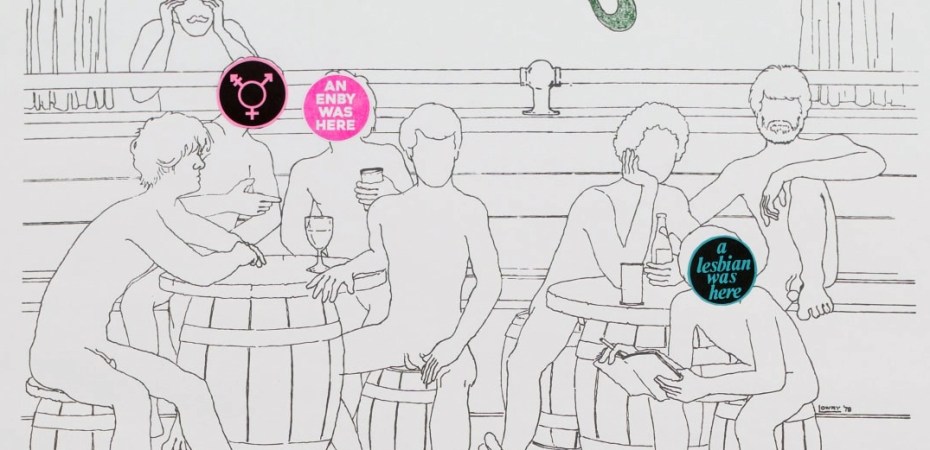
Pip: Takahashi’s Julius Bootleg is the piece that crystallizes this — it takes an earlier image of male queer sociability at Julius, a historic Greenwich Village bar, and marks it with a single annotation: “A lesbian was here.” Not a replacement. A correction to the archive.
Mara: The post reads that gesture as doing something close to what Sandoval did to masculinity — taking an existing image, reproducing it, marking it, and returning it changed.
Pip: And what ties it all together is that Sandoval never asked permission from either side of his identity — not from a predominantly white gay art world, not from the often heteronormative narratives of Chicano culture.
Mara: The post closes on that: Sandoval granting legitimacy to himself, using insult, imagery, reproduction, and humor to declare, with complete authority, that he and his community had always been there.
Pip: Which is where the copy stops being inferior to the original and becomes how a community finds itself.
Mara: The question Sandoval posed — who controls the image by which we are recognized — hasn’t gotten quieter.
Pip: We live inside a reproduction machine now. He just built his with a Xerox and a postcard. More to come from Art Sôlido next time.
Discover more from Art Sôlido
Subscribe to get the latest posts sent to your email.
 Art Sôlido